This edition in 9 slides Flip through ↓






Local surveillance data that travels, a split over extraordinary-ability green cards, and Mexico’s pursuit of accountability while border cooperation continues.
Agencies in five other states searched Akron's camera data for immigration enforcement
Akron’s Flock camera data was searched thousands of times for immigration enforcement outside the city, according to Signal Akron. On Feb. 9 alone, agencies in Florida, Texas, Georgia, North Carolina and Kansas accessed the system at least 41 times explicitly for federal immigration enforcement — the same day Akron’s council condemned ICE tactics. The city moved in May to block outside agencies’ immigration-related searches, but millions of unlabeled searches continued, leaving questions about whether local restrictions can meaningfully limit use of the shared surveillance network. [Signal Akron]
Get the Daybook in your inbox.
Free. Every weekday. English and Spanish.
We never sell or share your email. Unsubscribe any time.
A Nebraska judge upholds the EB-1A "final merits" step
Two federal judges in Nebraska have reached opposite conclusions about how USCIS decides extraordinary-ability green card petitions. EB-1A is for people in science, the arts, education, business or athletics who demonstrate sustained national or international acclaim. In his Sept. 25 *Agarwal v. Miller* ruling, Chief District Judge Brian C. Buescher upheld USCIS’s “final merits” review, rejecting the reasoning of Judge Joseph F. Bataillon’s Jan. 28 *Mukherji v. Miller* ruling, which ordered approval of a journalist’s petition. As Cyrus D. Mehta and Manjeeta Chowdhary explain, the disputed second step lets USCIS deny a petition after the applicant meets the evidentiary criteria if the agency concludes the overall record does not establish extraordinary ability. [U.S. District Court, Nebraska; The Insightful Immigration Blog]
Mexico announces U.S. complaint over Laredo detention death
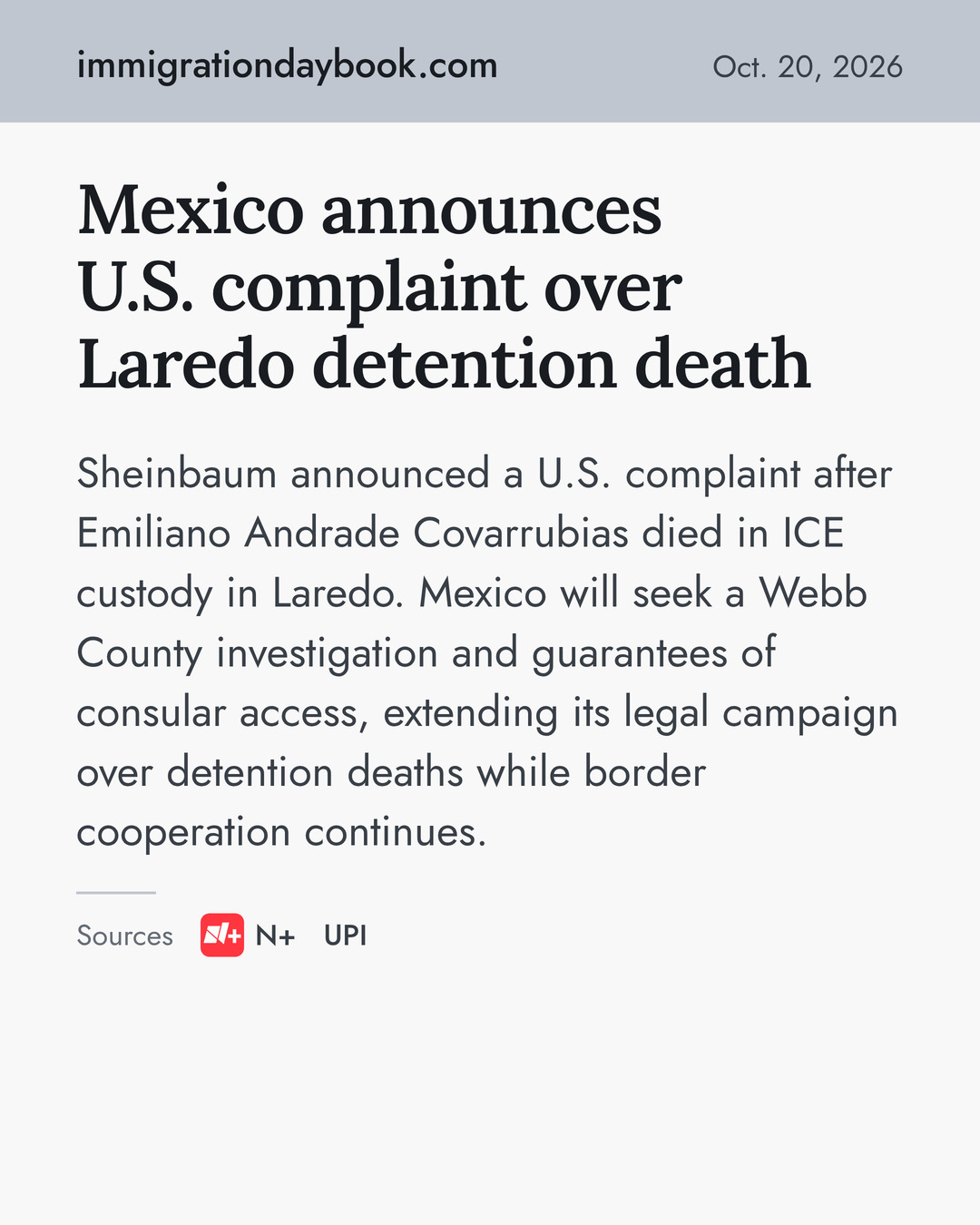
Mexico will file a U.S. complaint over the death of Emiliano Andrade Covarrubias, 56, at the Río Grande Processing Center in Laredo, Texas, President Claudia Sheinbaum announced Monday. He died Saturday; his family told Mexican officials he had diabetes and hypertension and might not have received all his medication. The Foreign Ministry says it will send a complaint to the Webb County prosecutor and seek guarantees of consular access to detention centers to monitor medical care. Mexico counts 18 citizens who have died in ICE custody or during immigration operations since Jan. 20, 2025. [N+]
Mexico’s campaign already includes 20 complaints filed with state and county prosecutors in July, a referral of 17 deaths to the Justice Department, and a request for U.N. human-rights scrutiny. It has also kept border-security cooperation intact: after the Coast Guard said it exchanged gunfire near Garceño on Sept. 26, Sheinbaum demanded evidence that shots came from Mexico while agreeing to coordinated patrols on both sides of the border. The new complaint and demand for consular access extend that parallel legal and diplomatic pressure. [UPI, Al Jazeera]
Wilder lawsuit tests ICE's use of another agency's criminal warrant
A lawsuit over the October 2025 raid at La Catedral Arena in Wilder, Idaho, tests whether ICE can use another agency’s criminal warrant for mass immigration arrests. TIME reports that an FBI warrant targeting alleged illegal gambling led to 105 immigration arrests. The plaintiffs’ ACLU complaint and Sept. 8 brief opposing dismissal argue that ICE used the unrelated warrant as cover to go looking for immigration violations, raising Fourth Amendment questions that could affect joint operations elsewhere. DHS says the arrests were lawful; a motion to dismiss remains pending. A new ACLU film released Monday revisits the raid’s impact on families; KTVB also posted a one-year-later investigative special. [TIME; court filings; ACLU; KTVB]
Inside ICE, officials describe pre-election escalation and reversals
ICE officials describe a pre-midterm scramble of enforcement surges, politically charged investigations and abrupt policy reversals, according to Karl Loftus’s reporting for The Intercept. Officials speaking anonymously point to a September voter-fraud investigation across nine states, announced surges into sanctuary cities, and a brief order to stop arrests of immigrants without criminal histories that was then reversed. DHS denied the stand-down order existed; officers told The Intercept they followed it for several days. One called it a “midterm panic move.” [The Intercept]
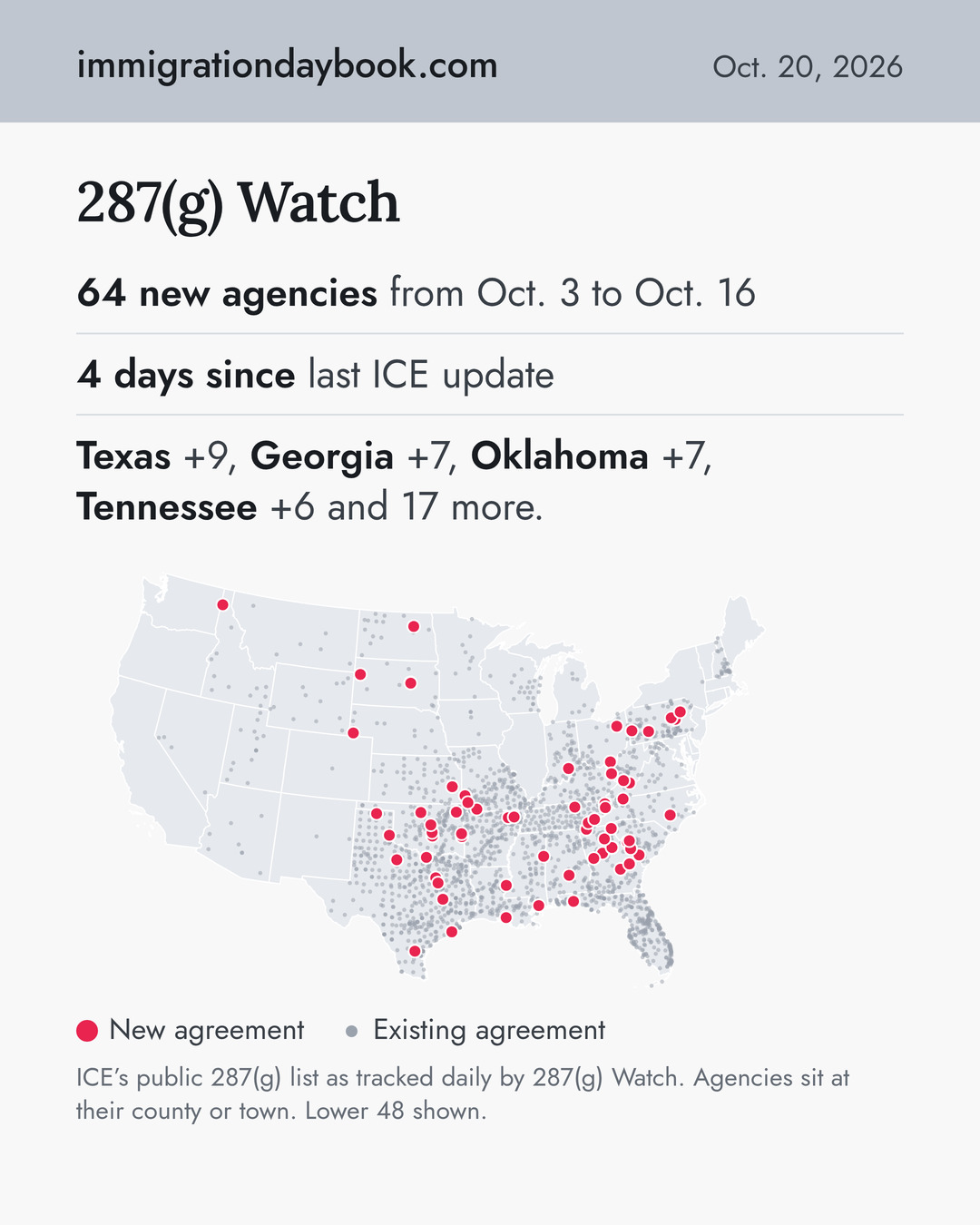
287(g) Watch adds sheriff-election information
Our 287(g) Watch project now includes sheriff-election information on agency pages for every race we could find, including whether a candidate signed a 287(g) agreement with ICE. Those agreements let local officers take on federal immigration-enforcement duties. The update puts the candidates alongside each agency’s participation record.
Upcoming
The next four weeks.
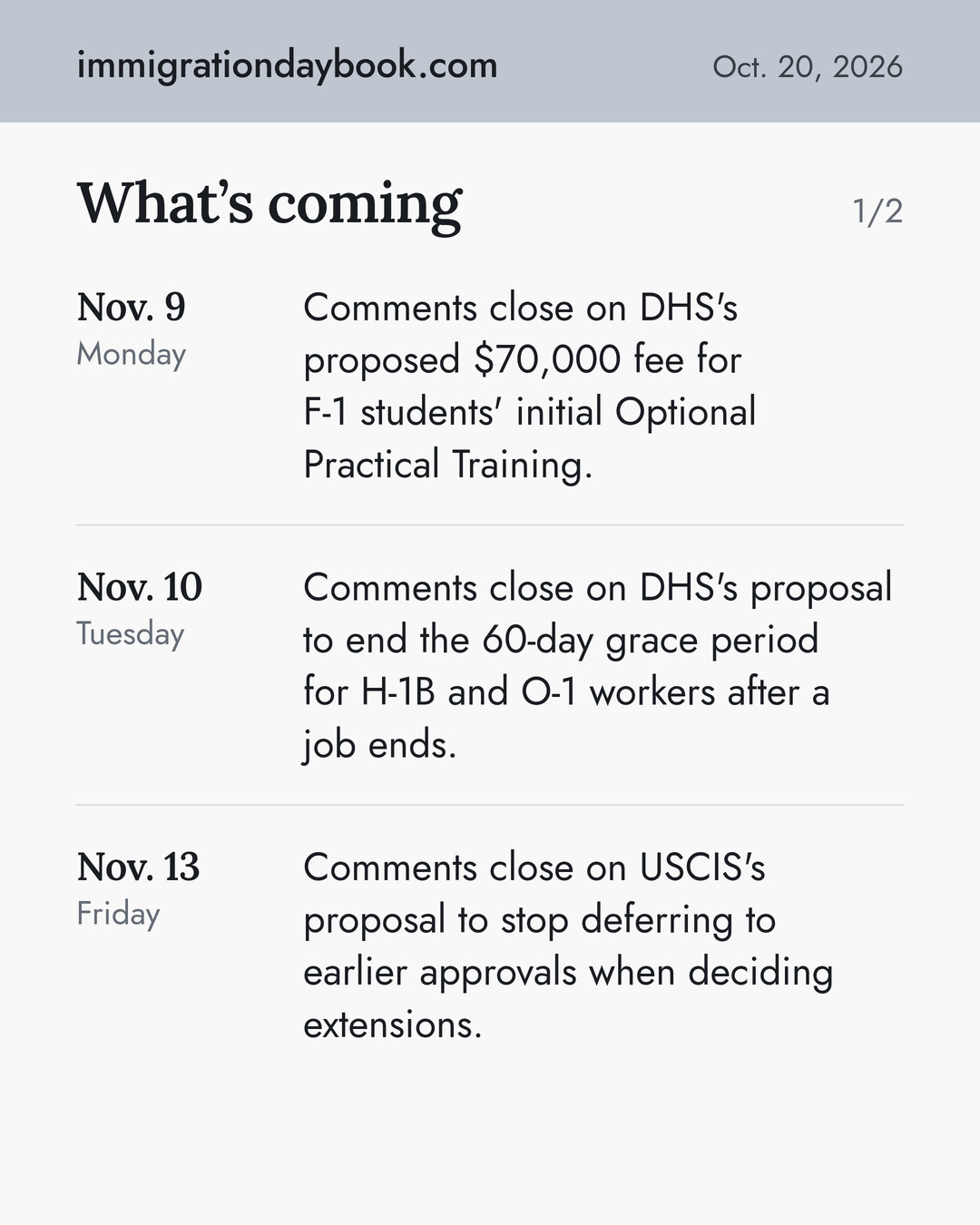
- Nov. 9, 2026
DHS proposes charging F-1 students $70,000 for an initial period of Optional Practical Training and $30,000 for a later period. The fees are not in effect: comments on the proposed rule close November 9, while comments specifically on its required paperwork and information-collection estimates close December 7.
- Nov. 10, 2026
DHS proposes ending the regulation that lets certain H-1B, O-1 and other covered workers—and their families—remain in the United States for up to 60 days after a job ends. The grace period remains in effect for now; comments on the proposal close November 10.
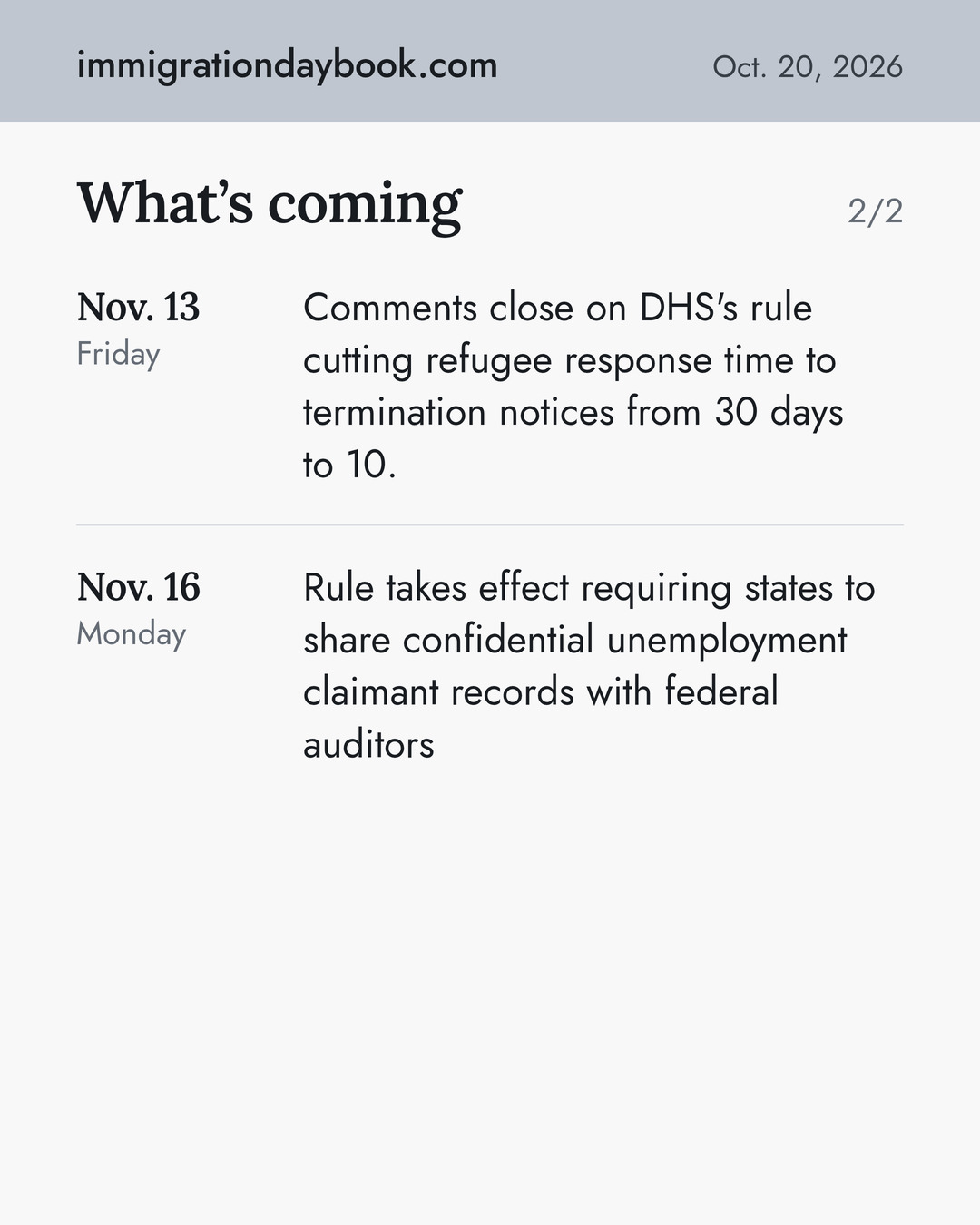
- Nov. 13, 2026
USCIS proposes ending the regulation that generally tells officers to give weight to an earlier approval when deciding an extension involving the same facts. The proposal is not in effect; comments close November 13.
A DHS interim final rule already in effect cuts from 30 days to 10 the time for a refugee to respond to a notice that DHS intends to terminate refugee status because it says the person did not qualify at admission. DHS is accepting post-implementation comments through November 13.
- Nov. 16, 2026
State unemployment agencies will have to hand over confidential unemployment compensation (UC) records — information about individual claims and claimants — to federal officials who audit the programs, including the Labor Department's internal watchdog (DOL Office of Inspector General). The stated purpose is oversight and fraud detection.
Send this edition to someone who should have it.
The link carries “?via” and nothing else — no identifiers, no cross-site tracking.
Around the system
A Haitian Creole-language guide explains access to gender-affirming care in New York City. Documented’s guide for LGBTQ+ immigrants covers anti-discrimination protections, care options and where to seek help. [Documented]
ICE wants more staff at its intelligence operations in Vermont. The agency is looking to boost staffing at intelligence hubs in the state. [VTDigger]
San Antonio has gone to court to stop a proposed ICE detention center. The city sued to halt the facility, which is reported to have a capacity of 1,500 people. [La Opinión]
A man who says he is a U.S. citizen was left with a fractured arm after an ICE detention in Long Beach. Video of the encounter has drawn widespread anger. [Los Angeles Times]
Detained young people with pending special immigrant juvenile cases have a new legal avenue. The National Immigration Project and the End SIJS Backlog Coalition launched a habeas project for detained SIJS youth. [National Immigration Project]
A website is cataloging the agents who take part in enforcement operations. ICE List documents agents' involvement in operativos and is drawing attention among immigrant communities. [Conexión Migrante]
Construction firms say Butler County's ICE agreement swept up longtime workers. Employers describe arrests of workers with no criminal records under the county's arrangement with the agency. [CBS Pittsburgh]