This edition in 8 slides Flip through ↓

ICE arrests at Sea-Tac drew a state inquiry. Also: a new ethics code for immigration judges, the reach of 287(g) on interstate highways, and court developments in Austin and Boston.
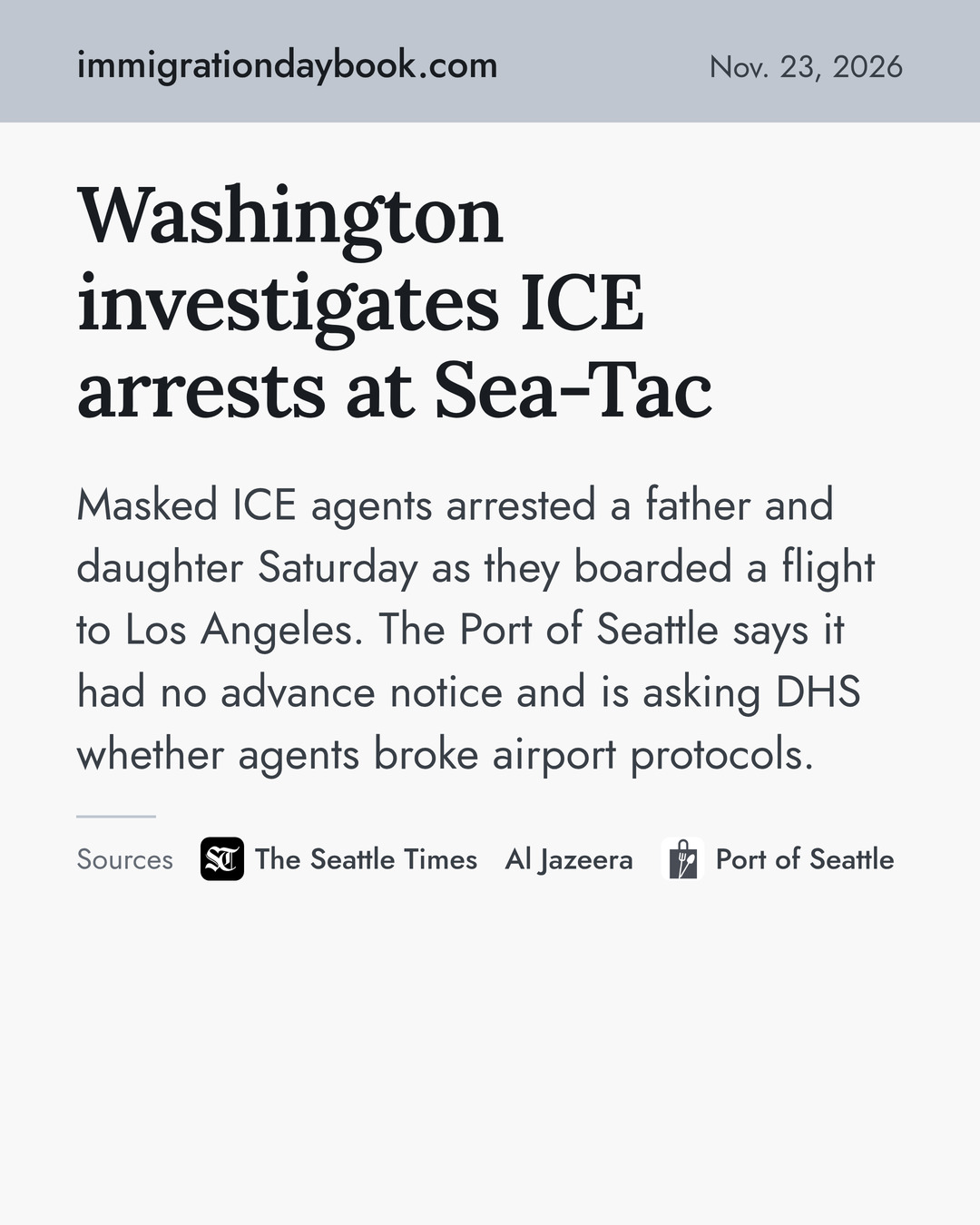
ICE arrests at Sea-Tac draw a state inquiry
Masked ICE agents arrested a father and daughter Saturday on a Sea-Tac jet bridge as passengers boarded a flight to Los Angeles. In video reviewed by The Seattle Times, the daughter shouts that they have a work permit. ICE says both overstayed their visas and alleges she threw hot coffee at officers. [The Seattle Times]
Washington Gov. Bob Ferguson said state officials were investigating how agents reached the jet bridge. The Port of Seattle said it had no advance knowledge of the operation and was asking DHS whether agents had breached previously agreed airport protocols. Alaska Airlines told KUOW it had not known about the law-enforcement activity in advance and was reviewing what happened. [Al Jazeera, Port of Seattle, KUOW]
Get the Daybook in your inbox.
Free. Every weekday. English and Spanish.
We never sell or share your email. Unsubscribe any time.
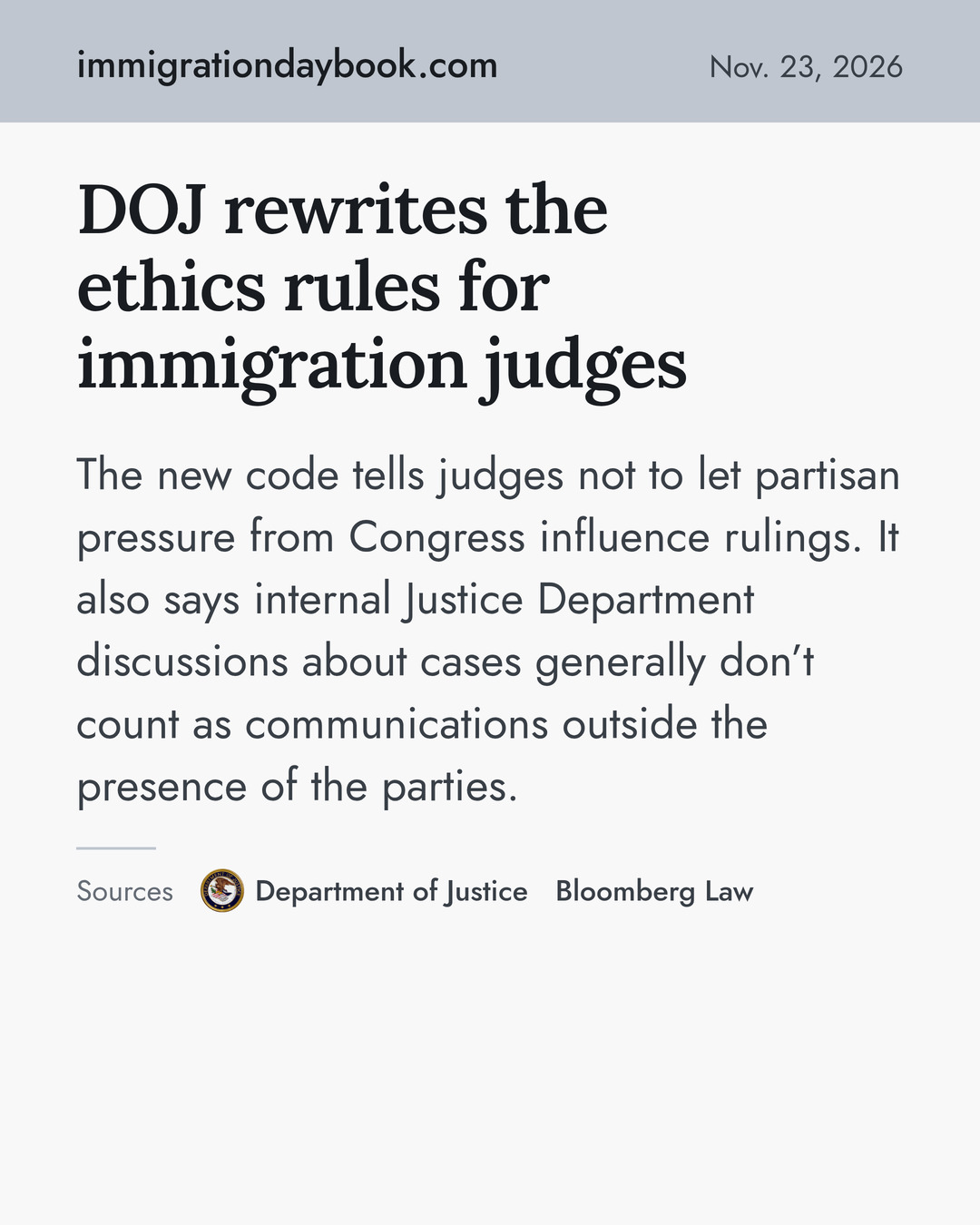
DOJ issues one ethics code for immigration adjudicators
The Justice Department replaced two 2011 ethics guides Friday with one code for immigration judges and members of the Board of Immigration Appeals. For the first time, the code also covers the department’s administrative law judges who hear employment discrimination and work-authorization cases. The memo took effect immediately. [Department of Justice]
The code says adjudicators must not base decisions on partisan pressure from Congress or public pressure that interest groups stir up through the media. It generally allows immigration court and DOJ staff to discuss cases internally without the parties present. That exception does not apply when the discussion is between the adjudicator hearing the case and one party, and both are department employees. [Department of Justice, Bloomberg Law]
The code treats law firms that practice before the immigration courts and most immigration advocacy and legal-service groups as “prohibited sources” under federal gift rules. One exception allows gifts worth up to $20 per occasion and $50 per calendar year from the same source. Free admission to a widely attended event under a separate exception requires written authorization. [Department of Justice]
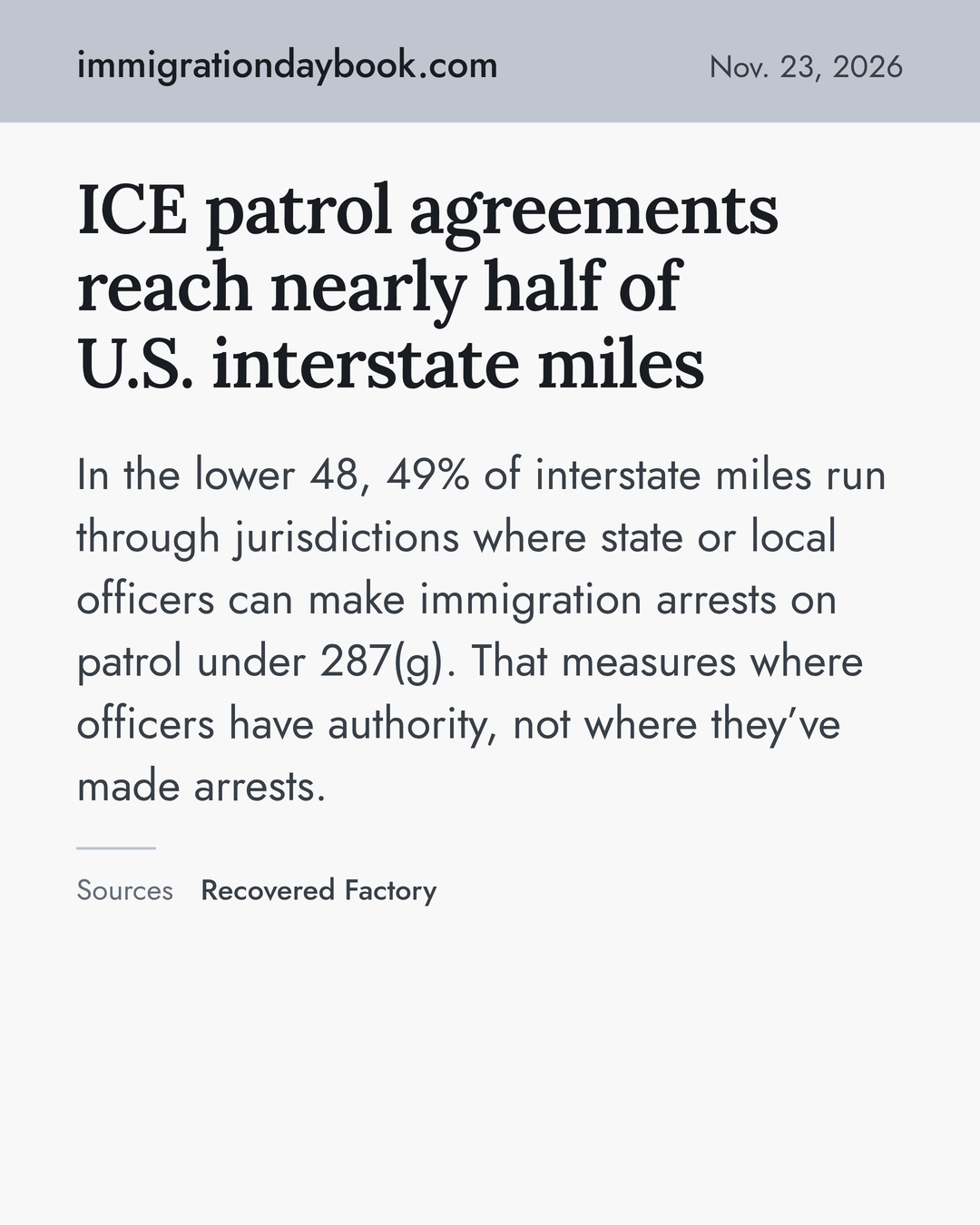
Where local and state officers can make immigration arrests on patrol
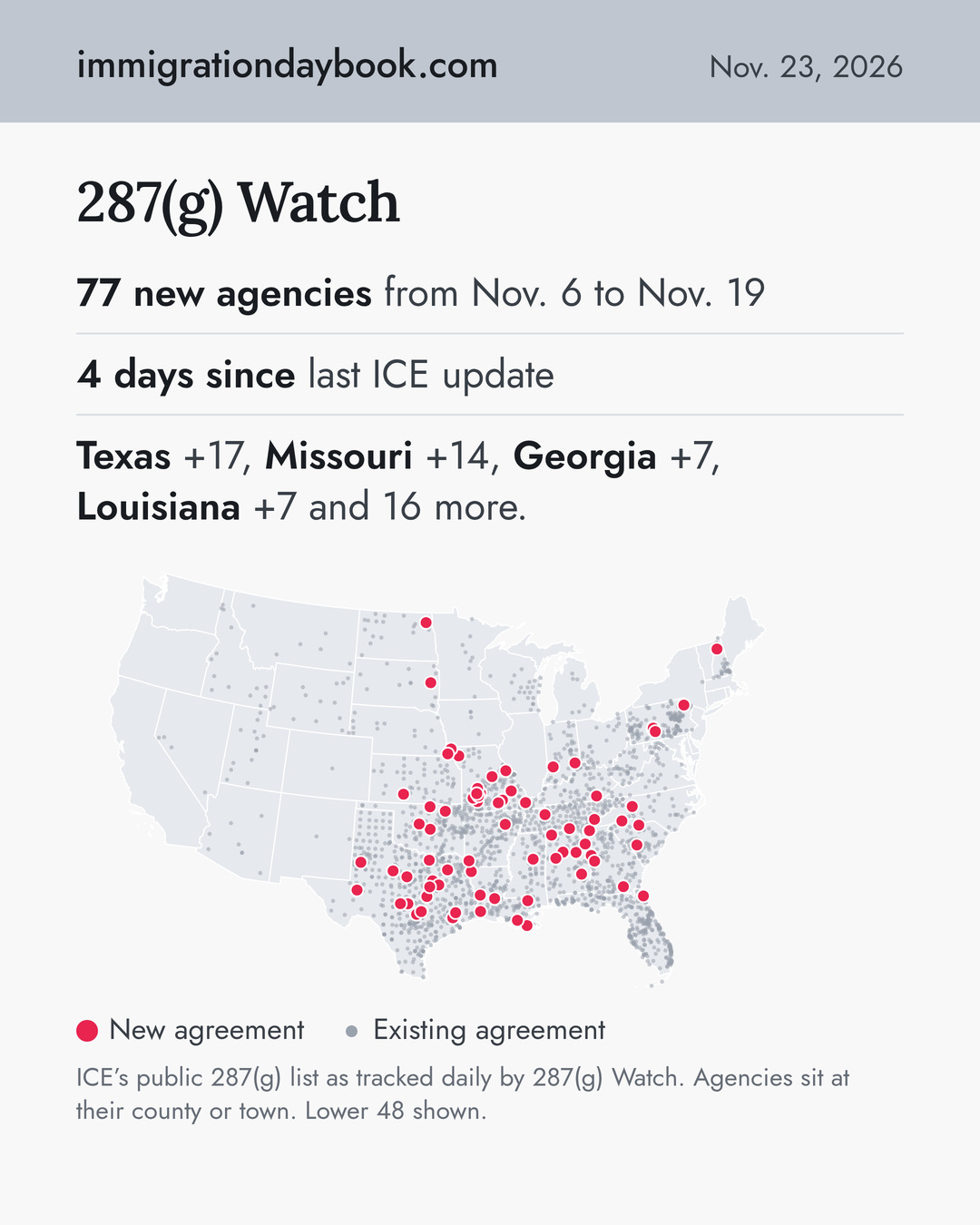
About 49% of interstate highway miles in the lower 48 now pass through jurisdictions where state or local officers can make immigration arrests on patrol under an ICE task-force agreement, up from zero at the start of 2025. The new Recovered Factory analysis includes state highway patrols and counts only agreements that authorize arrests on patrol. Thursday’s Daybook reported a different measure: nearly 30% counted local agencies only, under any type of 287(g) agreement. Neither figure counts stops or arrests. Counting only local agencies with task-force agreements puts the share at 19%; including state highway patrols brings it to 49%. [Recovered Factory, Immigration Daybook]
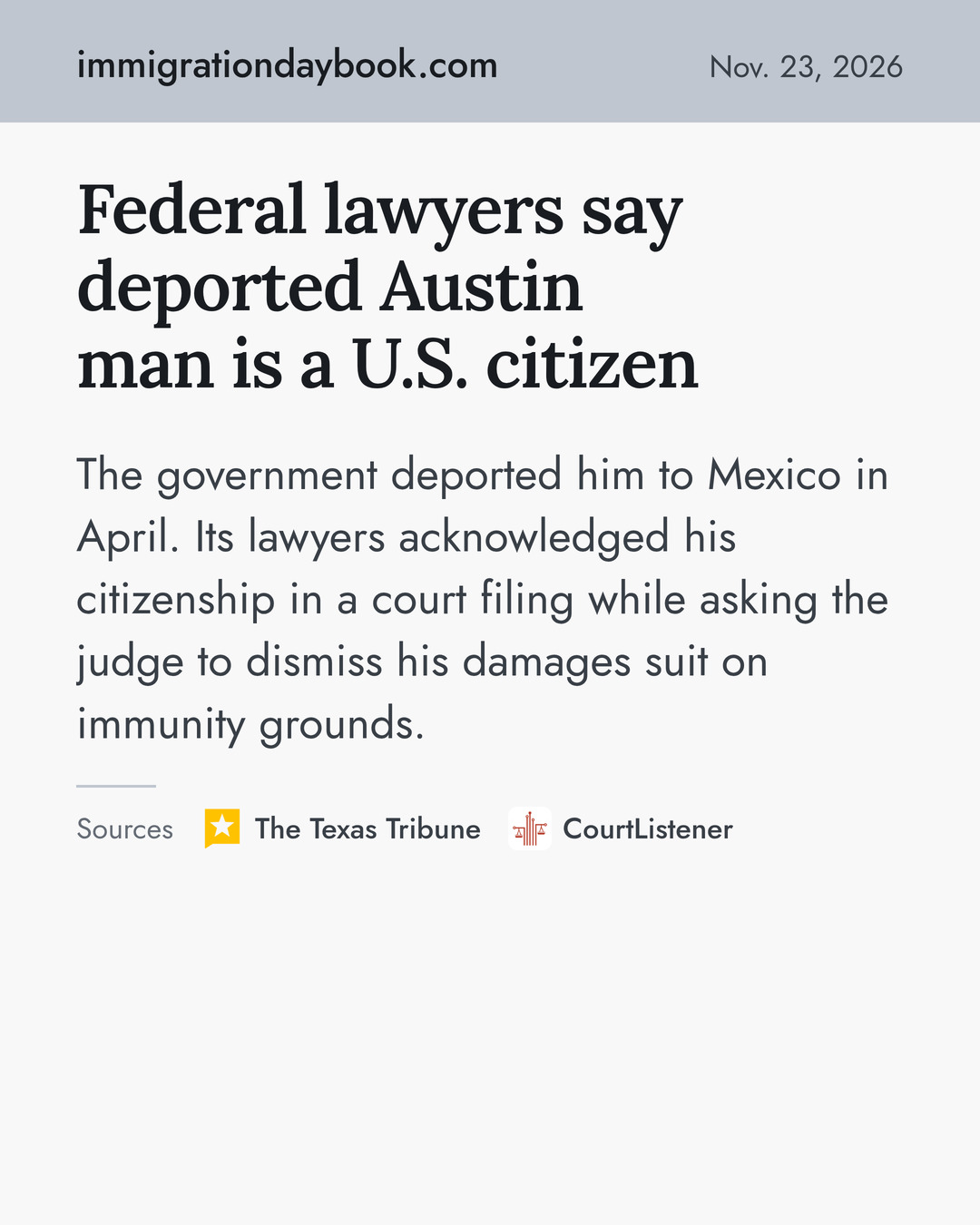
U.S. acknowledges deported Austin man is a citizen
Federal lawyers acknowledged Friday that a man deported to Mexico in April is a U.S. citizen, The Texas Tribune reports. The government is asking the judge to dismiss his damages suit on immunity grounds. The acknowledgment came in a court filing, not a ruling. The acknowledgment contradicts an April statement from Customs and Border Protection that its agents had not arrested a U.S. citizen. [The Texas Tribune, CourtListener]
Boston judge questions refugee green-card freeze
A federal judge in Boston questioned the freeze on refugee green-card applications Friday but did not lift it. The lawsuit also challenges plans to re-interview refugees admitted under the Biden administration and a rule that cuts the time to respond to a notice of intent to terminate refugee status from 30 days to 10. [Reuters, Civil Rights Litigation Clearinghouse]
Upcoming
The next four weeks.
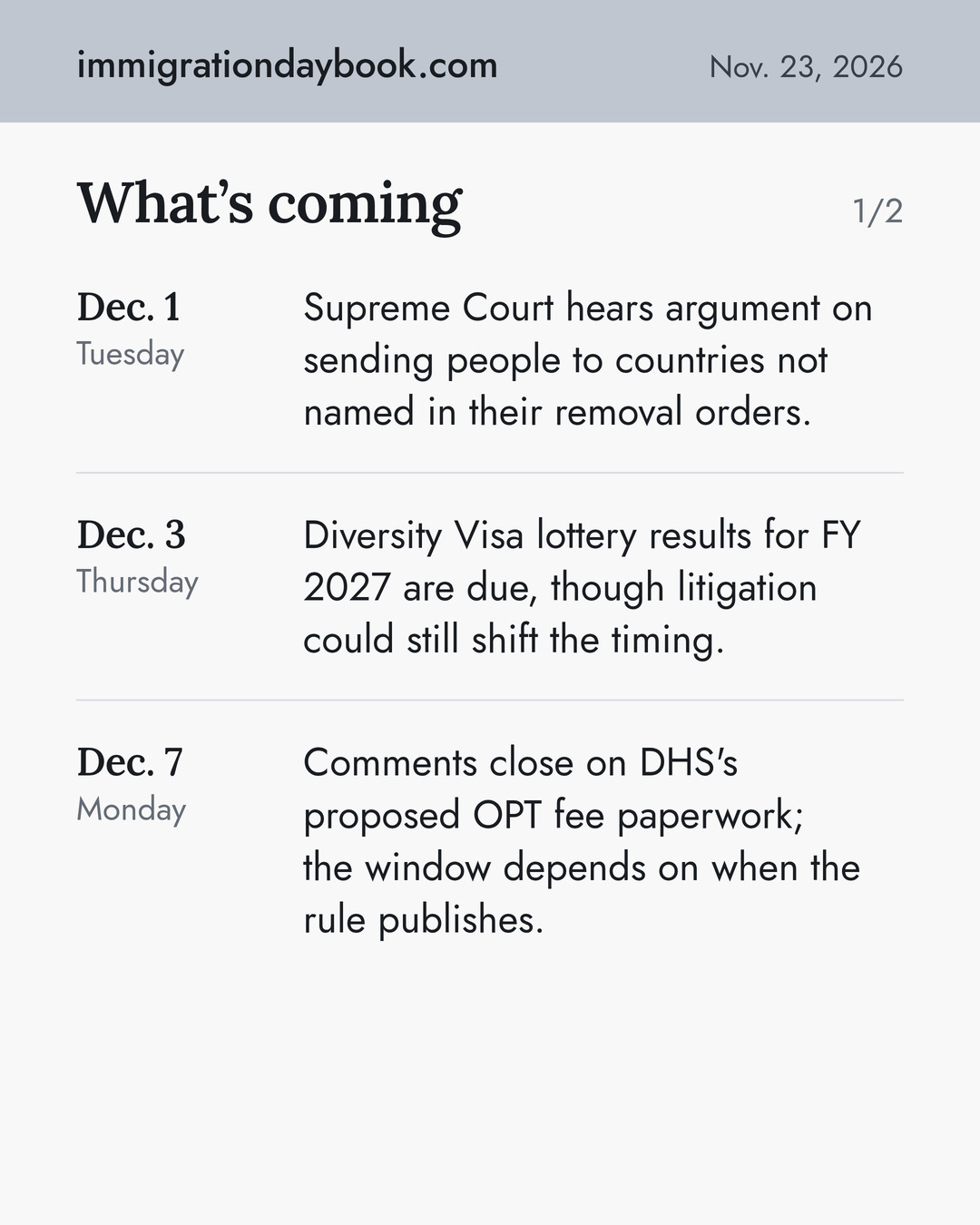
- Dec. 1, 2026
The Supreme Court hears argument in December on deporting people to a country that is not their own and not named in their deportation order (third-country removals), which an unsigned order on September 29 allowed to resume while the case continues. At issue is how much notice people get and how they can raise a fear of harm in that specific country; a ruling is expected in 2027.
- Dec. 3, 2026
People who entered the FY 2027 green card lottery (Diversity Visa program) are due to find out if they were selected: a court order requires the State Department to notify selectees by December 3, 2026. Whether the results come out on time may still shift with the litigation.
- Dec. 7, 2026
DHS's proposed rule charging a fee for the work permission international students get after graduating (OPT) carries a separate 60-day comment window on its paperwork and information-collection side. If the rule publishes October 8, 2026, that window would close around December 7; the published notice sets the actual date.
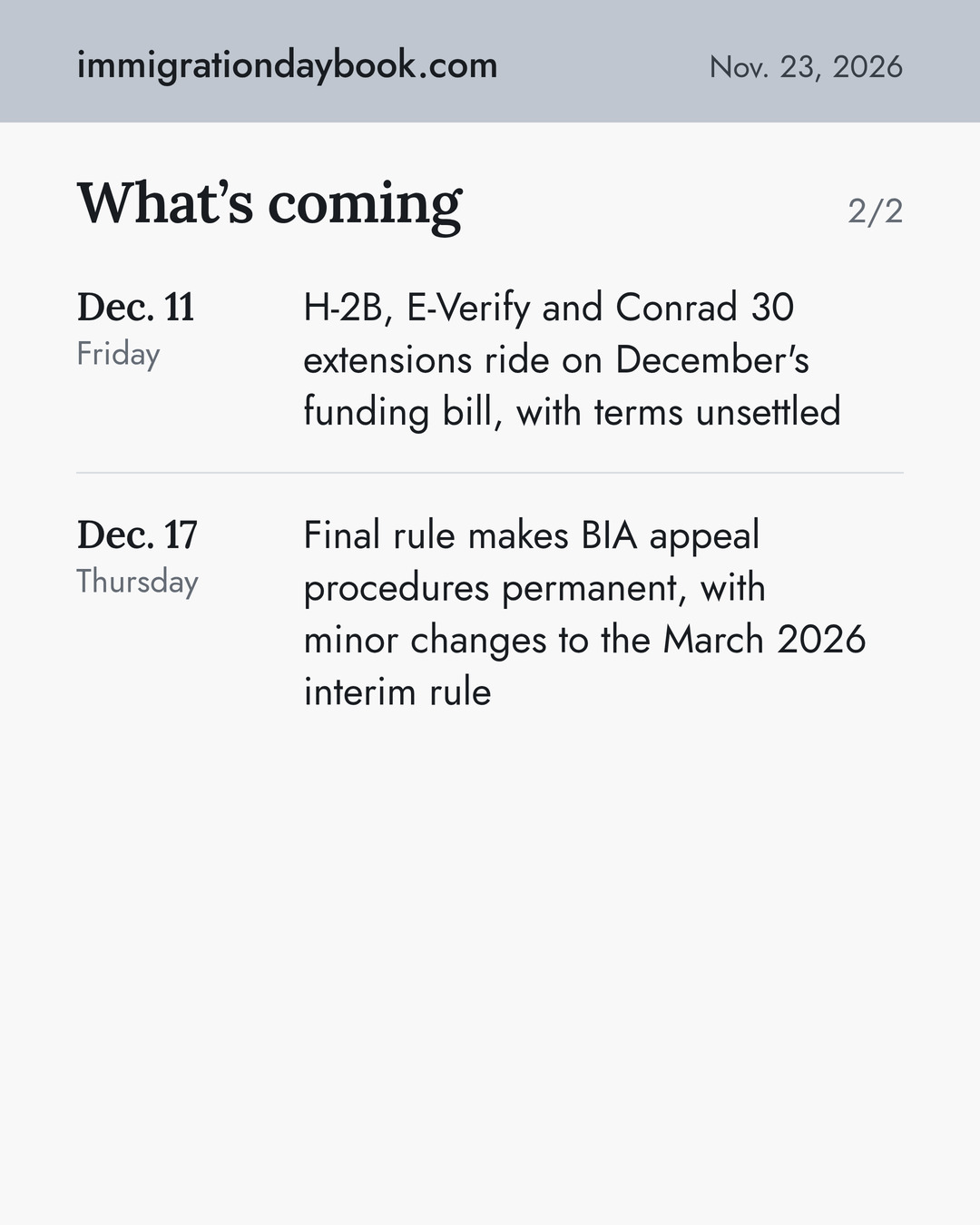
- Dec. 11, 2026
Several immigration programs that lapse with government funding ride on December's bill: extra seasonal worker visas (supplemental H-2B) and the employer work-eligibility check (E-Verify), plus the Conrad State 30 waiver for foreign doctors and the special immigrant religious worker green card. Whether they are extended again, and on what terms, is unsettled.
- Dec. 17, 2026
People appealing an immigration judge's decision to the Board of Immigration Appeals (BIA), the body that reviews those decisions, keep the faster appeal procedures put in place in March 2026. The Justice Department is answering the comments it received and finalising that interim rule with minor changes.
Send this edition to someone who should have it.
The link carries “?via” and nothing else — no identifiers, no cross-site tracking.
Around the system
- A federal judge in Connecticut temporarily blocked enforcement of parts of a state law regulating federal immigration officers. [U.S. District Court]
- Tenant and immigrant-rights groups in Massachusetts sued to block HUD’s mixed-status housing rule. The complaint also challenges related eligibility checks. [GBH, Filed complaint]
- Federal lawyers appealed an Alabama court order limiting ICE arrests at construction sites. The appeal did not itself overturn the order. [Law360]
- The Dallas immigration court moved some preliminary hearings up by years, giving people about a week’s notice. [The Dallas Morning News]
- Lawyers asked a federal judge to require phone access for children in Border Patrol holding cells, citing accounts of families unable to call for help. [inewsource]
- A Cuban asylum seeker in ICE custody told The Guardian he ended his hunger strike after staff force-fed him through a nasal tube. [The Guardian]
- Rep. Norma Torres asked the DHS inspector general to investigate ICE’s $950 million purchase of the California detention center from GEO Group. [Rep. Norma Torres]
- The Harris County sheriff plans limited cooperation with ICE under a Texas law requiring counties to sign agreements. [CW39]
- The town of Marana, Arizona, issued a business license for an ICE detention center at a former prison. No opening date has been announced. [El Imparcial]
- Directo a México stopped accepting new transfers on Nov. 20. The Federal Reserve notice says returns will be processed through Dec. 11. [Courthouse News Service, Federal Reserve Financial Services]