This edition in 8 slides Flip through ↓

Appeals court revives church-arrest challenge
In a 2–1 decision, the D.C. Circuit found that 27 Christian and Jewish religious groups had shown a credible threat of immigration enforcement at or near their houses of worship under the administration’s policy, as Courthouse News Service reported. The panel reversed the district court’s finding that the groups lacked standing and sent the case back for the district judge to reconsider their request for a preliminary injunction. [Courthouse News Service, D.C. Circuit]
Get the Daybook in your inbox.
Free. Every weekday. English and Spanish.
We never sell or share your email. Unsubscribe any time.
Visa revocations exceed 300,000
Reuters reported that the State Department says more than 300,000 visas have been revoked since President Trump returned to office. The report says revocations accelerated in recent weeks; the State Department had reported more than 175,000 on August 10. The New York Post also reported the October 20 announcement. Separately, an unnamed State Department official told Al Jazeera that more than 4,000 revocations were tied to alleged birth tourism. [Reuters, The New York Post, Al Jazeera]
Family and ICE dispute care before Laredo death
Emiliano Andrade Covarrubias, 56, was found unresponsive in his bed at an immigration detention facility in Laredo; he had diabetes, high blood pressure and a heart condition, and an autopsy was pending. His daughter said he did not receive the medication and care he needed. DHS said he received proper care, while Rep. Henry Cuellar said detainees told him medication had been withheld; ICE published its account of the death. [FOX 4 Dallas-Fort Worth, EL PAÍS English, ICE]
Mahmoud Khalil asks the Supreme Court to review his detention case
Mahmoud Khalil has asked the Supreme Court to review a Third Circuit ruling that federal courts cannot hear his detention challenge before he exhausts immigration proceedings. The Associated Press reported that the appeals court overturned a lower-court order for his release on jurisdictional grounds; the Center for Constitutional Rights says Khalil argues that federal courts should be able to hear his claim that detention and removal proceedings retaliated against his protected speech. Habeas corpus lets someone ask a court to review whether the government is holding them unlawfully; his petition asks whether federal law bars that review and, if so, whether the bar is constitutional in his case. [Associated Press, Center for Constitutional Rights]
Upcoming
The next four weeks.
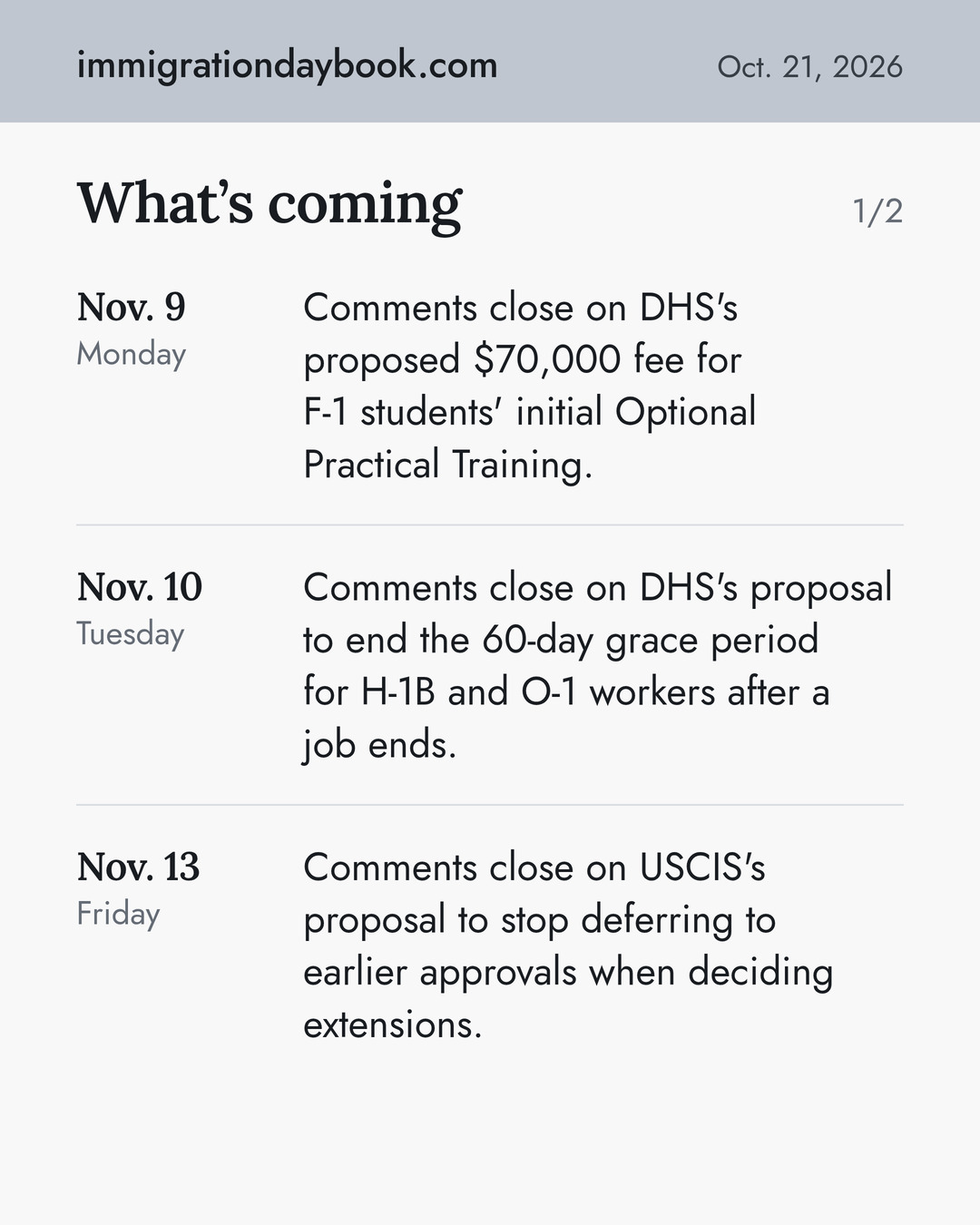
- Nov. 9, 2026
DHS proposes charging F-1 students $70,000 for an initial period of Optional Practical Training and $30,000 for a later period. The fees are not in effect: comments on the proposed rule close November 9, while comments specifically on its required paperwork and information-collection estimates close December 7.
- Nov. 10, 2026
DHS proposes ending the regulation that lets certain H-1B, O-1 and other covered workers—and their families—remain in the United States for up to 60 days after a job ends. The grace period remains in effect for now; comments on the proposal close November 10.
- Nov. 13, 2026
USCIS proposes ending the regulation that generally tells officers to give weight to an earlier approval when deciding an extension involving the same facts. The proposal is not in effect; comments close November 13.
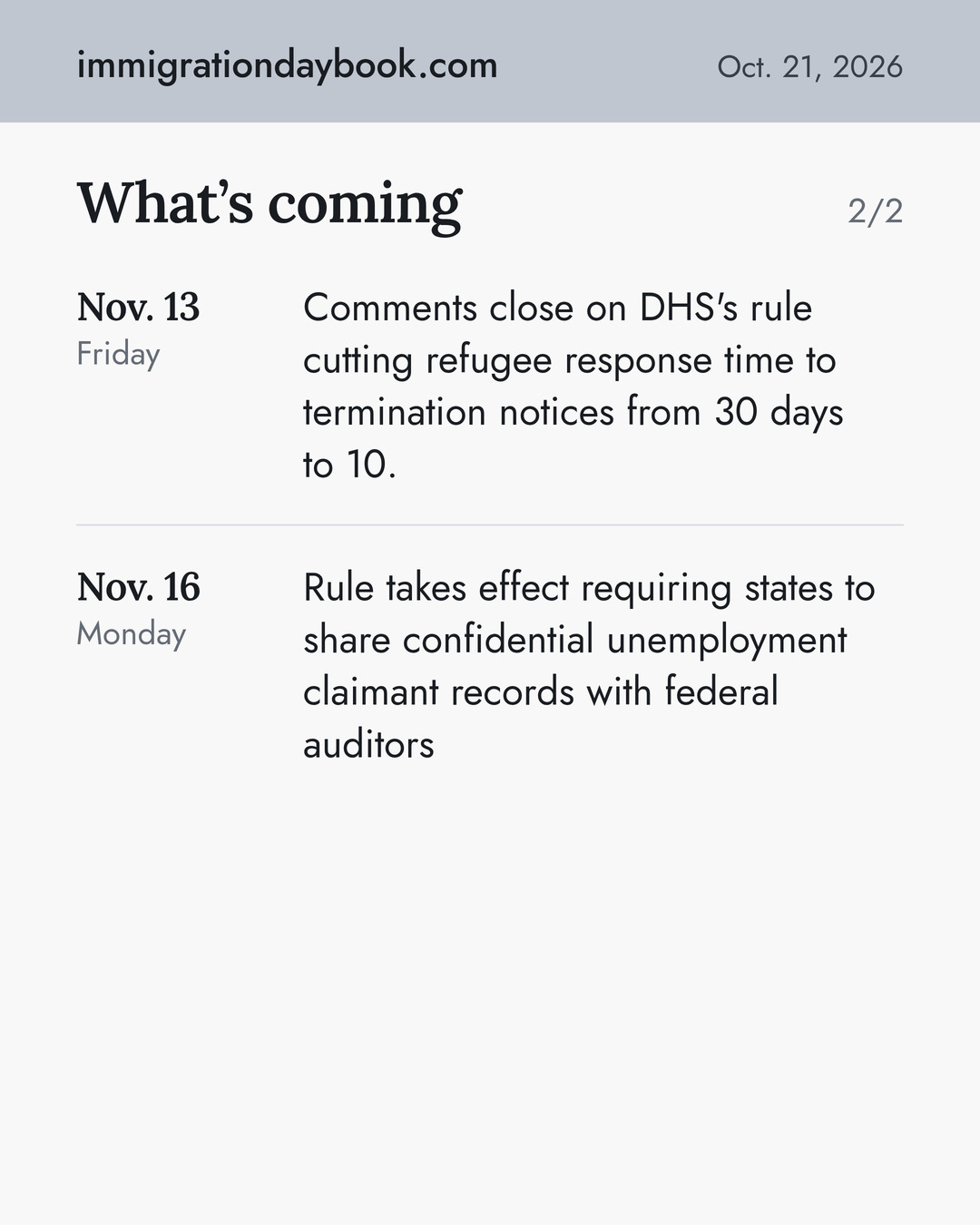
A DHS interim final rule already in effect cuts from 30 days to 10 the time for a refugee to respond to a notice that DHS intends to terminate refugee status because it says the person did not qualify at admission. DHS is accepting post-implementation comments through November 13.
- Nov. 16, 2026
State unemployment agencies will have to hand over confidential unemployment compensation (UC) records — information about individual claims and claimants — to federal officials who audit the programs, including the Labor Department's internal watchdog (DOL Office of Inspector General). The stated purpose is oversight and fraud detection.
Send this edition to someone who should have it.
The link carries “?via” and nothing else — no identifiers, no cross-site tracking.
Around the system
Twenty-one states and the District of Columbia backed a challenge to warrantless civil immigration arrests. Their amicus brief argues that officers need probable cause to believe someone is unlawfully present and likely to escape before a warrant can be obtained. [State Attorneys General]
Civil-rights groups sued for records about mass immigration-court calendars in San Francisco. Mission Local reports that the groups raise due-process concerns about the “mega master” hearings. [Mission Local]
The Marshall Project sued for nationwide access to ICE and CBP detention data. It is seeking names, ages and locations from ICE’s detention database. [The Marshall Project]
The Board of Immigration Appeals changed how evidence may be treated in motions to reopen. In Matter of J-E-D-C-, decided October 19, the Board held that immigration judges and the BIA need not accept facts in supporting affidavits or declarations as true, even when the statements are not inherently unbelievable. [Board of Immigration Appeals]
Border Report says at least 30 detainees are on hunger strike at the El Valle Detention Facility, including 13 on a “dry hunger” strike. Detainees alleged poor and unsanitary conditions; ICE denied their allegations and said detainees receive meals, drinking water, blankets, medical treatment and opportunities to contact family and lawyers. Border Report [Border Report]
A Savannah police officer’s Flock credentials were used by her husband, an ICE agent. WJCL’s review of city investigative records found 983 searches involving 97 license plates across six states, including 788 involving South Carolina plates. The husband said he searched for ICE targets with active warrants; the city said it had not authorized ICE access. [WJCL]
Documented published a Chinese-language guide for New Yorkers assessing public-charge risks. It includes official guidance and local legal-support resources; the NYC Mayor’s Office of Immigrant Affairs says the rule does not apply to every immigrant and advises people to consult a trusted legal provider before stopping needed benefits. [Documented, NYC Mayor’s Office of Immigrant Affairs]
Nearly three-quarters of minors recorded before the Charlotte Immigration Court lacked counsel. Enlace Latino NC reports that 635 of 866 minors recorded from January through August 2026 had no lawyer, or 73%. [Enlace Latino NC]