This edition in 8 slides Flip through ↓

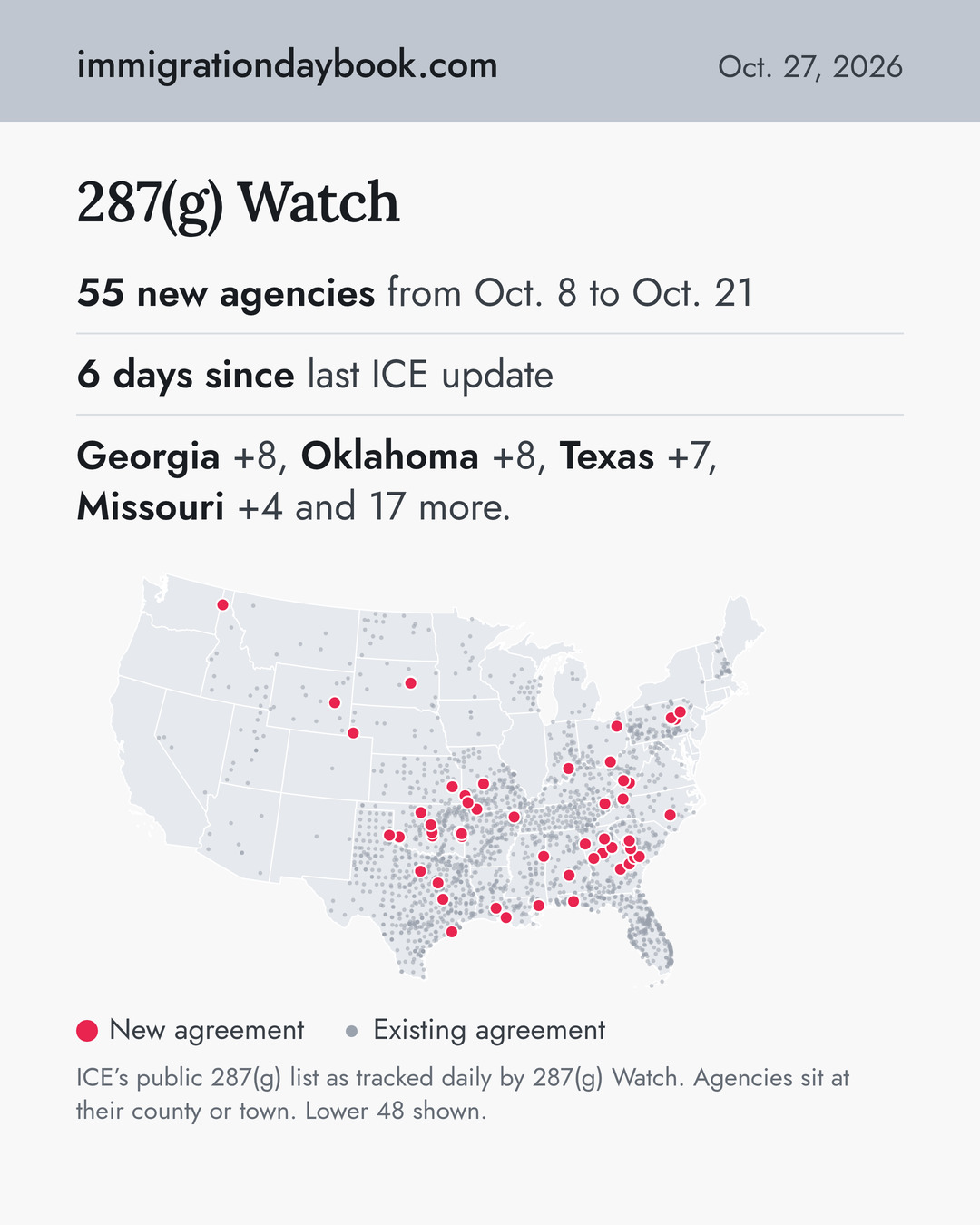
A court vacated the 75-country immigrant-visa pause, but thousands remain abroad without visas. Refugee groups are challenging new policies, naturalization approvals have fallen and DHS has proposed steep fees for student work training.
Court victory has not restarted immigrant visas from 75 countries
A federal judge struck down the administration’s immigrant-visa pause for nationals of 75 countries, finding that the secretary of state had exceeded his authority. Congress gave consular officers the job of assessing individual applicants, the judge ruled, rather than allowing a blanket refusal based on nationality. The State Department says the pause ended Aug. 21 and interviews can continue. Yet NPR found families still separated and applicants waiting for visas, with lawyers pointing to additional screening over whether applicants might rely on public benefits. The department told NPR in August that it had paused processing for consular training; it declined to comment for the October report, citing litigation. It’s unclear when those still waiting will receive their visas. [Associated Press, State Department, NPR]
Get the Daybook in your inbox.
Free. Every weekday. English and Spanish.
We never sell or share your email. Unsubscribe any time.
Refugee groups challenge shortened process for losing status
Six organizations and four refugees sued Oct. 26 over three policies affecting refugees already admitted to the United States. Their complaint challenges a hold on certain refugee green-card applications, renewed vetting and reinterviews, and a shorter deadline to contest the loss of refugee status. The Oct. 14 rule cuts that response period from 30 days to 10; DHS says faster decisions will improve security and efficiency when it determines someone did not qualify as a refugee when admitted. The plaintiffs argue that 10 days leaves too little time to find a lawyer, obtain records and answer the government’s allegations. They are asking the court to halt the policies while the lawsuit proceeds. [PANA v. Edlow complaint, Federal Register, International Refugee Assistance Project]
Naturalization approvals fall as citizenship cases slow
USCIS approved 173,000 people for citizenship in the first eight months of 2026—72% fewer than in the same period in 2025, according to a Washington Post report republished by The Detroit News. Separately, Univision reports that more than 800,000 naturalization applications remained pending and average waits reached 13 months, with times varying by field office. USCIS had set a six-month processing goal in August 2025. [The Detroit News, Univision]
DHS proposes $70,000 and $30,000 practical-training fees
DHS proposes a $70,000 fee for an international student’s first period of Optional Practical Training and $30,000 for subsequent training. The program allows international students on F-1 visas to work temporarily in jobs related to their studies. The student’s certified school would have to pay before recommending the training and provide proof of payment, but the proposal allows schools to pass the cost to participating students, other students or employers. DHS says the fees would deter fraud and protect U.S. workers; Jackson Lewis describes the potential consequences for students, schools and employers. The fees are not in effect. Comments are due Nov. 9, 2026. [Federal Register, Jackson Lewis]
Americans’ views of ICE have grown more negative, according to a new Pew Research Center survey
Fifty-six percent of Americans view ICE unfavorably and 35% favorably, a Pew Research Center survey found, compared with 49% unfavorable and 40% favorable a year earlier. The shift crosses party lines: Republican and Republican-leaning respondents’ favorable views fell to 67% from 72%, while unfavorable views among Democrats and Democratic leaners rose to 84% from 78%. ICE was the least favorably viewed of the 12 federal agencies and departments in the survey. Pew publishes the full question and response breakdowns and its survey methodology: 5,062 adults surveyed Sept. 28–Oct. 4 through a nationally representative, randomly recruited panel, with a full-sample margin of error of plus or minus 1.6 percentage points. [Pew Research Center]
Upcoming
The next four weeks.
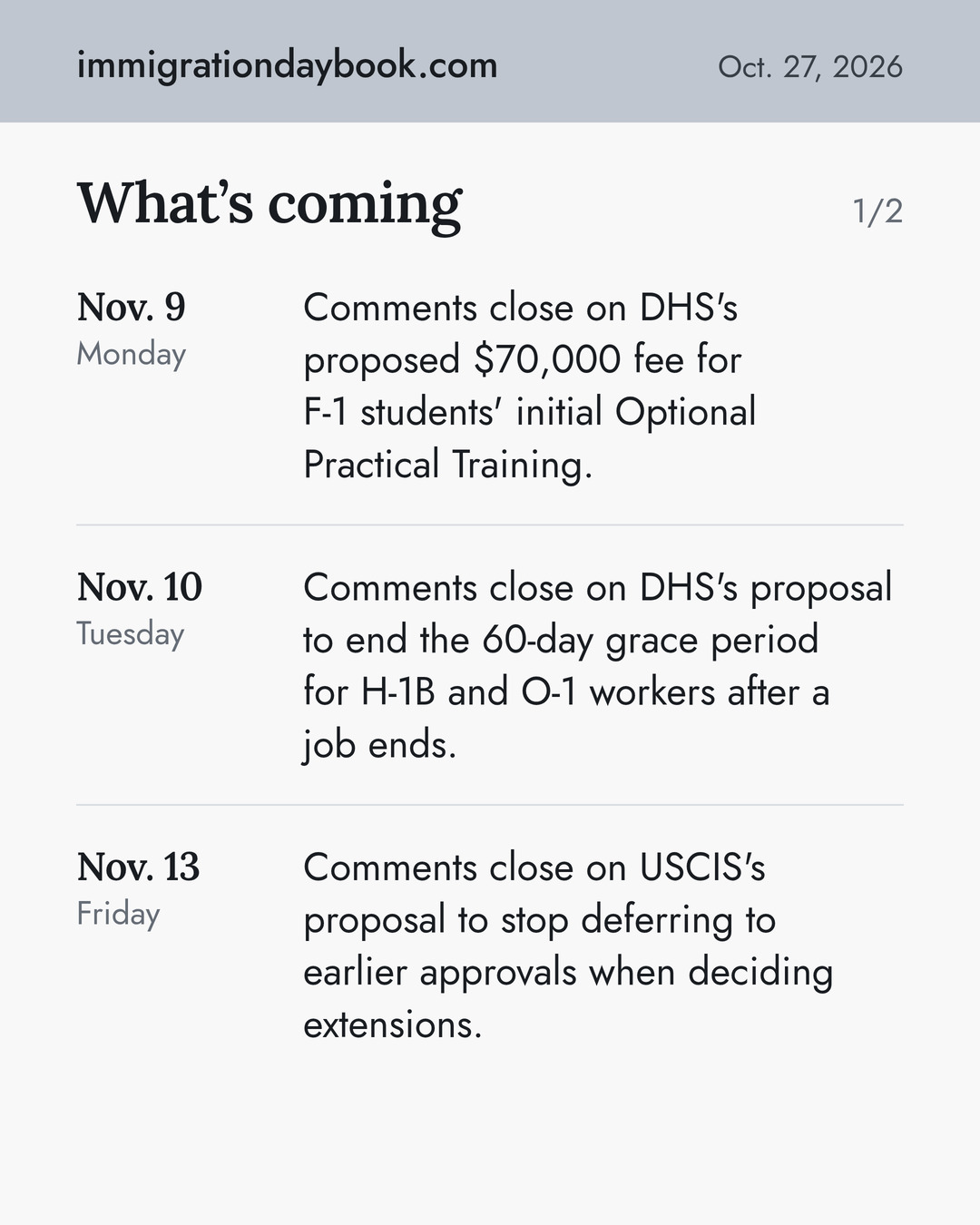
- Nov. 9, 2026
DHS proposes charging F-1 students $70,000 for an initial period of Optional Practical Training and $30,000 for a later period. The fees are not in effect: comments on the proposed rule close November 9, while comments specifically on its required paperwork and information-collection estimates close December 7.
- Nov. 10, 2026
DHS proposes ending the regulation that lets certain H-1B, O-1 and other covered workers—and their families—remain in the United States for up to 60 days after a job ends. The grace period remains in effect for now; comments on the proposal close November 10.
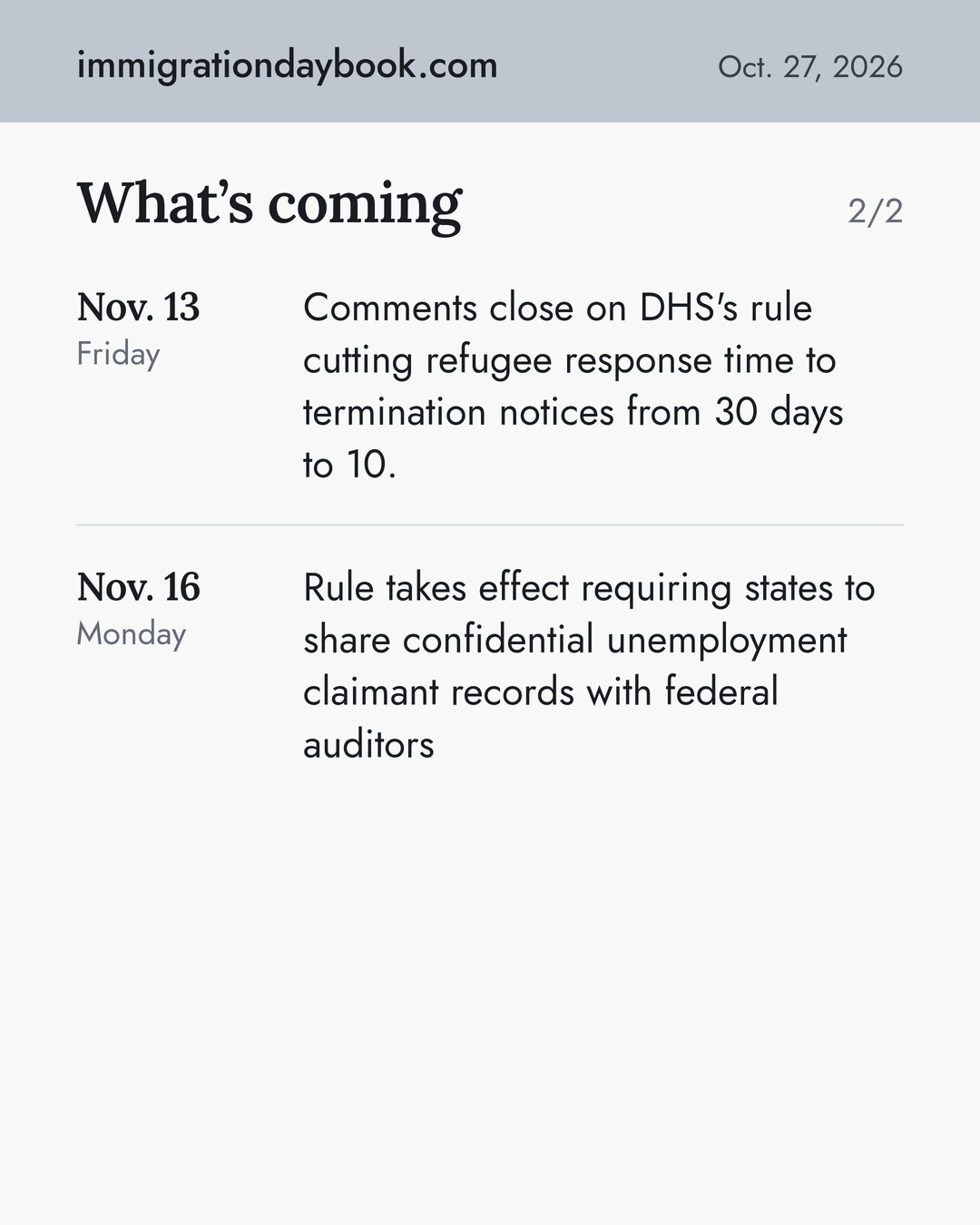
- Nov. 13, 2026
USCIS proposes ending the regulation that generally tells officers to give weight to an earlier approval when deciding an extension involving the same facts. The proposal is not in effect; comments close November 13.
A DHS interim final rule already in effect cuts from 30 days to 10 the time for a refugee to respond to a notice that DHS intends to terminate refugee status because it says the person did not qualify at admission. DHS is accepting post-implementation comments through November 13.
- Nov. 16, 2026
State unemployment agencies will have to hand over confidential unemployment compensation (UC) records — information about individual claims and claimants — to federal officials who audit the programs, including the Labor Department's internal watchdog (DOL Office of Inspector General). The stated purpose is oversight and fraud detection.
Send this edition to someone who should have it.
The link carries “?via” and nothing else — no identifiers, no cross-site tracking.
Around the system
New York county jails billed ICE about $20 million for holding immigrants since early 2025, New York Focus reports. The total combines $18.1 million in invoices through July 2026 with an estimate for Nassau County, which had not supplied its records; a state law barring counties from detaining people for ICE takes effect Nov. 25. [New York Focus]
Ohio plans to downgrade about 3,000 outstanding nondomiciled commercial driver’s licenses to standard licenses. The BMV will notify affected drivers by letter; the downgrade takes effect 30 days after the letter, and drivers may request a hearing. [The Columbus Dispatch]
In the Sileiri Doe case, eligible members of the CBP One mobile-app parole class may ask USCIS without a fee to reopen or reconsider certain adverse immigration-benefit decisions. The Sept. 28 court order addresses decisions arising from the April 2025 mass emails terminating parole; requests are reviewed case by case, cover original decisions from April 1, 2025, through April 21, 2026, and exclude parole-based work permits. [USCIS]
San Juan Mayor Miguel Romero directed municipal police and city agencies not to participate in or support ICE operations. After recent federal immigration actions in the city, he called for an investigation and said the municipality would provide guidance and support to affected families. [El Nuevo Día]
A federal judge ordered the administration to disclose its plans for federal agents at polling places by Oct. 26 and supporting threat analyses by Oct. 28. The order lets the court examine claims of voter intimidation—it does not send agents to polling sites—and the administration says the plaintiffs have identified no policy to deploy armed agents there. [EFE]
Documented published a guide to finding and contacting someone in ICE detention. It explains how to use the detainee locator, identify a facility’s communication provider and add money to phone, messaging and commissary accounts, while warning that calls generally are recorded and facility procedures vary. [Documented]
CBP is preparing to seek bids for an application-development contract worth up to $50 million. The work could add biometrics and artificial intelligence to new or existing applications across the agency, but specific deployments have not been defined. [Biometric Update]
A proposal to revise the labor-certification process for employment-based green cards cleared White House review Oct. 23. The Labor Department says it would change recruitment standards and protections concerning layoffs and discrimination, but the full proposal will not be known until publication; the PERM program’s rules have not changed. [Office of Information and Regulatory Affairs, Fragomen]