This edition in 8 slides Flip through ↓

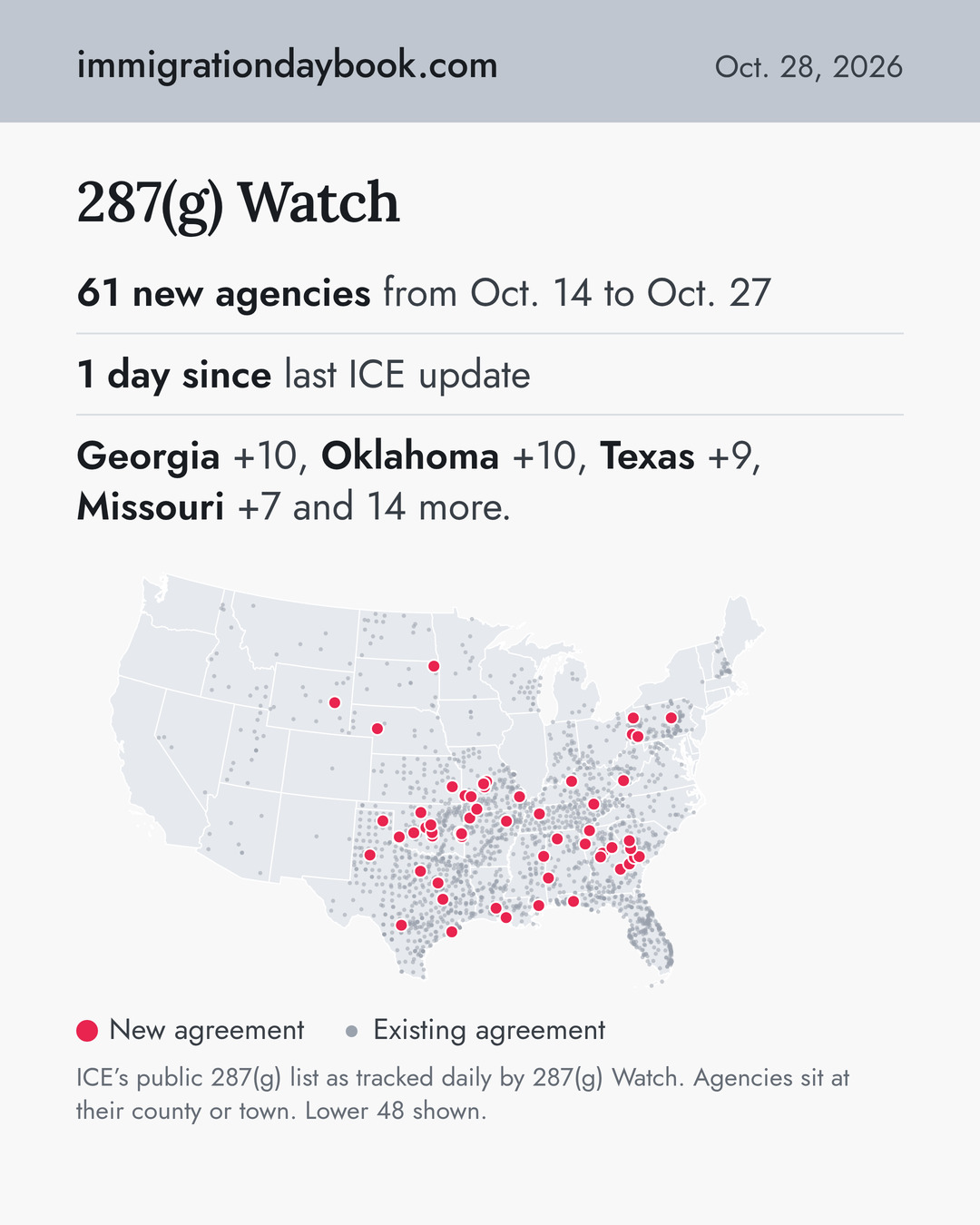

Today’s edition follows what happens when deportation cases cannot be paused, refugees get less time to answer the government, and people in detention become harder to track or protect.
Supreme Court leaves deportation-case pauses blocked
The Supreme Court declined to lift a restriction on administrative closure while litigation continues, leaving immigration judges without a longstanding way to pause some deportation cases. The tool gave people time to pursue visa petitions or protection claims that could let them stay while their deportation cases were paused. It also helped immigrant crime victims and witnesses cooperate with law enforcement. The justices’ one-sentence order gave no explanation and noted no dissents. [Courthouse News Service]
Texas sued to overturn the Biden-era rule. The Trump Justice Department agreed with Texas instead of defending the rule, and a judge approved their deal that same day. The cities and legal-services group challenging the deal say the administration used a friendly lawsuit to undo the rule rather than the normal public rulemaking process. [Reuters]
Get the Daybook in your inbox.
Free. Every weekday. English and Spanish.
We never sell or share your email. Unsubscribe any time.
Judge restores refugees’ 30-day response window for now
A federal judge temporarily stopped DHS from enforcing its new 10-day deadline for refugees to answer notices proposing termination of their status. The order runs through Nov. 6 and protects refugees who received notices from Oct. 14 through Oct. 27 allowing fewer than 30 days, including against termination for failing to answer those notices. The temporary protection leaves the previous response window in place while the court considers what comes next; the lawsuit’s challenges to refugee re-vetting and an alleged freeze on some green-card cases remain unresolved. [The Hill, U.S. District Court for the District of Massachusetts]
Otay Mesa death is reported as ICE custody’s 30th this year
Roberto Jimenez Gutierrez, a 43-year-old man from Guatemala, died Oct. 24 at the Otay Mesa Detention Center in San Diego, and inewsource counts his death as the 30th in ICE custody during 2026. ICE says staff found him unresponsive at 11:31 a.m., began CPR at 11:38 and received paramedics at 11:52; the agency says an autopsy will determine the cause and manner of death. San Diego County officials are demanding cooperation with an investigation after previously going to court for access to inspect the facility and reporting concerns about health care there. [inewsource, ICE, 10News]
Records support Florida birth claim for man ICE wants to deport
An Associated Press investigation found records supporting lawyers’ claim that Phillip James, whom ICE has detained since January and seeks to deport, was born in Florida. AP independently obtained a 1988 paternity record matching his Florida birth certificate and documented two prior U.S. passport approvals. Medical experts cited in court records diagnosed paranoid schizophrenia and described James’ assertion that he was born in Jamaica as a grand delusion. DHS disputes his citizenship and alleges the certificate was fraudulent but supplied AP no supporting evidence; his removal appeal and federal petition seeking release remain unresolved. [Associated Press]
Rapid ICE transfers leave families and lawyers searching
More than one in 10 ICE detainees are moved out of state within their first 24 hours, according to The Marshall Project. Its reporting describes how rapid transfers and an online locator that can lag leave relatives and lawyers struggling to find people. In a separate, unresolved lawsuit, the newsroom is seeking public disclosure of the names, ages and locations of everyone in ICE and CBP custody. [The Marshall Project]
Upcoming
The next four weeks.
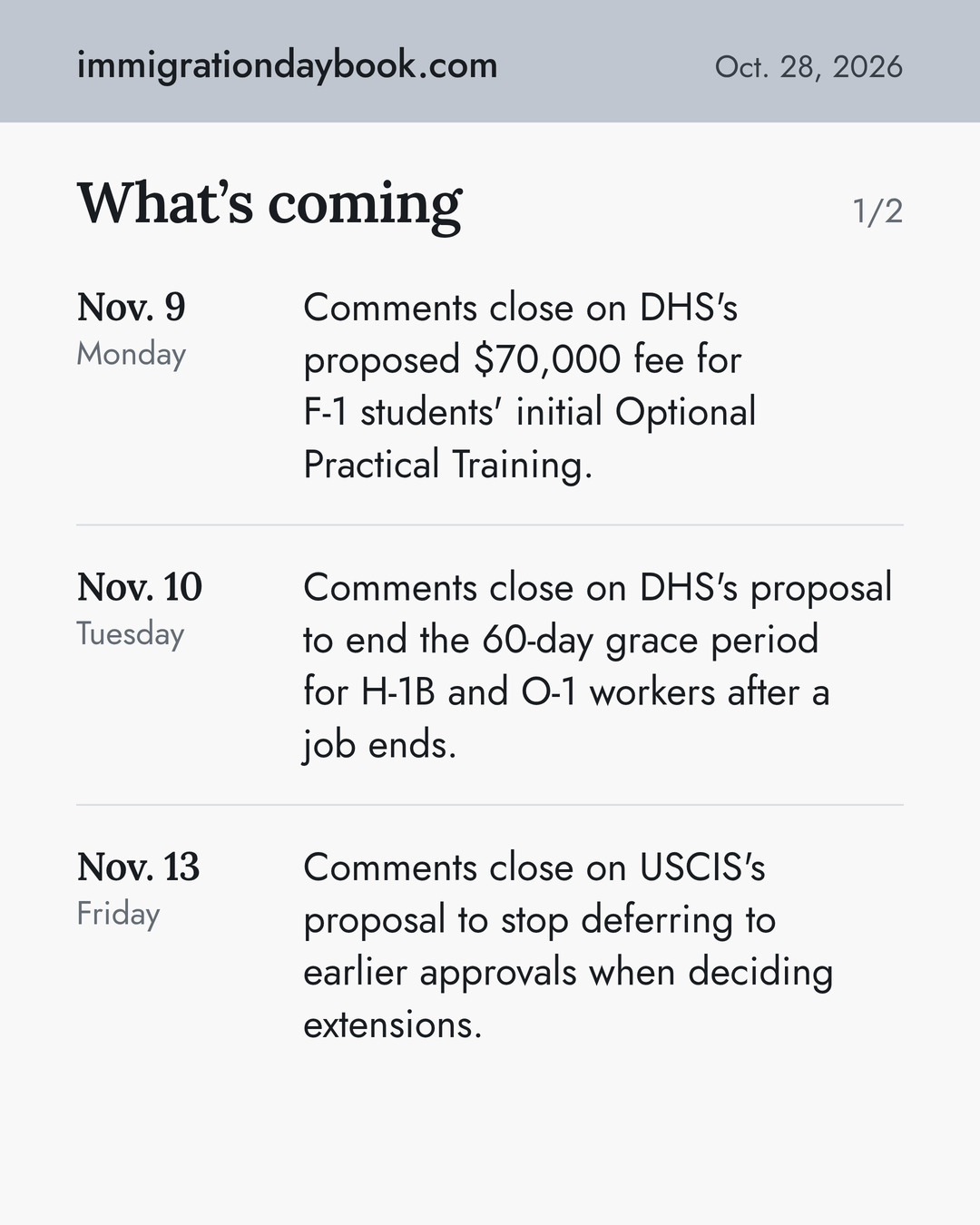
- Nov. 9, 2026
DHS proposes charging F-1 students $70,000 for an initial period of Optional Practical Training and $30,000 for a later period. The fees are not in effect: comments on the proposed rule close November 9, while comments specifically on its required paperwork and information-collection estimates close December 7.
- Nov. 10, 2026
DHS proposes ending the regulation that lets certain H-1B, O-1 and other covered workers—and their families—remain in the United States for up to 60 days after a job ends. The grace period remains in effect for now; comments on the proposal close November 10.
- Nov. 13, 2026
USCIS proposes ending the regulation that generally tells officers to give weight to an earlier approval when deciding an extension involving the same facts. The proposal is not in effect; comments close November 13.
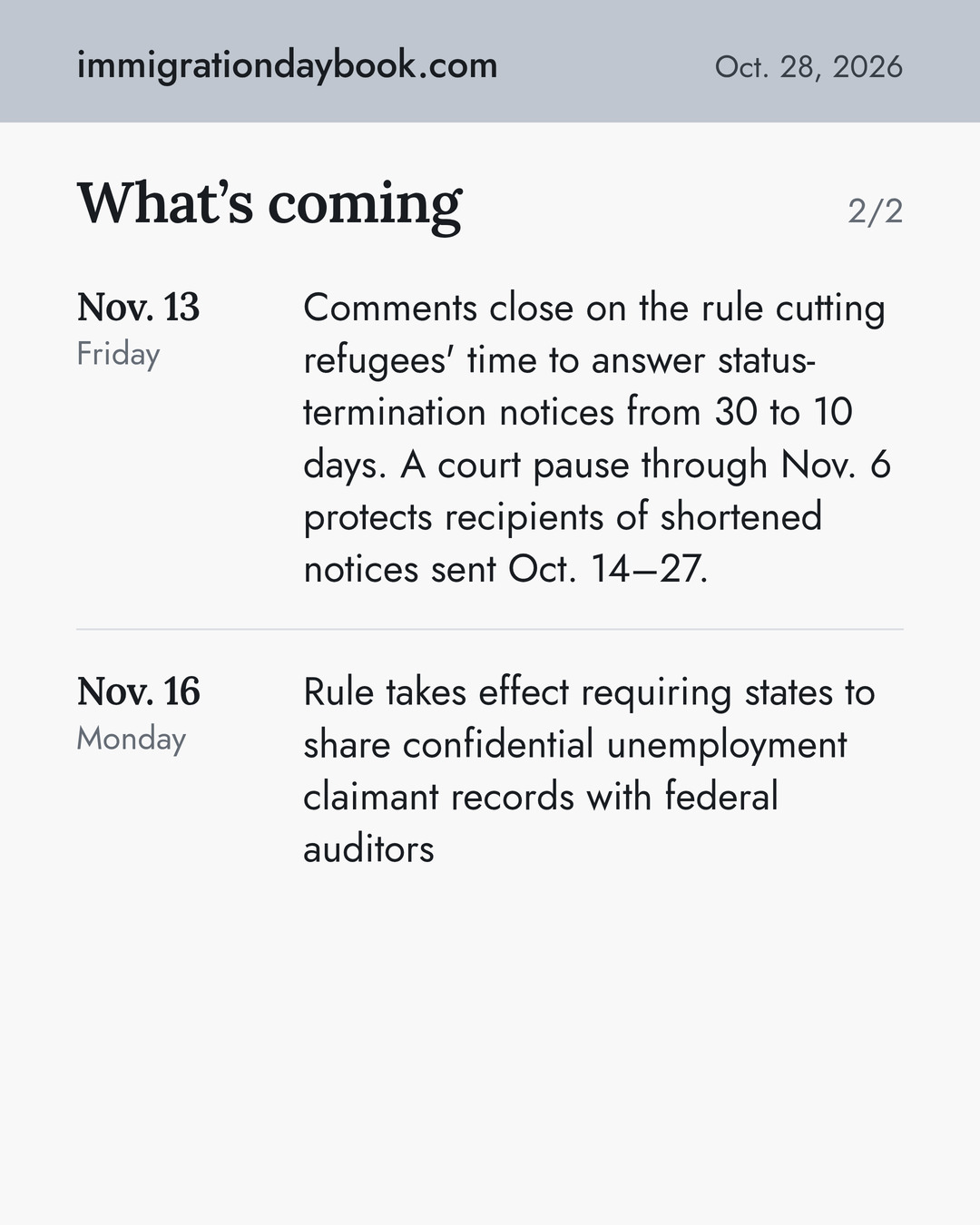
Comments close November 13 on DHS's rule cutting from 30 days to 10 the time refugees have to answer notices proposing to terminate their status. A court has blocked the shorter deadline through November 6 for refugees sent notices October 14–27 giving them fewer than 30 days.
- Nov. 16, 2026
State unemployment agencies will have to hand over confidential unemployment compensation (UC) records — information about individual claims and claimants — to federal officials who audit the programs, including the Labor Department's internal watchdog (DOL Office of Inspector General). The stated purpose is oversight and fraud detection.
Send this edition to someone who should have it.
The link carries “?via” and nothing else — no identifiers, no cross-site tracking.
Around the system
DACA recipients and other work-permit holders in Tennessee are reporting driver’s-license renewal denials under a 2025 law. Advocates have received dozens of reports; the state distinguishes federal work authorization from proof of a specified period of authorized stay. [The Tennessean]
A woman detained at the ICE facility in Eloy, Arizona, was on life support after what her family described as an apparent act of self-harm. CoreCivic confirmed that an unresponsive detainee was hospitalized Oct. 23, while the family is seeking a full investigation into what happened. [Arizona Daily Star]
Colorado voters will decide whether to require local law enforcement to notify DHS within 72 hours in specified cases. Amendment 81 would apply when a person whose citizenship or immigration status is not confirmed is charged with a violent crime, or is charged with any crime and already has a felony conviction. [Denver7]
The El Paso City Council voted 7–0 to draft a resolution calling for Camp East Montana, the Texas ICE facility on Fort Bliss, to close. The vote begins work on a statement of the city’s position; it does not adopt a final resolution or close the federal site. [KVIA]
Akron, Ohio, temporarily blocked direct out-of-state searches of its Flock license-plate-reader network. The limited opt-out does not shut down the cameras or create a complete barrier to immigration-related access: Ohio agencies retain access, and out-of-state agencies may ask Akron police to conduct searches. Signal Akron maintains a resource hub explaining the city’s Flock network. [Signal Akron]
Residents and local officials are pressing New Jersey’s governor for answers after ICE used a Roxbury warehouse for initial processing on Sept. 4 and 8. Whether that use violated an existing court order remains disputed; the parties are due to file status reports Nov. 16. [Gothamist]
Community observers documented at least 40 ICE arrests over two months at Home Depot parking lots around Seattle. Neighbors have organized observation networks, while ICE declined to say whether a particular operation explains the activity. [KUOW]
A federal judge ordered CBP to explain what it did with a traveler’s seized phone and found that most information the agency sought to redact was not privileged. CBP has until Thursday at noon to object to unsealing the material. The agency’s current policy distinguishes basic from advanced device searches and bars intentional access to information stored solely online; the court development concerns disclosure in this case, not a blanket new warrant requirement. [Reason, CBP]
DHS will suspend visa-free EVS-TAP travel for Chinese visitors to the Northern Mariana Islands at 2 p.m. EDT on Oct. 30. The general notice applies to new applicants and existing travel authorizations, but Chinese nationals already lawfully admitted under the program may remain through their current authorized stay; they will need another lawful basis for future travel. [Federal Register]