This edition in 9 slides Flip through ↓




Democrats line up subpoenas for ICE, a judge strips immigration strings from state justice grants, and Texas, Massachusetts and Colorado redraw the lines of local cooperation.
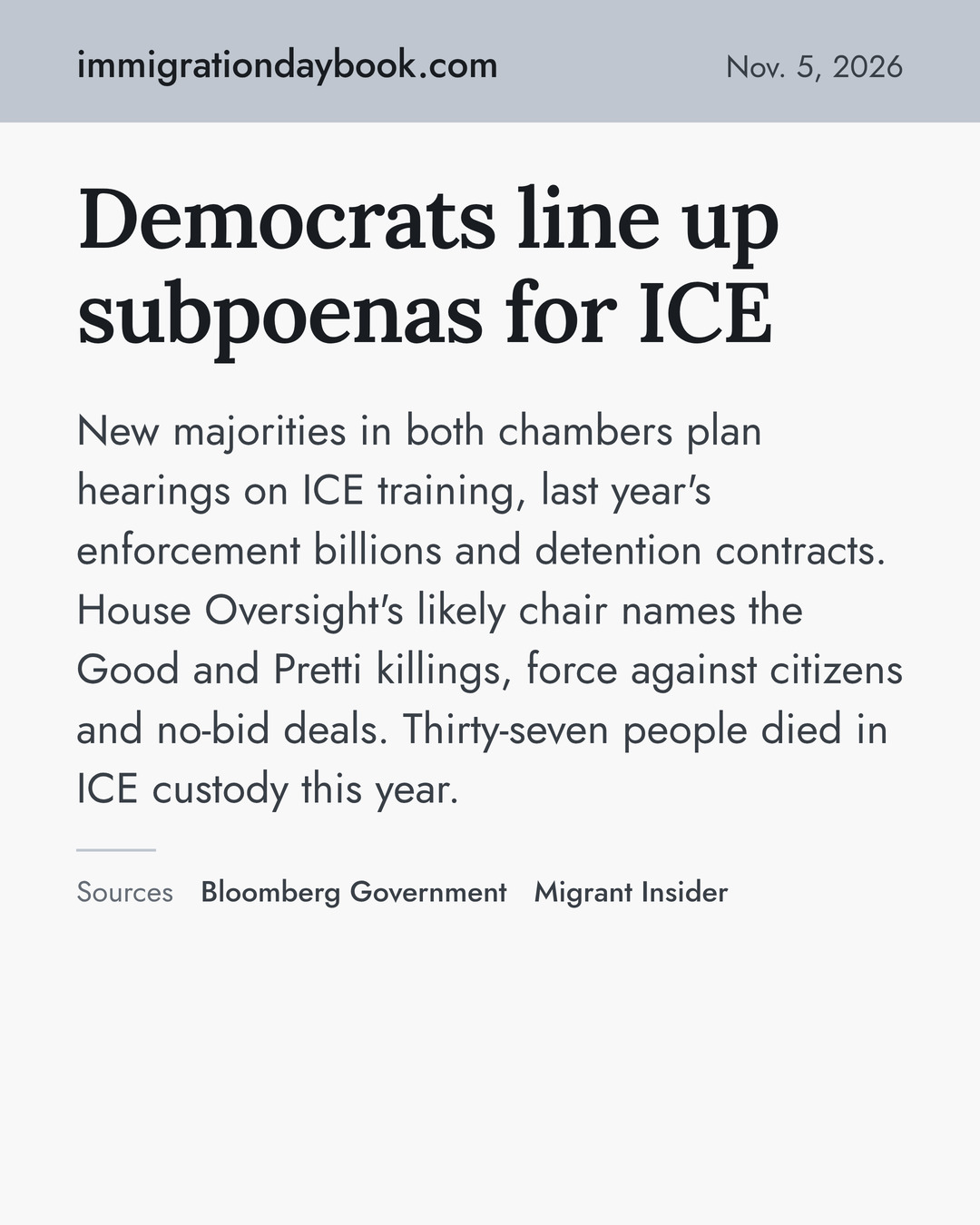
Incoming Democrats target ICE training, spending and contracts
Democrats in Congress are preparing investigations, hearings and subpoenas into the administration’s immigration agenda. Their top homeland-security targets, Bloomberg Government reports, are ICE training requirements, the billions Republicans provided for immigration enforcement last year and detention-center contracts. Rep. Robert Garcia, expected to chair House Oversight, has named the January killings of Renee Good and Alex Pretti by federal agents, use of force against U.S. citizens, detention conditions and no-bid contracts as his targets, Migrant Insider reports. Thirty-seven people died in ICE custody this year, the most on record. [Bloomberg Government, Migrant Insider]
Subpoenas are the majority’s strongest tool; money is harder. The One Big Beautiful Bill Act keeps ICE flush through the rest of President Trump’s term, and any clawback would almost certainly draw a veto, Scripps News notes. Its ICE Inc. investigation points to the kind of contract investigators could pull apart: more than $1 billion to Acquisition Logistics LLC, run out of a suburban house, to stand up the Camp East Montana detention center in Texas, where three detainees have died. “LAWYER UP,” Garcia posted on election night; DHS general counsel James Percival dismissed the coming inquiries as “political shenanigans.” [Scripps News]
Human Rights Watch is pressing the new Congress to restore gutted oversight bodies, set protections against excessive force and hold officials and agents accountable. “Without comprehensive oversight and accountability, abusive practices will most likely continue with impunity,” said Michael García Bochenek, the group’s interim U.S. program director. [Human Rights Watch]
Get the Daybook in your inbox.
Free. Every weekday. English and Spanish.
We never sell or share your email. Unsubscribe any time.
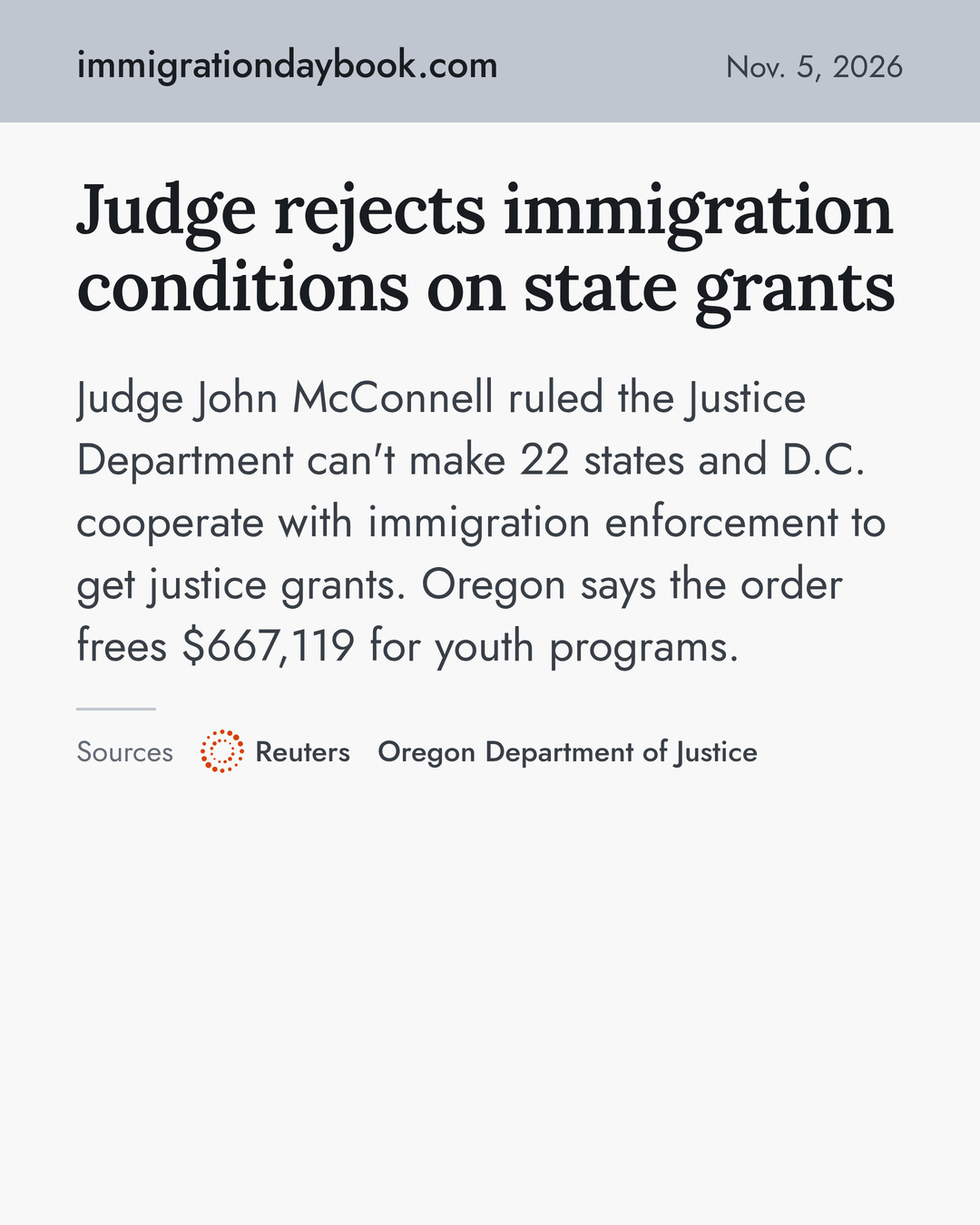
Judge rejects immigration conditions on justice grants
Chief U.S. District Judge John McConnell ruled from the bench in Providence on Nov. 4 that the Justice Department cannot require 22 states and the District of Columbia to cooperate with immigration enforcement to receive law-enforcement and juvenile-justice grants. The conditions, which would have required recipients to give federal agents access to immigrants in state custody and to notify DHS of their release, covered Byrne Justice Assistance Grants — $80 million to the states in fiscal 2025 — and Byrne crisis-intervention and juvenile-justice funds. Oregon says the order clears the way for $667,119 this year for Youth Development Oregon. “Congress set this funding aside to help kids, not as leverage to advance a partisan, anti-immigrant agenda,” Attorney General Dan Rayfield said. [Reuters, Oregon Department of Justice]
Texas victories reopen the debate over local ICE cooperation
Gina Hinojosa routed Gov. Greg Abbott, and Democrats swept every other statewide office and took the Texas House; the state Senate keeps a Republican majority under Democratic Lt. Gov.-elect Vikki Goodwin. KXAN looks at what that means for SB 8, which requires sheriffs in counties that run or contract for jails to seek 287(g) agreements giving trained local officers certain federal immigration powers. Expanding the mandate would now take the legislature and the governor’s signature, or enough votes to override a veto. [The Texas Tribune, KXAN]
In Houston, Council Member Alejandra Salinas plans to revive her ordinance limiting police cooperation with ICE in January. The council repealed it earlier this year after Abbott threatened to pull $114 million in grant funding. “If there is an opportunity to make change sooner, we will absolutely do it,” Salinas said. [Houston Chronicle]
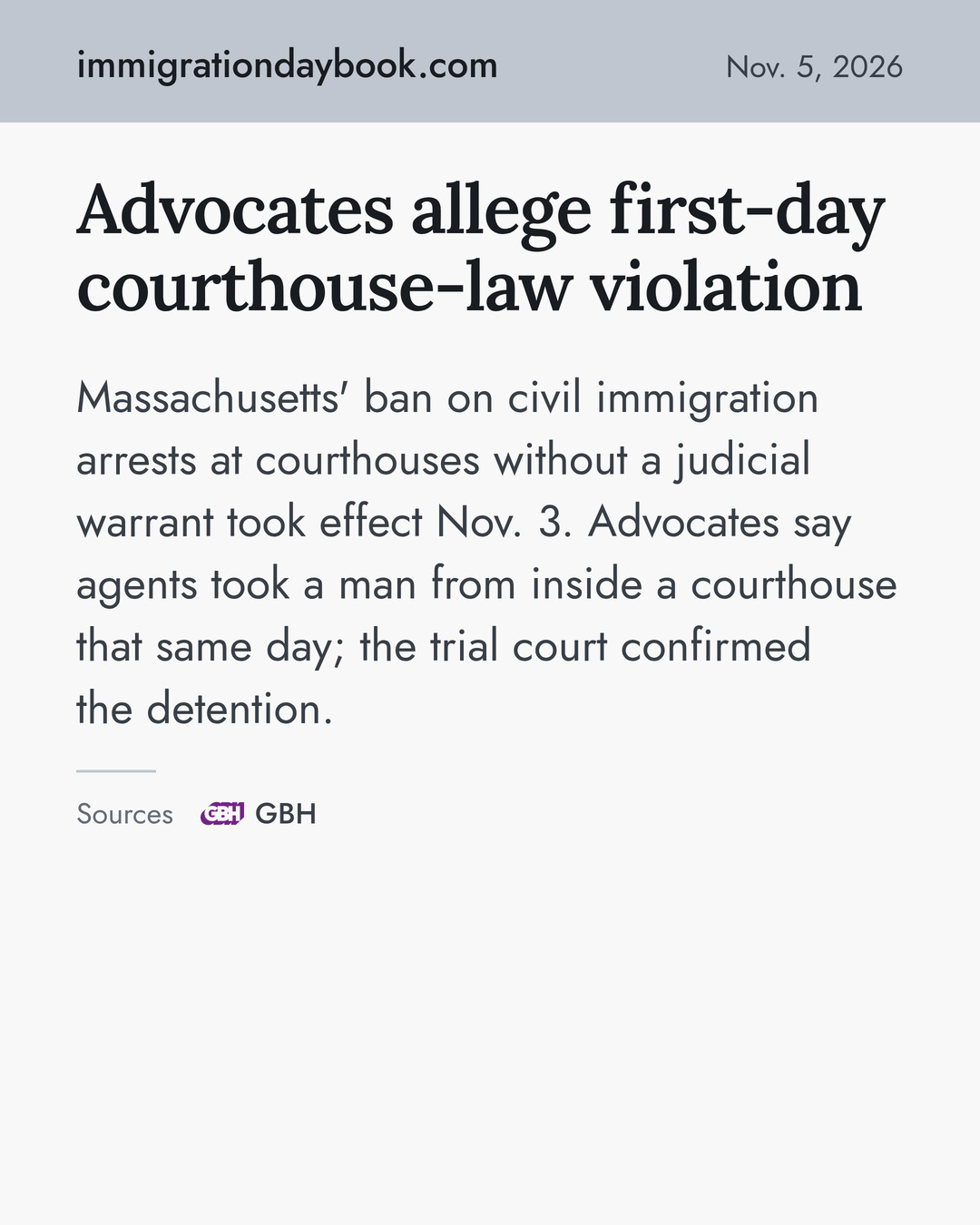
Massachusetts courthouse protections face a first-day test
The PROTECT Act’s ban on civil immigration arrests in and around courthouses without a judicial warrant took effect Nov. 3 — and advocates say it was broken the same day. “Four individuals were taking a young man right inside the courthouse,” said Gladys Vega, president of La Colaborativa, who says an agent asked for the man by name inside the courtroom and handcuffed him afterward without showing a warrant. The trial court confirmed the detention; DHS did not respond to GBH. [GBH]
The law treats such arrests as false imprisonment under state law and lets the attorney general sue ICE over violations, the New Bedford Light reports, and court guidance bars trial court employees from interfering with or assisting ICE arrests. [New Bedford Light]
Colorado rejects an ICE-cooperation mandate
Colorado voters defeated Amendment 81, 55% to 45%, The Colorado Sun reports, settling a race Colorado Politics had shown trailing but uncalled in our Nov. 4 edition. The constitutional amendment would have required police, sheriff’s deputies and prosecutors to alert DHS when they charge someone whose immigration status is in question with a violent crime, or who has a prior felony conviction. State laws limiting cooperation with ICE, including a ban on sharing personal information without a judge’s order, remain intact. [The Colorado Sun, Colorado Politics]
Upcoming
The next four weeks.
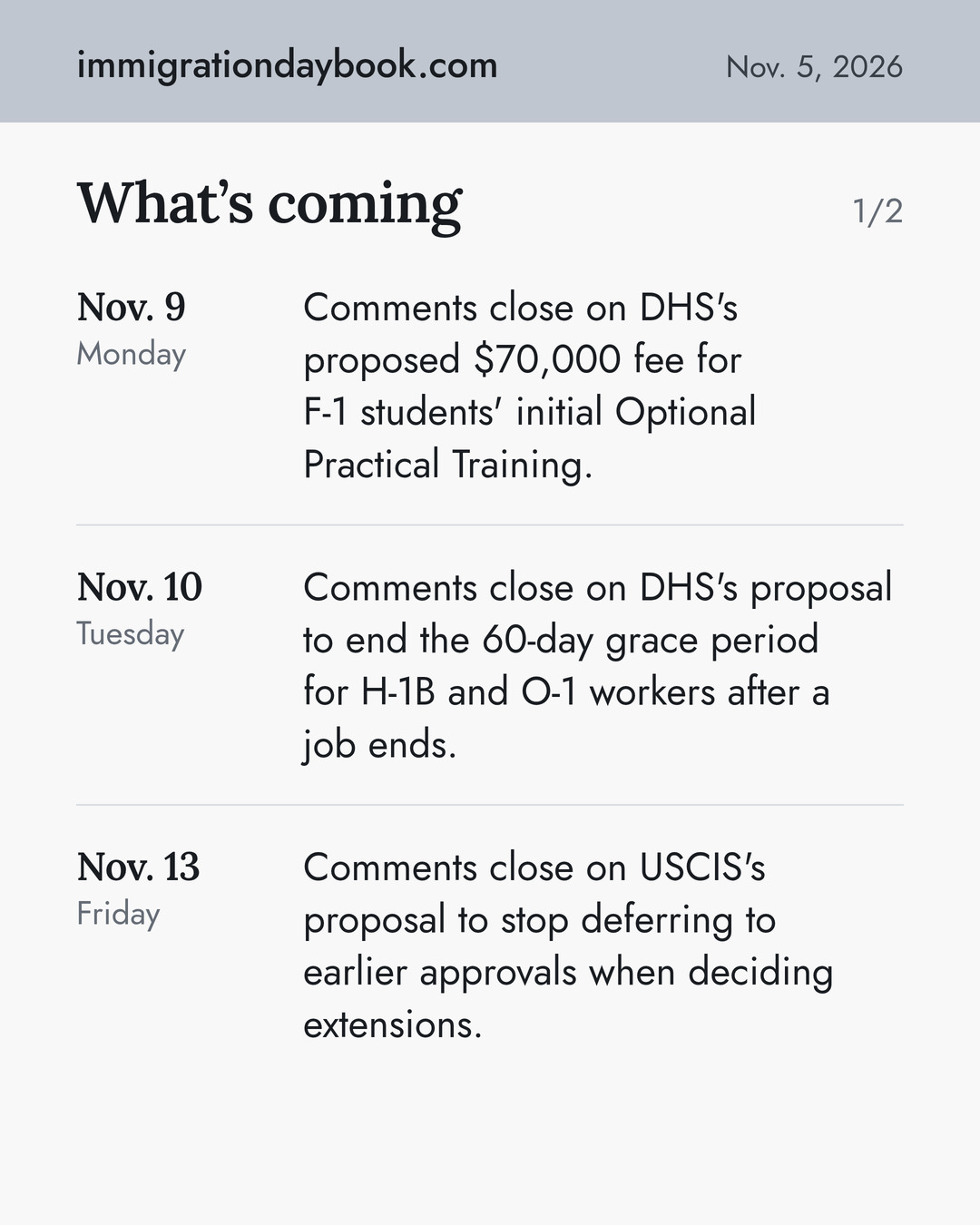
- Nov. 9, 2026
DHS proposes charging F-1 students $70,000 for an initial period of Optional Practical Training and $30,000 for a later period. The fees are not in effect: comments on the proposed rule close November 9, while comments specifically on its required paperwork and information-collection estimates close December 7.
- Nov. 10, 2026
DHS proposes ending the regulation that lets certain H-1B, O-1 and other covered workers—and their families—remain in the United States for up to 60 days after a job ends. The grace period remains in effect for now; comments on the proposal close November 10.
- Nov. 13, 2026
USCIS proposes ending the regulation that generally tells officers to give weight to an earlier approval when deciding an extension involving the same facts. The proposal is not in effect; comments close November 13.
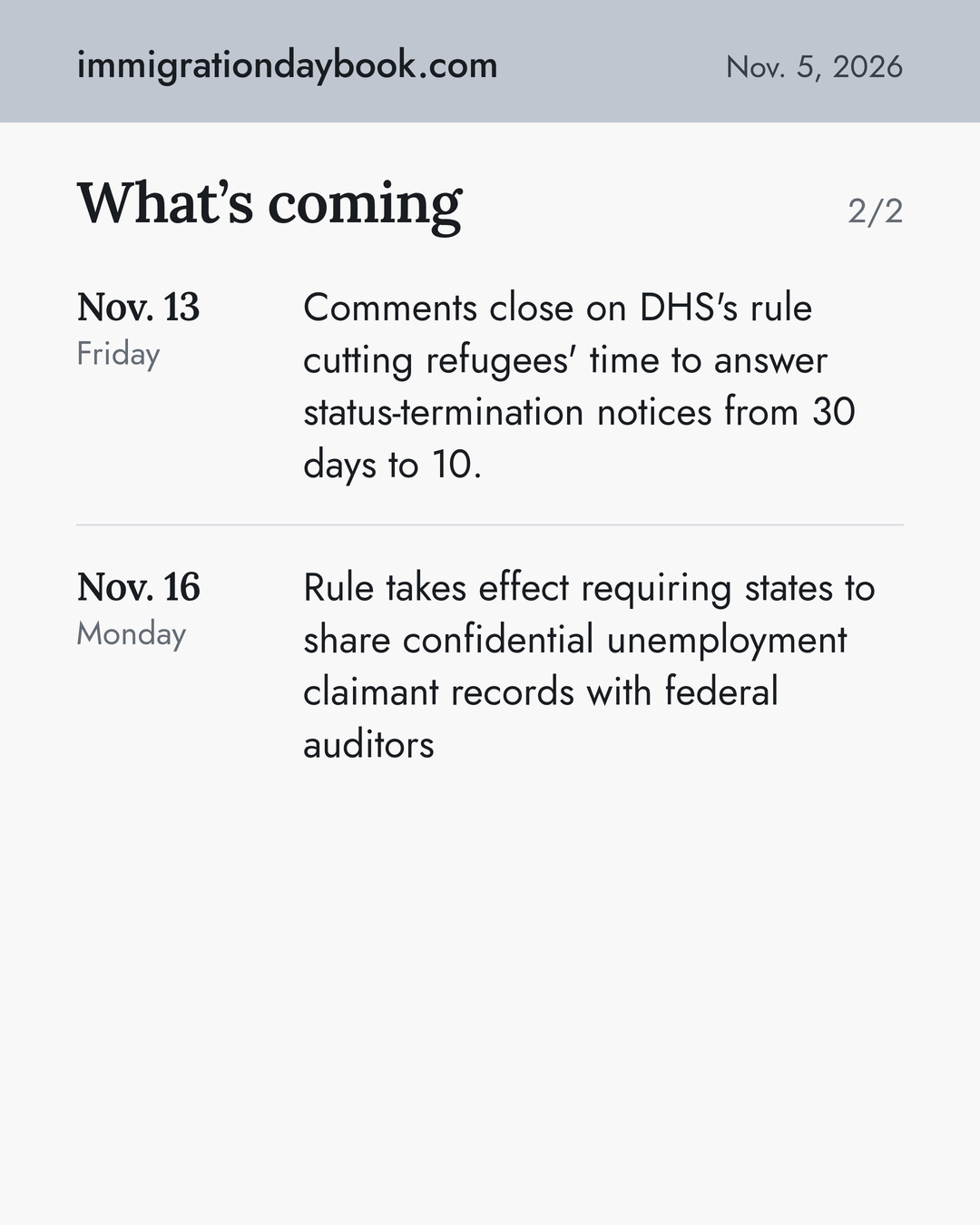
Comments close November 13 on DHS's rule cutting from 30 days to 10 the time refugees have to answer notices proposing to terminate their status. A court has blocked the shorter deadline through November 6 for refugees sent notices October 14–27 giving them fewer than 30 days.
- Nov. 16, 2026
State unemployment agencies will have to hand over confidential unemployment compensation (UC) records — information about individual claims and claimants — to federal officials who audit the programs, including the Labor Department's internal watchdog (DOL Office of Inspector General). The stated purpose is oversight and fraud detection.
Send this edition to someone who should have it.
The link carries “?via” and nothing else — no identifiers, no cross-site tracking.
Around the system
New York’s limits on ICE cooperation stay in place for now. A judge rejected sheriffs’ request for an immediate block on the statewide ban on officers working with federal immigration agents to make civil arrests. [Bloomberg Law]
Iranian researchers face immigration and employment limbo. Nature documents frozen immigration status, disrupted work and family pressures among early-career Iranian scientists in the United States amid the U.S.–Iran conflict. [Nature]
A new study tracks private ICE detention’s expansion. The University of Minnesota Law School’s Binger Center for New Americans released an updated study Nov. 4 on private detention facilities and the companies behind them. [University of Minnesota Law School]
A guide explains how to avoid deportation orders issued after missed hearings. The National Immigration Project lays out the barriers to attending immigration court and tips for avoiding an in-absentia order. [National Immigration Project]
A valid visa does not guarantee admission at a U.S. airport. An American Immigration Lawyers Association analysis explains how CBP decides admission at the port of entry and when it can cancel a visa or refuse entry; secondary inspection is not an arrest, but statements made there can enter a traveler’s immigration record. [American Immigration Lawyers Association]
A court dismissed the federal challenge to Rochester’s sanctuary policies. It found the policies did not unlawfully regulate or discriminate against the federal government and were not preempted by federal law. [Law360]
Jury selection began in the GEO Group forced-labor trial. A class of immigrants held at the Denver Contract Detention Facility from 2004 to 2014 says GEO made them work for $1 a day or face solitary confinement; GEO says it followed ICE and congressional rules for a voluntary work program. [Courthouse News Service]
Border device searches are near a record high. CBP searched 32% more phones and computers in the first three quarters of fiscal 2026 than a year earlier, the Freedom of the Press Foundation reports, citing CBC News data, and offers digital-security guidance for travelers. [Freedom of the Press Foundation]