This edition in 7 slides Flip through ↓

A federal judge in Boston wiped out the fixed-term rule for foreign students. The Labor Department proposed a PERM overhaul, the Justice Department finalized a 10-day appeal clock at the immigration appeals board, and the board itself dropped a 70-year-old safeguard.
Federal judge vacates fixed-term rule for foreign students, exchange visitors and journalists
U.S. District Judge F. Dennis Saylor IV in Boston vacated the DHS rule on Nov. 16, so it is gone, not paused. The July rule would have replaced “duration of status” with fixed stays of up to four years for F-1 students and J-1 exchange visitors and 240 days for I-visa journalists, with longer stays left to USCIS discretion. It never took effect: Saylor had postponed it on Sept. 14, a day before its start date. [U.S. District Court for the District of Massachusetts, Federal Register, Fragomen]
Saylor found DHS skipped the reasoning the Administrative Procedure Act requires. It didn’t weigh costs against benefits or answer major comments, and its limits on study conflicted with the student-visa statute. Students and exchange visitors keep their status for the length of their programs, with no Form I-539 extension due at a four-year mark. DHS has already appealed the September order and can appeal this one in the case brought by NAFSA, the Presidents’ Alliance and unions. [Bloomberg Law, Politico, USCIS, U.S. District Court for the District of Massachusetts, The Boston Globe]
Get the Daybook in your inbox.
Free. Every weekday. English and Spanish.
We never sell or share your email. Unsubscribe any time.
Labor Department proposes sweeping overhaul of PERM green card labor certifications
The Labor Department proposed rebuilding PERM, the job-market test most employers must pass before sponsoring a worker for an EB-2 or EB-3 green card. It is only a proposal, so nothing changes yet. The rule text would end Schedule A, the shortcut that lets employers skip recruitment for nurses and physical therapists — about 23,835 petitions a year, and a change that worries the American Hospital Association. [Federal Register, Cornell Legal Information Institute, Newsweek, American Hospital Association]
Employers would have to recruit online for at least 90 days and could not file for two years after related layoffs, up from six months. The layoff bar would cover workers let go through staffing firms, and each certification would back one I-140 petition filed within 180 days. Comments are due 60 days after the Nov. 17 publication, around Jan. 16; the department posts current processing times. [Department of Labor, Fragomen]
Justice Department finalizes 10-day appeal deadline and rapid dismissals at the BIA
A final rule cuts the time to appeal most immigration judge decisions to the Board of Immigration Appeals from 30 days to 10. One Board member will dismiss an appeal without an opinion within 15 days unless a majority votes to take it, and any issue left out of the notice of appeal is waived. [Federal Register, Erickson Immigration Group]
The rule revives parts of a February interim rule that a judge struck down in March in *Amica Center v. EOIR* because the department skipped public comment. The Justice Department says taking comment this time fixes that, and argues there is no constitutional right to an administrative appeal. Practitioners say the short clock will hit detained and unrepresented people hardest. It takes effect around Dec. 17 for decisions issued from then on; review in the federal appeals courts is unchanged. [Federal Register, CourtListener, Bloomberg Law, Law360, Newsweek]
BIA drops a 70-year-old safeguard on admitting to crimes
In *Matter of Mendez Maldonado*, the Board ruled that admitting under oath to the acts behind a drug offense can block a green card — with no conviction, and without first being told the crime’s legal elements. Since Matter of K- in 1957, officials had to explain those elements so that an admission was knowing and informed; the Board said the statute doesn’t require it. The decision binds immigration judges and USCIS officers, applies to crimes involving moral turpitude too, and lands the same week the Board’s own appeal clock shrinks. [Department of Justice]
Immigration lawyer Cyrus Mehta argues the ruling turns a few uninformed words into a permanent bar. Whether conduct counts as a drug crime turns on definitions laypeople can’t know, he writes, and the words may come from someone nervous, without a lawyer or speaking through an interpreter. He warns it reaches green card holders questioned at the border after a trip abroad, and that paired with the Supreme Court’s Blanche v. Lau it lets the government treat them as new arrivals on suspicion. He wants a federal appeals court to overturn it. [The Insightful Immigration Blog]
Suits challenge warrantless ICE arrests in Virginia and the Southeast
Civil rights groups filed a proposed class action in Alexandria on Nov. 16 alleging ICE arrests Virginians without warrants and without the case-by-case judgment the law requires. Federal law allows a warrantless civil arrest only when an officer has reason to believe a person is here unlawfully and is likely to flee before a warrant can be obtained. Plaintiffs include an 18-year-old U.S. citizen held for hours in Norfolk, and the Legal Aid Justice Center says such arrests rose from about six a week in 2024 to 109. These are allegations; the court hasn’t ruled. [Legal Aid Justice Center, The Washington Post]
The ACLU of South Carolina sued over re-detentions in the Carolinas and Georgia, and DHS asked the Tenth Circuit to lift a Colorado order limiting warrantless arrests, KhanList reports. [ACLU of South Carolina, KhanList]
Judge blocks DHS from searching immigration lawyer's phone seized at the border
U.S. District Judge Allison Burroughs in Boston barred DHS from searching data copied from lawyer Andrew Lattarulo’s phone while his lawsuit goes on. The order is temporary and doesn’t require the data to be destroyed. Agents seized the phone at Logan Airport during an I-9 inquiry into his firm, and the judge found the search was likely retaliation for his videos criticizing ICE: phone searches are rare in I-9 cases, and his law partner, who doesn’t speak publicly, wasn’t searched. She didn’t decide the border-search question. [U.S. District Court for the District of Massachusetts, Reason, inkl, Law.com]
ICE inspectors rate Newark's Delaney Hall acceptable despite 22 deficiencies
ICE’s own inspectors rated GEO Group’s Delaney Hall “Acceptable/Adequate” in a September report that lists 22 deficiencies, six in the categories ICE treats as most serious. In sampled files, some people got no medical or suicide-risk screening within 12 hours, no full health exam within 14 days, or medication not as prescribed, and four of six staff-misconduct grievances never reached the DHS inspector general or ICE internal affairs. Staff recorded none of the three force incidents inspectors reviewed. [ICE]
A 2025 inspection found 12 deficiencies and gave the same rating, but ICE changed its standards in between, so the counts aren’t directly comparable. The report pairs a passing grade with documented lapses in medical care, force reporting and grievances. [NJ.com]
Upcoming
The next four weeks.
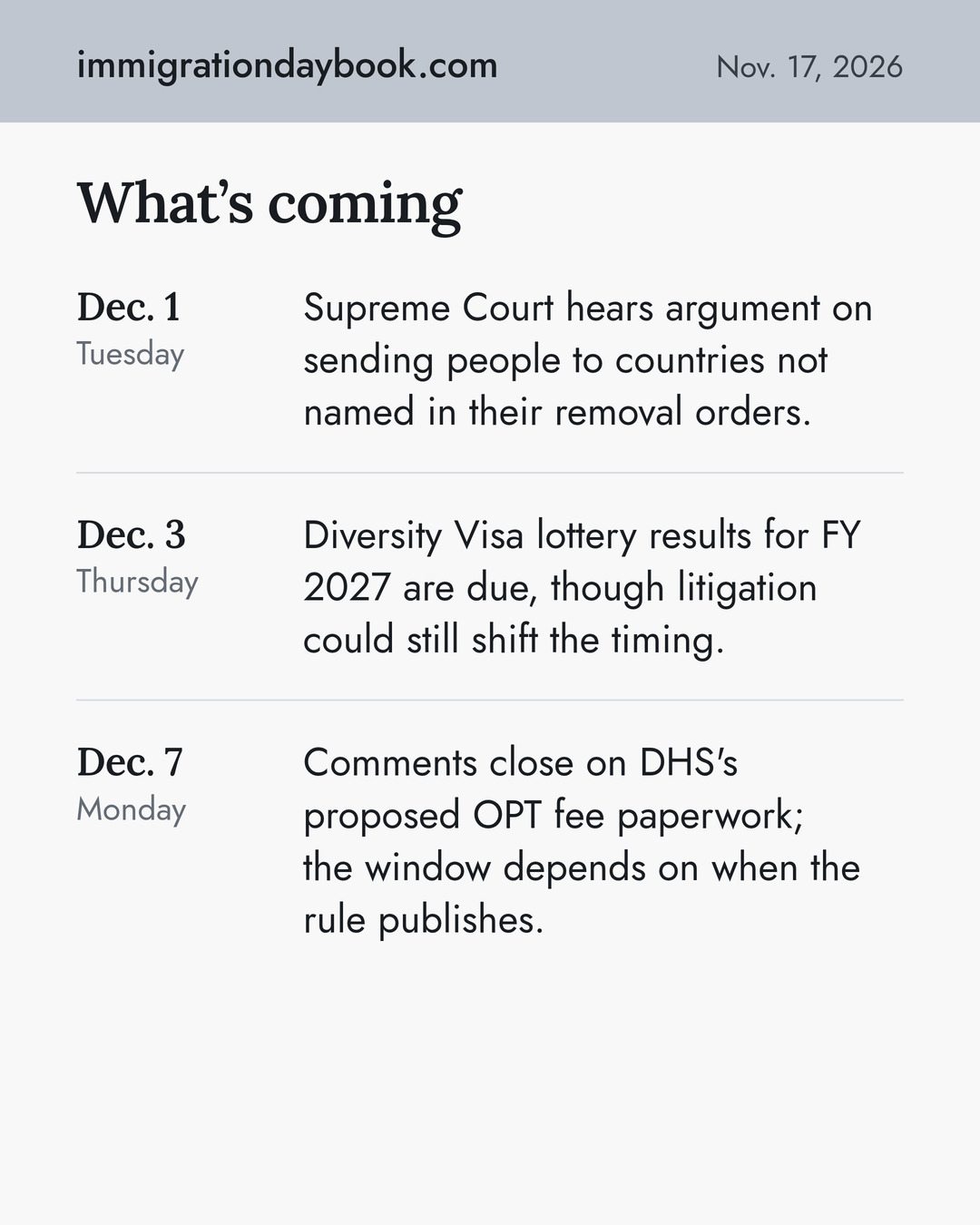
- Dec. 1, 2026
The Supreme Court hears argument in December on deporting people to a country that is not their own and not named in their deportation order (third-country removals), which an unsigned order on September 29 allowed to resume while the case continues. At issue is how much notice people get and how they can raise a fear of harm in that specific country; a ruling is expected in 2027.
- Dec. 3, 2026
People who entered the FY 2027 green card lottery (Diversity Visa program) are due to find out if they were selected: a court order requires the State Department to notify selectees by December 3, 2026. Whether the results come out on time may still shift with the litigation.
- Dec. 7, 2026
DHS's proposed rule charging a fee for the work permission international students get after graduating (OPT) carries a separate 60-day comment window on its paperwork and information-collection side. If the rule publishes October 8, 2026, that window would close around December 7; the published notice sets the actual date.
Send this edition to someone who should have it.
The link carries “?via” and nothing else — no identifiers, no cross-site tracking.
Around the system
Fresno’s council voted 6–1 to bar ICE from staging on city property, without physically blocking federal officers (California58). The same week DHS rejected Alameda County’s demand to stay off property near Santa Rita Jail, and Albany County, N.Y., proposed extending its own limits. [City of Fresno, California58, Pleasanton Weekly, Hoodline]
Dozens of people held at the CoreCivic-run Diamondback facility in Watonga, Okla., reported coughing and fainting after two chemical exposures in one week. At least one was hospitalized. [The Journal Record]
DHS released a draft environmental assessment for a 1,500-bed ICE center in a Surprise, Ariz., warehouse tied to a federal contract. It finds no significant impact; comments are open through Dec. 9. [Department of Homeland Security, USAspending.gov, AZPM]
A 570-bed family detention center opens this week in Alexandria, La., the country’s second after Texas. [Univision]
Fast-tracked immigration dockets are giving families as little as four days’ notice for asylum hearings, while children’s cases in Milwaukee are decided in moments. [The Guardian, Milwaukee Journal Sentinel]
New York City immigration judges denied 92% of asylum claims in fiscal 2026, against 31% from 2001 to 2024. [Documented]
A Maryland judge issued orders on Nov. 10 and Nov. 13 pressing USCIS to obey a temporary order protecting children’s asylum interviews (Factum Immigration). [National Center for Youth Law, Factum Immigration]
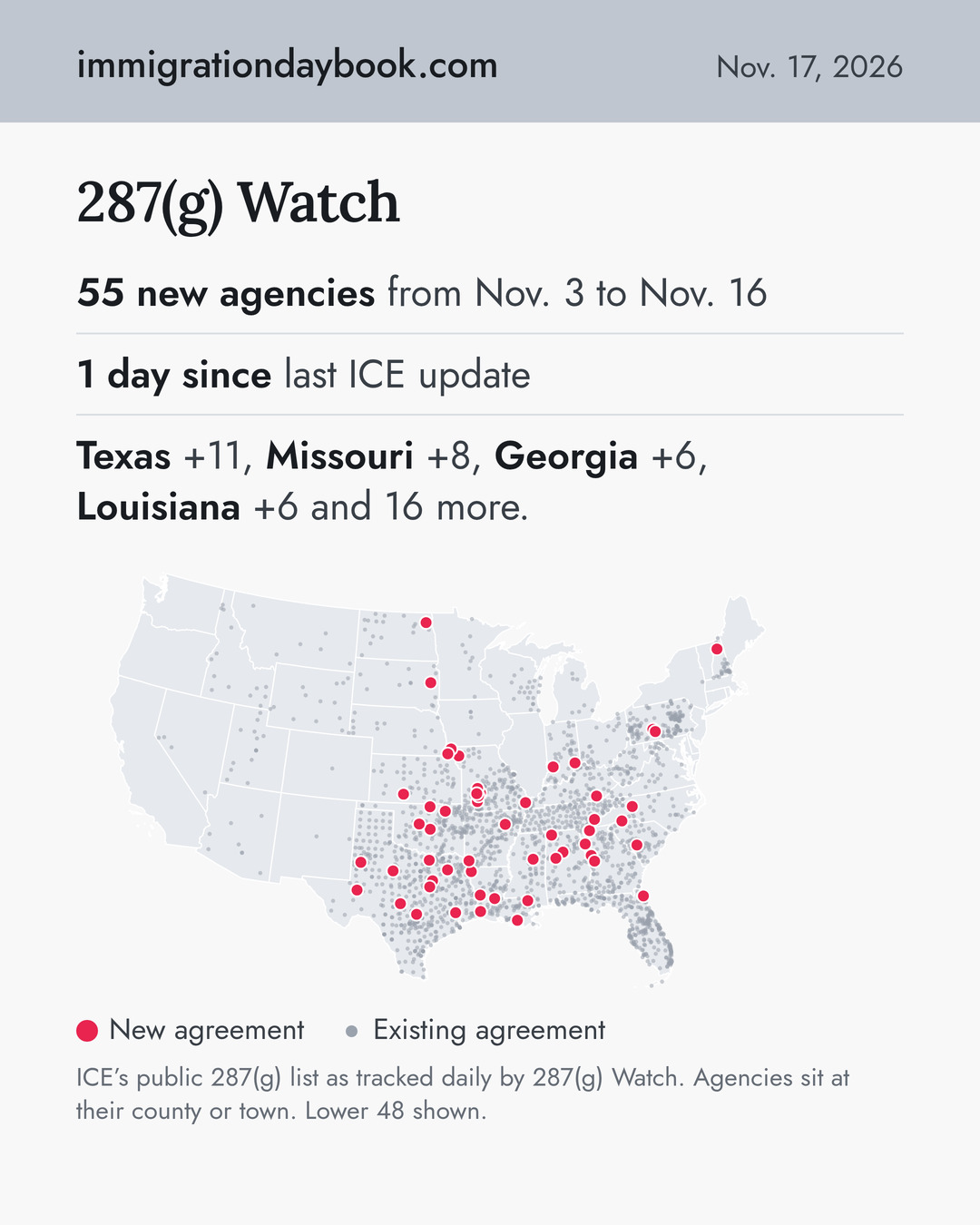
Brazoria County, Texas, approved 5–0 a 287(g) Task Force agreement that goes past its 2025 warrant-service deal, letting trained deputies question people about status and make some warrantless arrests. [Brazoria County, ICE, Detention Pipeline]
Contra Costa County supervisors vote Tuesday on a policy limiting cooperation with ICE that goes beyond the state attorney general’s model policies, due by Jan. 1 (Contra Costa News). [Contra Costa County, California Department of Justice, Contra Costa News]
A Ninth Circuit pause in the Venezuelan TPS case runs out Friday, Nov. 20. It is a short hold, not a ruling, entered after the Supreme Court sent the case back, and it leaves protections and work permits in question (Clarín, Latin Times). [U.S. Court of Appeals for the Ninth Circuit, Supreme Court of the United States, Clarín, Latin Times]