This edition in 8 slides Flip through ↓

The Supreme Court will review Trump's border asylum ban, monitors say children are held for weeks in short-term border rooms, and the government agrees to stop pressuring platforms over an ICE-monitoring group and app.
Supreme Court takes up Trump's border asylum restrictions
The Supreme Court agreed Nov. 13 to decide whether the Trump administration can bar migrants who cross the southern border between ports of entry from seeking asylum. Proclamation 10888, issued Jan. 20, 2025, declared an invasion at the border, suspended entry and cut off access to asylum, including for people at official crossings who lack specified medical or criminal-history information. A federal judge and the D.C. Circuit found the policy unlawful where it bypasses removal procedures Congress set, but that ruling is on hold, so the restrictions remain in force. In *Mullin v. RAICES*, the justices will decide whether the policy is lawful and whether federal law bars the classwide relief the district court granted, with a ruling expected by the end of June. [JURIST, SCOTUSblog, U.S. Supreme Court, AFP]
Get the Daybook in your inbox.
Free. Every weekday. English and Spanish.
We never sell or share your email. Unsubscribe any time.
Children held for weeks in 72-hour border rooms, monitors say
Immigrant children are spending up to a month in cold, sunless CBP holding rooms meant for stays of no more than 72 hours, according to lawyers who monitor the Flores settlement. The groups filed a Nov. 13 motion asking a judge to confirm detained children's right to call a lawyer; parents held in Del Rio and Laredo, Texas, and San Diego described lights left on day and night, cement floors and calls to lawyers that lasted under five minutes or never happened. CBP's own annual report to the court found family processing ran past recommended limits from March through June. Zooming out, ICE arrested more than twice as many children in the first half of 2026 as a year earlier, The Marshall Project found, and Noticias Telemundo reports that 8,755 children were held in ICE detention from January 2025 through August 2026. [Associated Press, The Marshall Project, Noticias Telemundo]
U.S. agrees to stop pressuring platforms over ICE-monitoring group and app
The federal government agreed to permanently stop pressuring Apple and Meta to suppress the "ICE Sightings – Chicagoland" Facebook group and the Eyes Up app, the Foundation for Individual Rights and Expression told Reuters. A court order filed Nov. 13 converts an April preliminary injunction into a permanent one and dismisses the creators' First Amendment suit; it binds federal officials, not the platforms. In a separate incident in Huntington Park, California, federal agents arrested and later released Angie Vargas, an activist known for recording ICE operations, Noticias Telemundo reported. [Reuters, U.S. District Court for the Northern District of Illinois, Noticias Telemundo]
Appleton detention center draws protests in its first weekend
More than 70 people rallied Saturday outside the reopened Appleton Detention Facility in western Minnesota, formerly the Prairie Correctional Facility, during its first weekend holding ICE detainees. Organizers say at least 60 to 70 people are already held at the site, which has up to 1,600 beds; speakers called for transparency and access to food, clean water, families and lawyers. [West Central Tribune, MPR News]
Lawyers report unpredictable immigration adjudications
Immigration attorneys tell Law360 that unexpected denials, atypical requests for evidence and apparently shifting standards leave them unable to assure clients that once-routine applications will be approved. Separately, a World Journal attorney column notes that the Sept. 18 edition of Form I-485, with expanded questions on means-tested public benefits, remains in use as public-charge litigation proceeds; an injunction against the rule ending duration of status keeps older editions of Forms I-539 and I-765 in place. [Law360, World Journal]
Upcoming
The next four weeks.
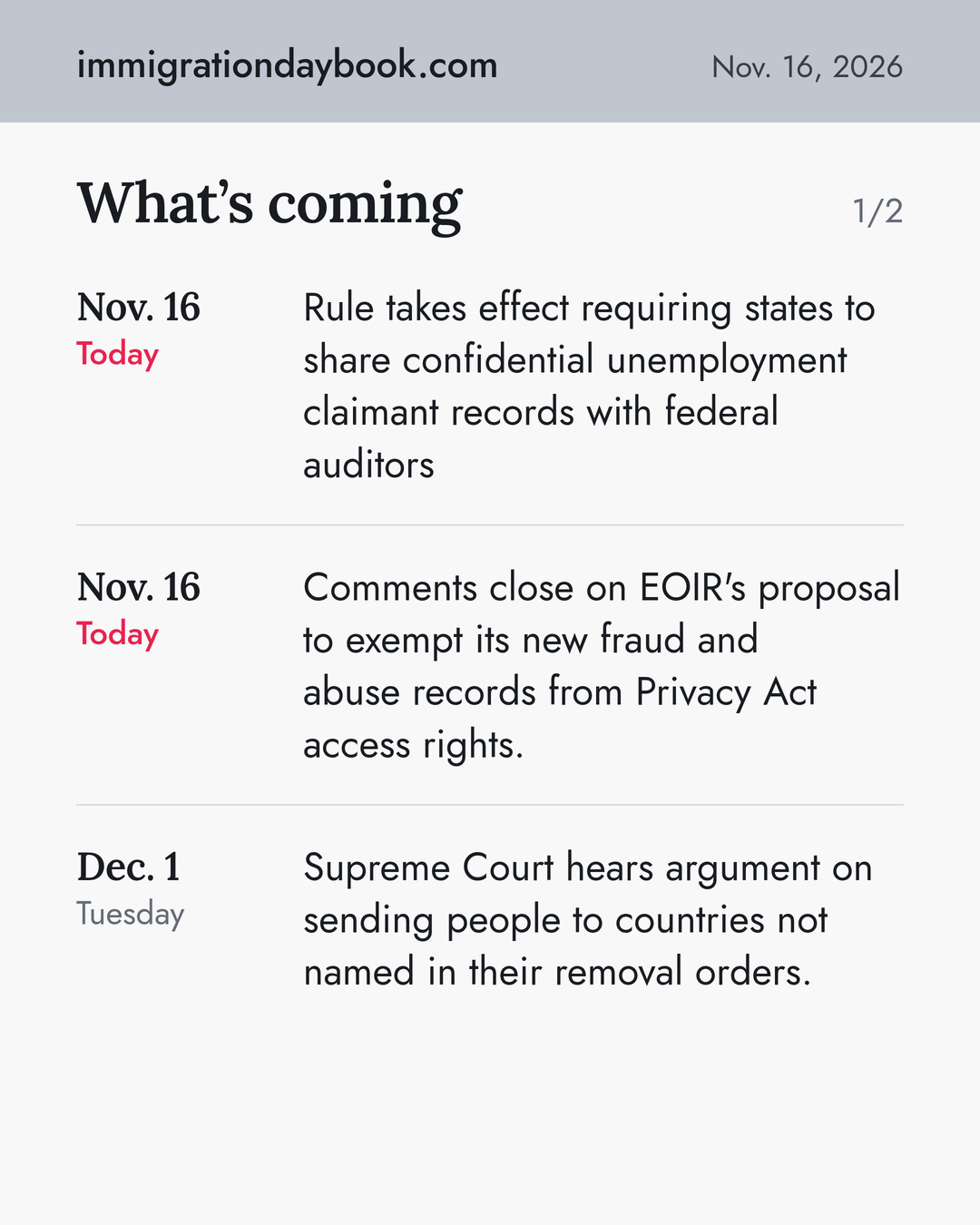
- Nov. 16, 2026
State unemployment agencies will have to hand over confidential unemployment compensation (UC) records — information about individual claims and claimants — to federal officials who audit the programs, including the Labor Department's internal watchdog (DOL Office of Inspector General). The stated purpose is oversight and fraud detection.
The agency that runs the immigration courts (EOIR) wants to exempt a new set of records on suspected fraud and abuse (JUSTICE/EOIR-006) from parts of the Privacy Act, so people would not be able to see or correct what those files say about them. Comments close November 16, 2026.
- Dec. 1, 2026
The Supreme Court hears argument in December on deporting people to a country that is not their own and not named in their deportation order (third-country removals), which an unsigned order on September 29 allowed to resume while the case continues. At issue is how much notice people get and how they can raise a fear of harm in that specific country; a ruling is expected in 2027.
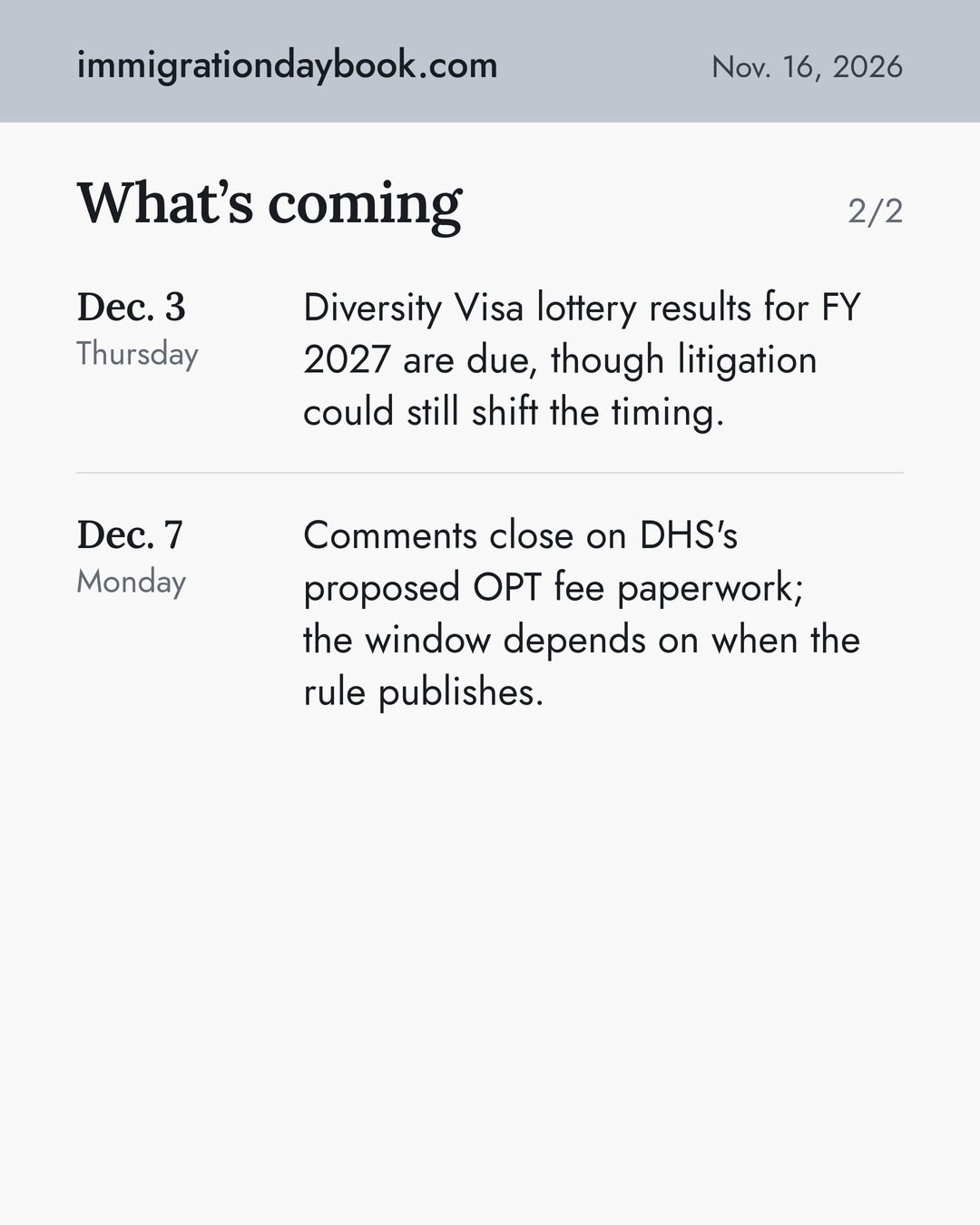
- Dec. 3, 2026
People who entered the FY 2027 green card lottery (Diversity Visa program) are due to find out if they were selected: a court order requires the State Department to notify selectees by December 3, 2026. Whether the results come out on time may still shift with the litigation.
- Dec. 7, 2026
DHS's proposed rule charging a fee for the work permission international students get after graduating (OPT) carries a separate 60-day comment window on its paperwork and information-collection side. If the rule publishes October 8, 2026, that window would close around December 7; the published notice sets the actual date.
Send this edition to someone who should have it.
The link carries “?via” and nothing else — no identifiers, no cross-site tracking.
Around the system
- A Spokane County Superior Court judge ruled Nov. 13 that the Adams County Sheriff's Office violated Washington's Keep Washington Working Act. The court barred the county from sharing nonpublic jail information and release dates with immigration agents or holding people on civil immigration warrants or detainers. [Washington State Standard]
- A Minnesota federal court refused to pause its order requiring ICE to return a Nicaraguan man flown to the Central African Republic in August. The court found ICE failed to comply with due process and offered no ground that outweighed the risk of harm to him. [Courthouse News Service]
- The Second Circuit set aside a federal penalty that withheld nearly $74 million in highway funds from New York over non-domiciled commercial driver's licenses. The court held that regulations in effect at the time did not require states to match those licenses' expiration dates to drivers' lawful-presence documents. [U.S. Court of Appeals for the Second Circuit, Associated Press]
- New Jersey allocated $20.2 million among 10 legal-service providers to represent low-income residents facing detention and deportation. Gov. Mikie Sherrill's administration said the funding aims to reach unrepresented detainees at Newark's 1,000-bed Delaney Hall. [NJ.com]
- A Davidson County chancellor extended a temporary restraining order requiring Tennessee to keep issuing temporary driver's licenses to noncitizens with valid federal work permits. The agreed order keeps the policy change on hold through Dec. 8 while litigation continues. [Última Hora Nashville]
- Michigan resident George Jarrous now needs a wheelchair after six months in ICE custody. His health worsened at a northern Michigan facility while the government, barred from removing him to Israel, seeks a third country to take him. [MLive]
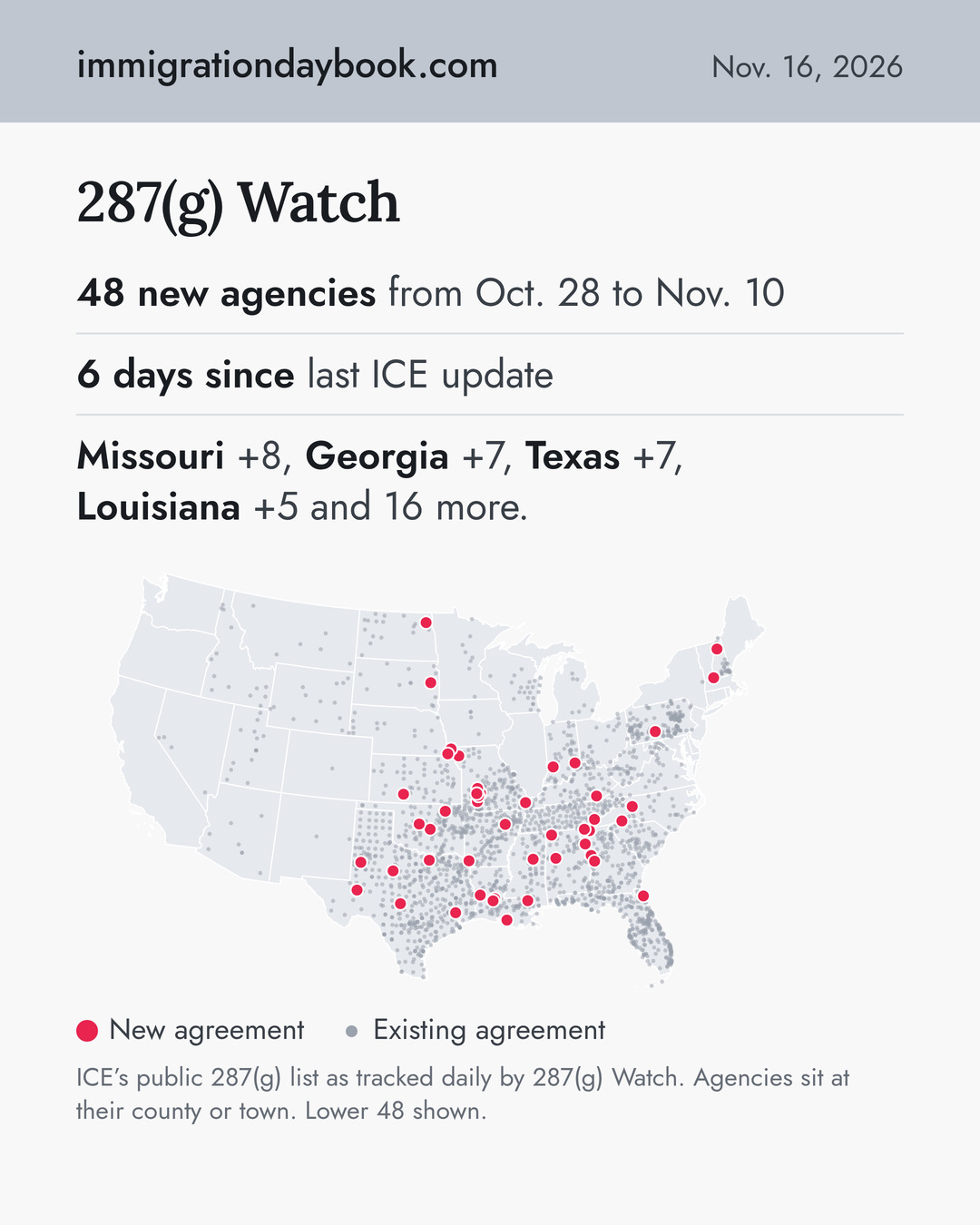
- Logan Township, Pennsylvania, supervisors approved a 287(g) task-force agreement with ICE on Nov. 12. Neighboring Duncansville signed its agreement months ago, and its officers are already in the 40-hour online training. [Altoona Mirror]
- The U.S. Conference of Catholic Bishops and Catholic Charities USA filed Nov. 12 comments opposing a DHS rule that cuts the time to answer a notice of intent to terminate refugee status from 30 days to 10. The groups say it reduces due process and harms families, adding to objections we covered Nov. 10. [Catholic Charities USA, Federal Register]