This edition in 8 slides Flip through ↓


Record fiscal-year enforcement figures meet mounting legal, municipal and diplomatic friction today—from unopposed detention lawsuits in western Washington and Mexican inquiries into 18 deaths to cities trying to stall warehouse jails and stricter federal housing verification.
ICE posts record FY 2026 removals and arrests amid post-midterm political strain
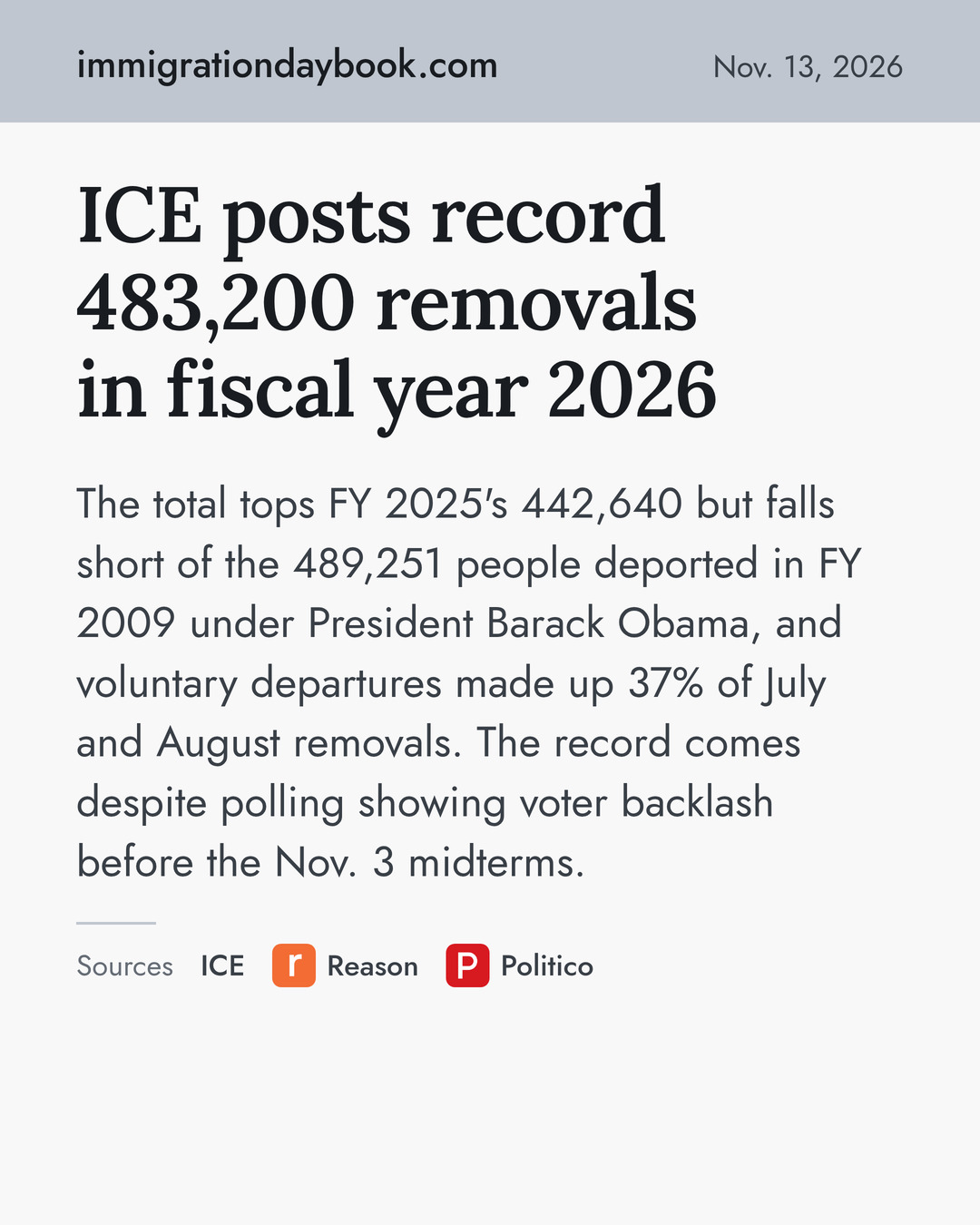
U.S. Immigration and Customs Enforcement carried out 483,200 deportations and more than 491,000 arrests in fiscal year 2026, figures the Department of Homeland Security announced Nov. 12 as the highest annual totals in the agency’s 23-year history. The removal count is 9% above FY 2025’s 442,640 and 78% above the final full year of the Biden presidency, though DHS did not say how many deportees had criminal histories. [ICE, Associated Press]
Past peaks come close. Internal ICE data obtained by Syracuse University’s Transactional Records Access Clearinghouse show this year’s deportations were the highest since FY 2009, when ICE under President Barack Obama deported 489,251 people—more than this year’s total—and that voluntary departures and returns made up 37% of deportations in July and August. Aaron Reichlin-Melnick of the American Immigration Council cautioned that cross-administration comparisons can mislead because more than 2 million Title 42 expulsions under the Biden administration are not counted as removals. The figures land a week after midterm elections in which polling showed voters soured on aggressive enforcement. [Reason, Newsweek, Politico]
Get the Daybook in your inbox.
Free. Every weekday. English and Spanish.
We never sell or share your email. Unsubscribe any time.
Mexico presses U.S. prosecutors over nationals killed or injured in ICE custody and raids
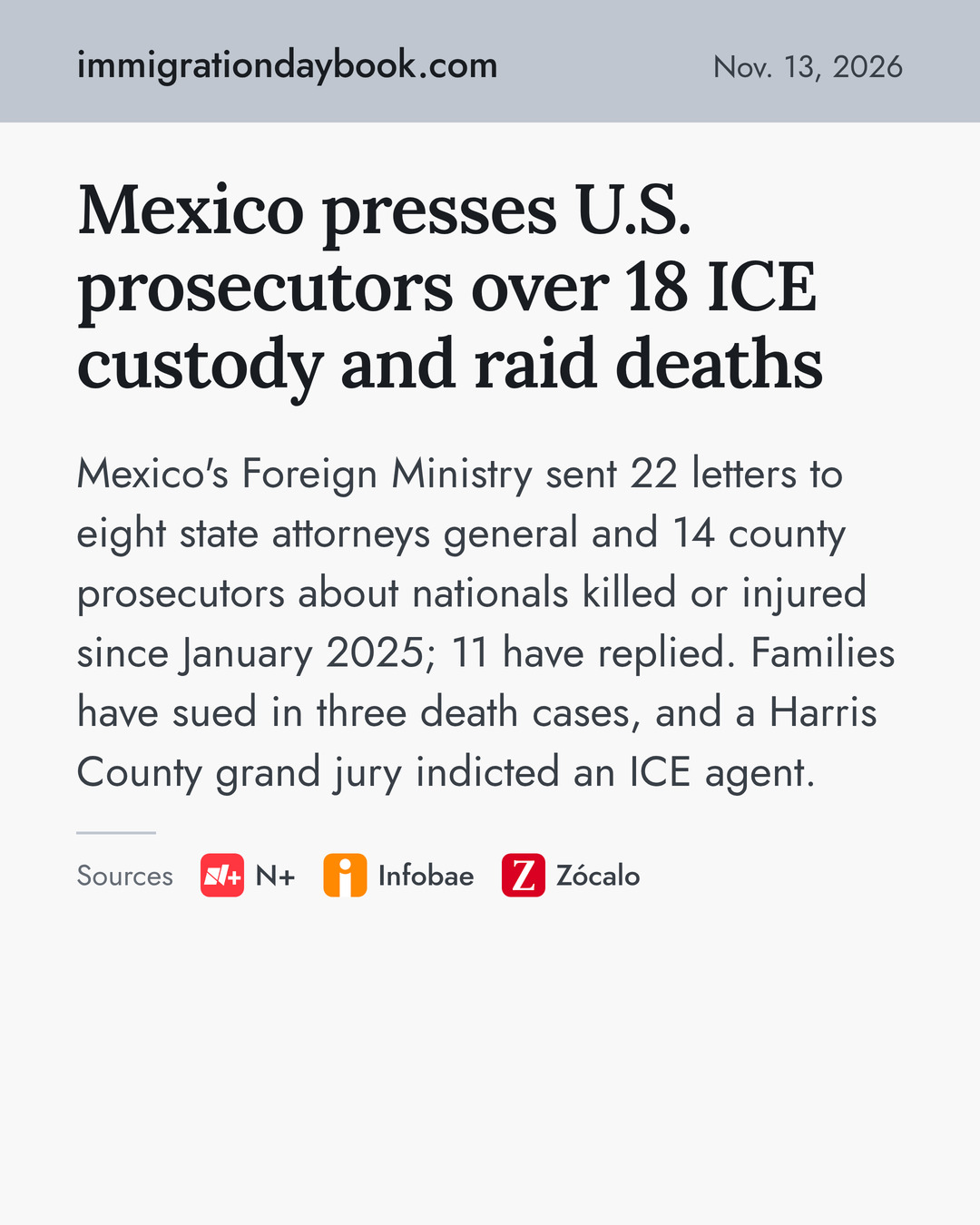
Mexico’s Foreign Ministry said Nov. 12 that it sent 22 letters to U.S. prosecutors seeking accountability for Mexican nationals killed or injured in ICE custody and enforcement operations, with 11 offices responding so far. Following up on recent detention-death coverage, the ministry said the outreach went to eight state attorneys general and 14 county prosecutors’ offices and covers 18 Mexican citizens who have died in ICE custody or raids since January 2025, alongside injury cases including a Houston incident in which a Harris County grand jury indicted an ICE agent. Embassy officials remain in contact with prosecutors in Texas’s Harris and Webb counties and California’s Ventura County, while families have filed civil suits in three of the 18 death cases and five decided against going to court. [N+, Infobae, Zócalo]
Administration advances warehouse detention conversions as cities try to run out the clock
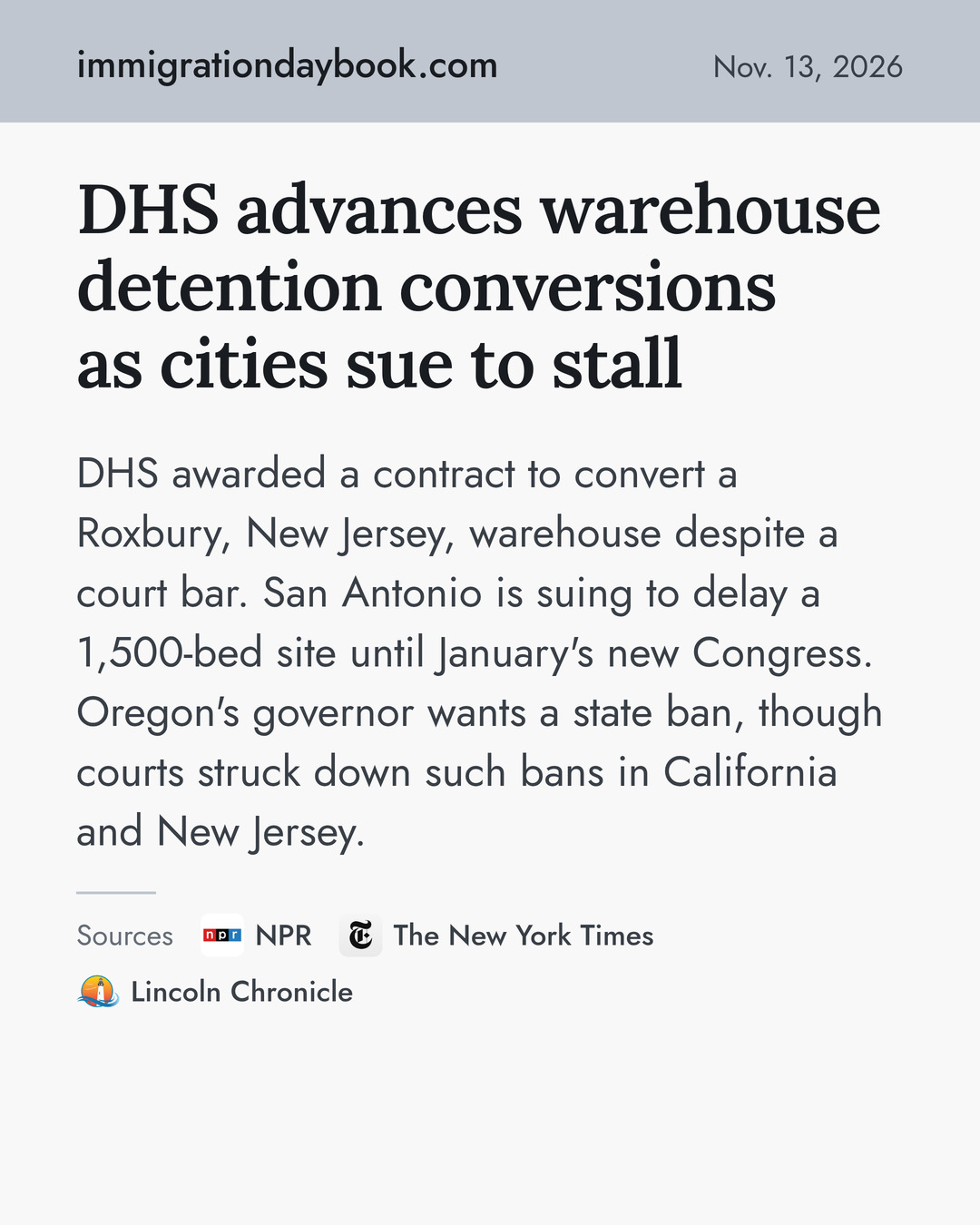
The Trump administration moved ahead over the past week with converting two commercial warehouses into immigration detention centers, awarding a conversion contract in Roxbury, New Jersey, despite a court order barring DHS from taking that step. Cities and states are pushing back where they can: San Antonio is using its lawsuit against a planned 1,500-bed warehouse facility to delay the project until a Democratic House majority takes office in January, and after a fight over a Newport site, Gov. Tina Kotek asked Oregon lawmakers to bar new immigration detention centers statewide, though federal appeals courts have struck down state bans on private federal detention contracts in California and New Jersey. [NPR, The New York Times, Lincoln Chronicle]
HUD finalizes stricter status verification rule for mixed-status households in subsidized housing
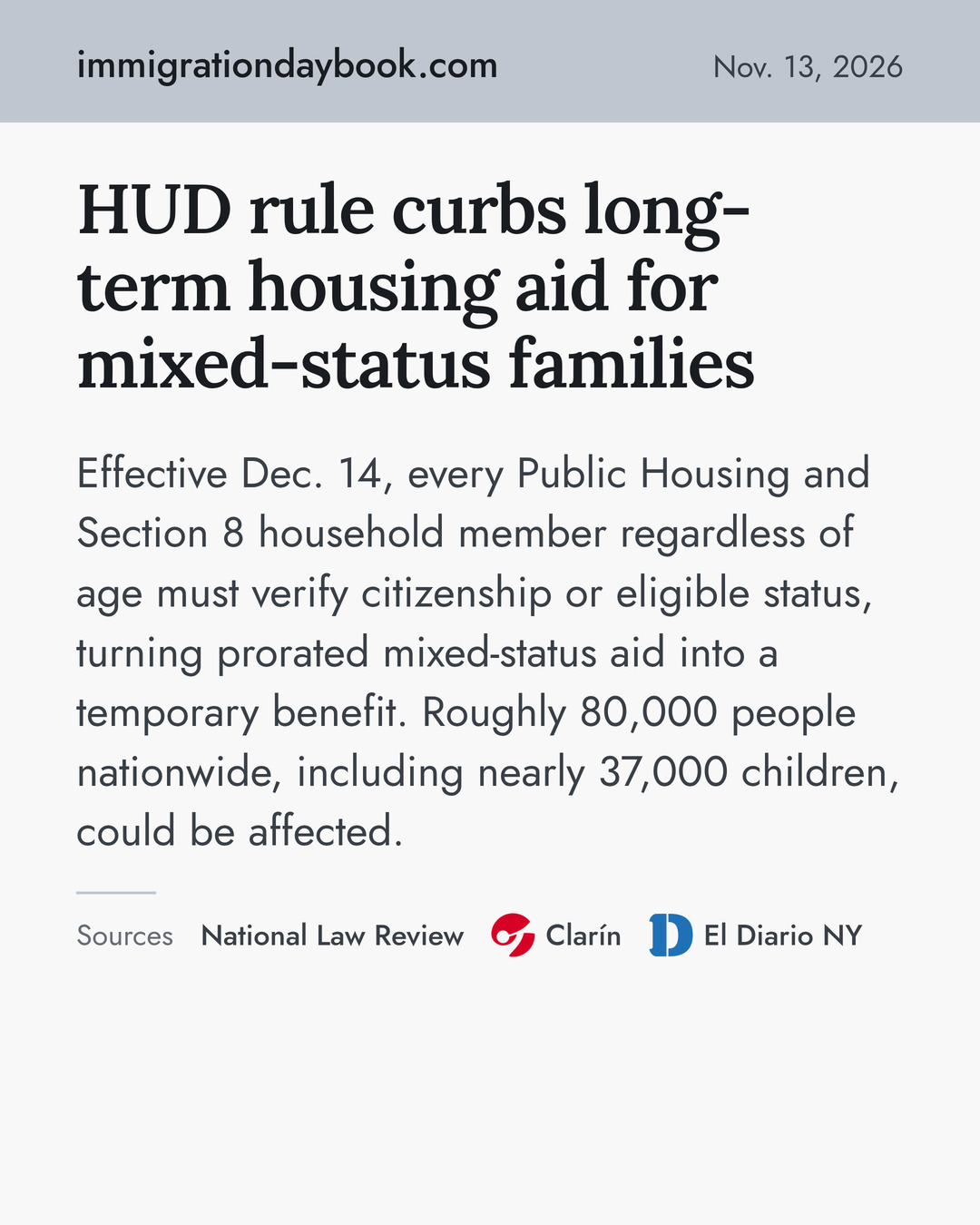
A Department of Housing and Urban Development final rule scheduled for publication Nov. 12 tightens citizenship and immigration status verification across federal housing assistance starting Dec. 14. Covering Public Housing, Section 8 and other rental programs, the rule requires every household member regardless of age to prove citizenship or eligible status through DHS’s SAVE system, ending an exemption for residents 62 and older. It also turns prorated aid for mixed-status households into a temporary benefit while status is checked—a shift that Center on Budget and Policy Priorities estimates cited in coverage say could threaten housing support for roughly 80,000 people, including nearly 37,000 children, among them more than 3,000 mixed-status families in New York City, where The Legal Aid Society says it is weighing a legal challenge. [National Law Review, Clarín, El Diario NY]
Staffing shortage leaves ICE without government defense in western Washington habeas cases
The U.S. Attorney’s Office for the Western District of Washington says it lacks the staffing to answer every immigration detention lawsuit and will leave federal judges to rule on many habeas corpus petitions without government opposition. Acting U.S. Attorney Charles Neil Floyd notified Chief Judge David S. Estudillo that dozens of weekly petitions have strained civil prosecutors, explaining that courts may resolve petitions on detainees’ filings alone when no government lawyer enters an appearance within seven business days of a scheduling order. The shortfall underscores how surging detention challenges—border czar Tom Homan recently put habeas cases weighing on courts nationwide at about 85,000—have frustrated administration officials alongside judges and advocates who say ICE has trampled individual rights. [Pioneer Press, Univision, Houston Chronicle]
Upcoming
The next four weeks.
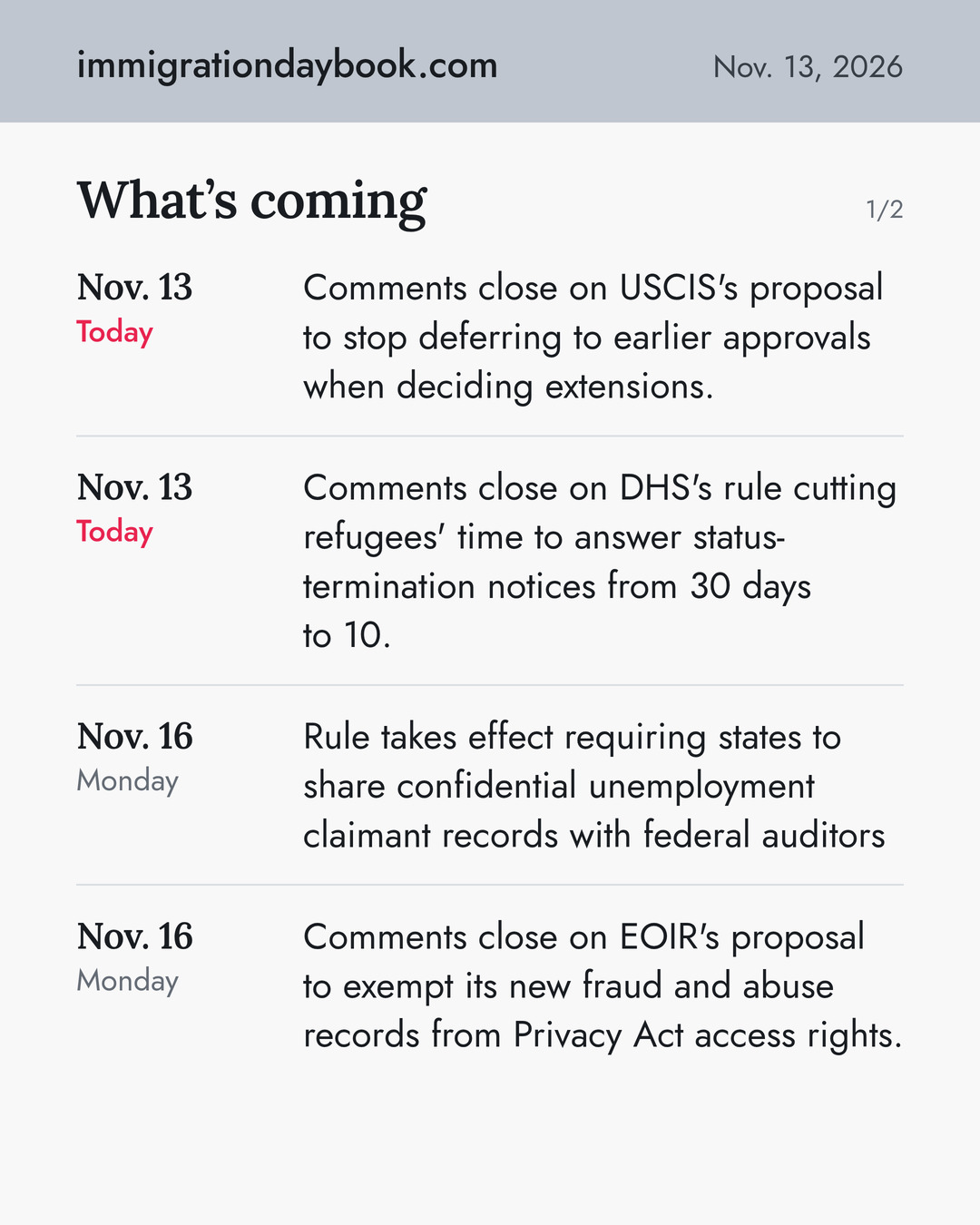
- Nov. 13, 2026
USCIS proposes ending the regulation that generally tells officers to give weight to an earlier approval when deciding an extension involving the same facts. The proposal is not in effect; comments close November 13.
Comments close November 13 on DHS's rule cutting from 30 days to 10 the time refugees have to answer notices proposing to terminate their status. A court has blocked the shorter deadline through November 6 for refugees sent notices October 14–27 giving them fewer than 30 days.
- Nov. 16, 2026
State unemployment agencies will have to hand over confidential unemployment compensation (UC) records — information about individual claims and claimants — to federal officials who audit the programs, including the Labor Department's internal watchdog (DOL Office of Inspector General). The stated purpose is oversight and fraud detection.
The agency that runs the immigration courts (EOIR) wants to exempt a new set of records on suspected fraud and abuse (JUSTICE/EOIR-006) from parts of the Privacy Act, so people would not be able to see or correct what those files say about them. Comments close November 16, 2026.
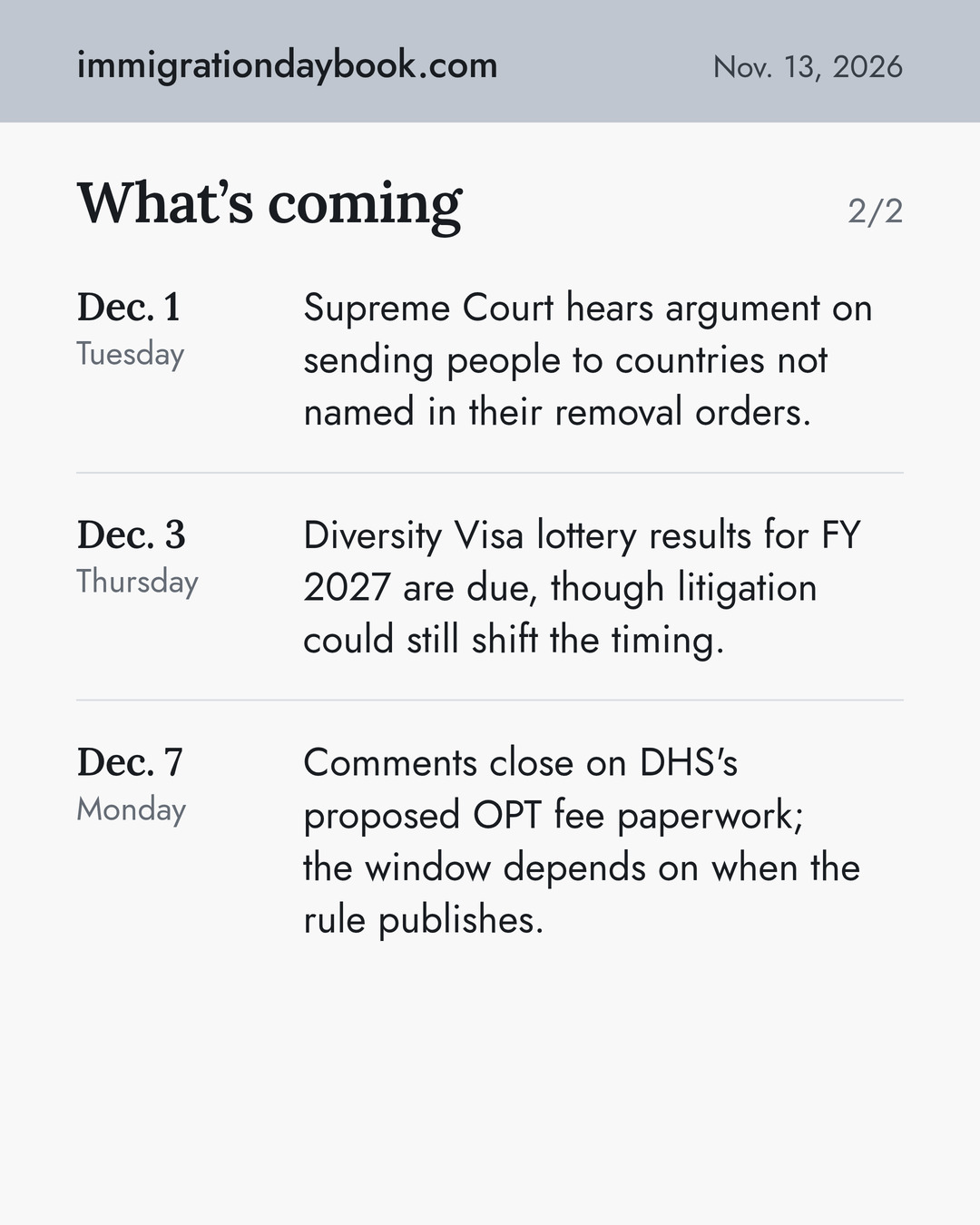
- Dec. 1, 2026
The Supreme Court hears argument in December on deporting people to a country that is not their own and not named in their deportation order (third-country removals), which an unsigned order on September 29 allowed to resume while the case continues. At issue is how much notice people get and how they can raise a fear of harm in that specific country; a ruling is expected in 2027.
- Dec. 3, 2026
People who entered the FY 2027 green card lottery (Diversity Visa program) are due to find out if they were selected: a court order requires the State Department to notify selectees by December 3, 2026. Whether the results come out on time may still shift with the litigation.
- Dec. 7, 2026
DHS's proposed rule charging a fee for the work permission international students get after graduating (OPT) carries a separate 60-day comment window on its paperwork and information-collection side. If the rule publishes October 8, 2026, that window would close around December 7; the published notice sets the actual date.
Send this edition to someone who should have it.
The link carries “?via” and nothing else — no identifiers, no cross-site tracking.
Around the system
The Justice Department dropped its Ninth Circuit appeal of a judicial block on Alien Enemies Act deportations on Nov. 12. The voluntary dismissal leaves in place a preliminary injunction barring the wartime removal of Venezuelan detainees held in California’s Central District whom the administration accused of belonging to Tren de Aragua. [Bloomberg Law]
A Nov. 4 USCIS policy memorandum links naturalization “good moral character” reviews to public-benefits conduct and sponsorship duties, immigration practitioners report. According to a legal summary of Policy Memorandum PM-602-0201, officers deciding Form N-400 applications may weigh willful non-support of dependents, benefits fraud or broken Form I-864 and I-134 promises against citizenship applicants. [International Legal and Business Services Group]
The Supreme Court heard oral arguments Nov. 9 in Nielsen v. Watanabe, a Honolulu federal inmate’s medical-care suit testing constitutional damages claims against federal officers. The justices appeared inclined to curtail prisoner medical-neglect suits without overturning the 1971 *Bivens* precedent, a doctrine legal observers watch closely as lawsuits against ICE agents mount. [The Daily Record]
ProPublica published documented profiles of U.S. citizens detained by federal immigration agents, drawing on more than 500 cases identified since January 2025. The accounts—spanning children, teenagers and workers held for hours or days—counter written DHS statements that agents do not arrest citizens and release Americans immediately once identified. [ProPublica]
Chinese detainee Chaofeng Ge twice asked to be housed with Mandarin speakers before dying by suicide at western Pennsylvania’s Moshannon Valley Processing Center in August 2025. FOIA records obtained by family attorneys show both requests went unanswered despite four Chinese detainees living in another unit and transfer files noting prior suicide attempts. [Documented]
At least 23 states considered legislation governing ICE activity around K-12 schools in 2026 after the administration rescinded federal sensitive-locations protections. Thirty-five of the 40 proposals reviewed sought to restrict immigration officers’ campus access, while Mississippi passed a law requiring school districts to cooperate with federal enforcement. [NPR]
Officials in Doral, Florida, blocked a councilwoman’s effort to revisit the city’s 287(g) police agreement with ICE at the Nov. 18 council meeting. The city attorney denied the agenda request under a 14-day fiscal-impact deadline and cited a pending state attorney general opinion in one of Florida’s first post-election tests of local cooperation. [Axios Miami]
USCIS expanded its planned Immigration Biometrics and Identity Services overhaul into a $200 million-to-$250 million competition, up from an acquisition earlier described at over $100 million. The agency targets Dec. 1 for a request for quotations consolidating biometric records, identity resolution, machine learning and scheduling through February 2032. [Biometric Update]
South Texas construction leaders met with Rep. Henry Cuellar in Washington to press lawmakers on labor shortages and homebuilding delays tied to worksite enforcement. Builders said fear of warrantless raids is keeping even workers with legal documents away from job sites. [KGNS]