This edition in 9 slides Flip through ↓

Today: a border heat-ray test, federal voter investigations, sheriff races and 287(g), children’s counsel and asylum assessments.
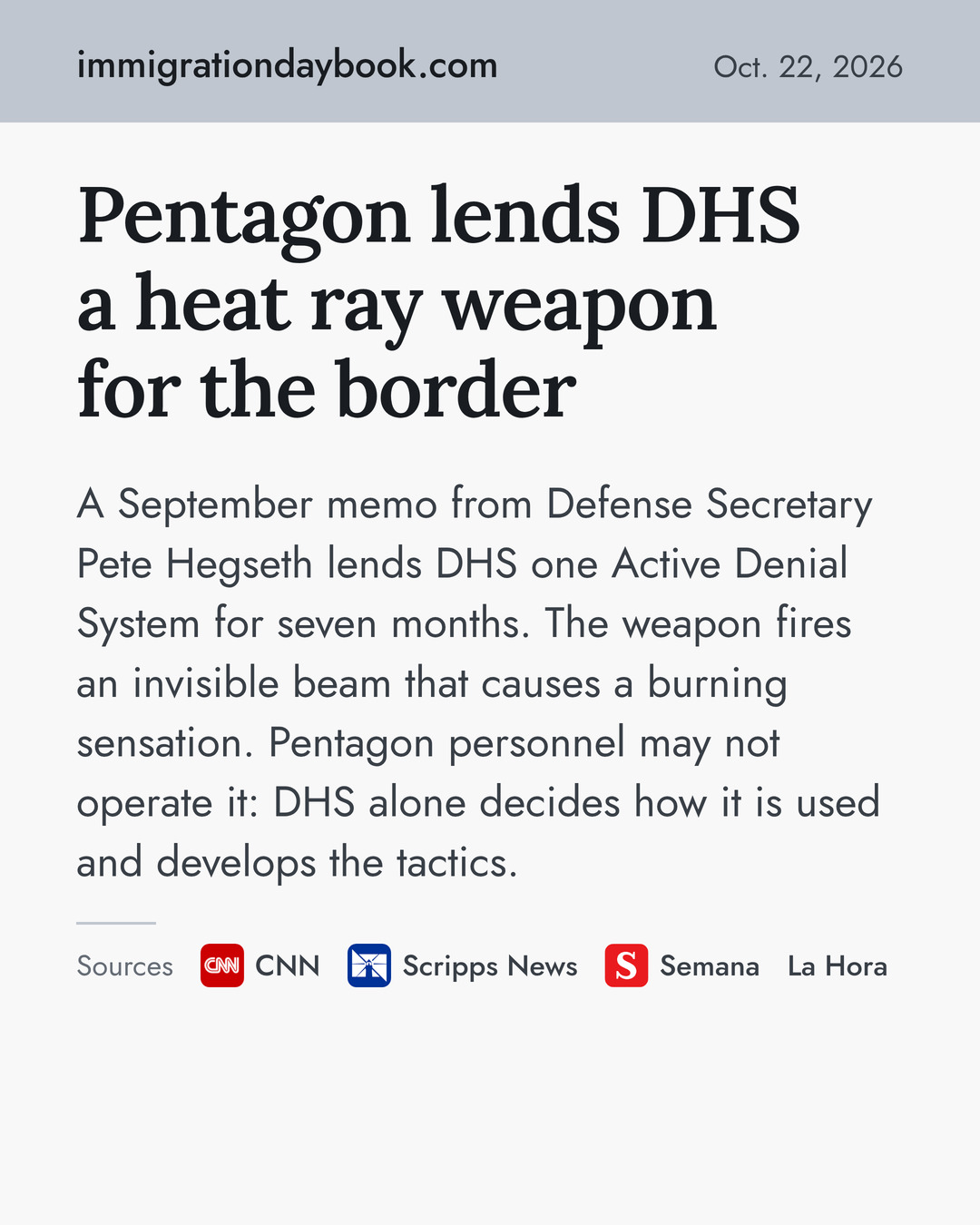
Pentagon lends DHS a heat ray for border testing
The Pentagon authorized the Department of Homeland Security to test a military heat ray and develop tactics for possible use at the southern border, under a memo Defense Secretary Pete Hegseth signed in September. The weapon, called the Active Denial System, fires an invisible beam that causes a burning sensation. The memo lends DHS one system for seven months, bars Pentagon personnel from operating it and makes DHS solely responsible for how it is used. The leaked memo first surfaced Oct. 8. [CNN, Scripps News, Semana, La Hora, Jim Acosta]
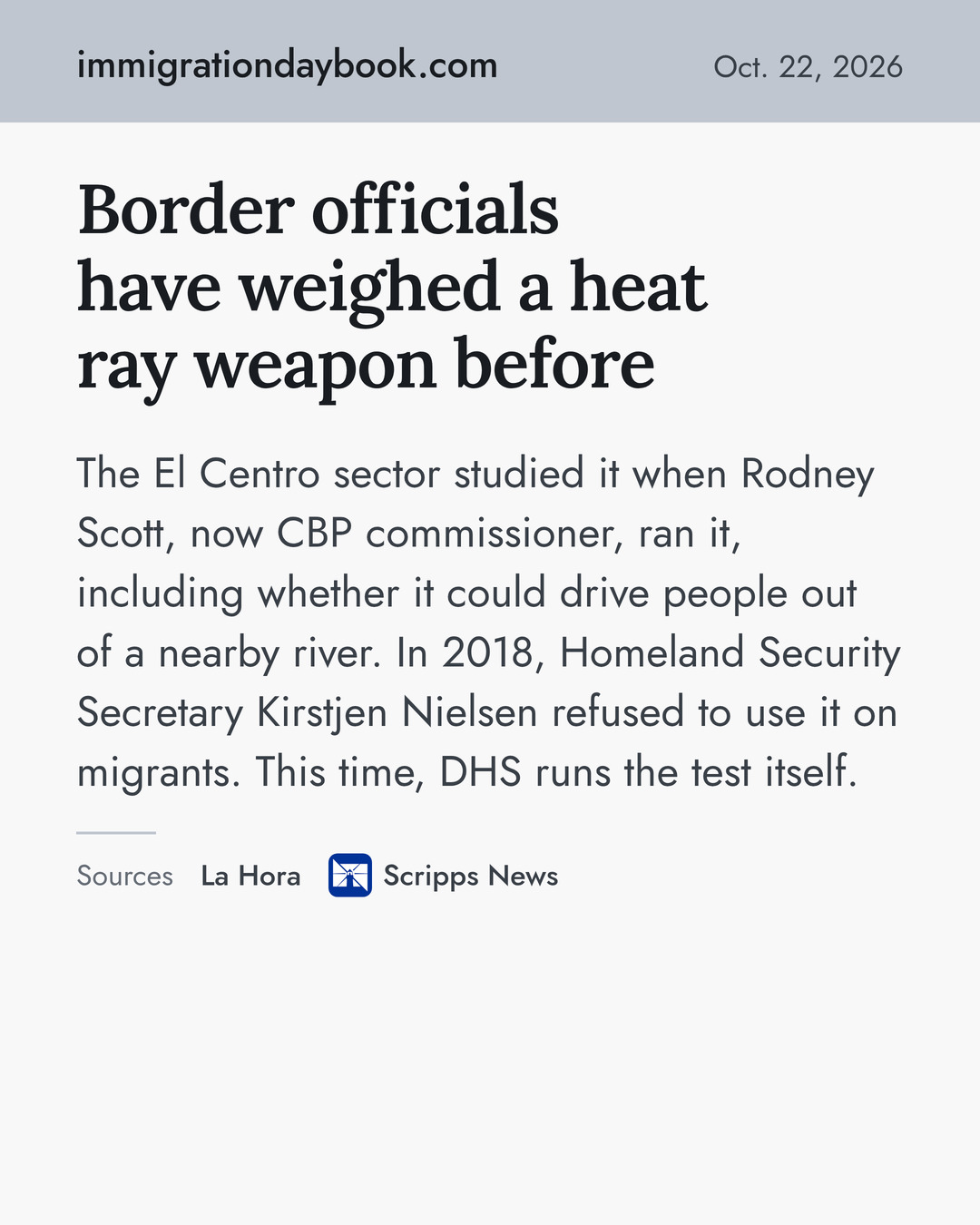
The idea has circulated at the border for years. The El Centro sector evaluated the system when Rodney Scott, now CBP commissioner, led it, weighing whether it could push people out of a nearby river; a former CBP official warned, “you don’t want them to go in and drown.” In 2018, then-Homeland Security Secretary Kirstjen Nielsen rejected using it against migrants. CBP said it “is continually evaluating new technologies.” [La Hora, Scripps News]
Zooming out, a Just Security analysis of DHS’s artificial-intelligence inventory finds the department does not label ICE’s ELITE app — which uses AI to pull likely migrant addresses from government records, including Health and Human Services data — as “high-impact,” letting it skip required testing and auditing. ICE and CBP list 25 high-impact uses, including the Mobile Fortify facial-recognition app, but disclose little about their safeguards. [Just Security]
Get the Daybook in your inbox.
Free. Every weekday. English and Spanish.
We never sell or share your email. Unsubscribe any time.
Voting cases expand beyond the courtroom
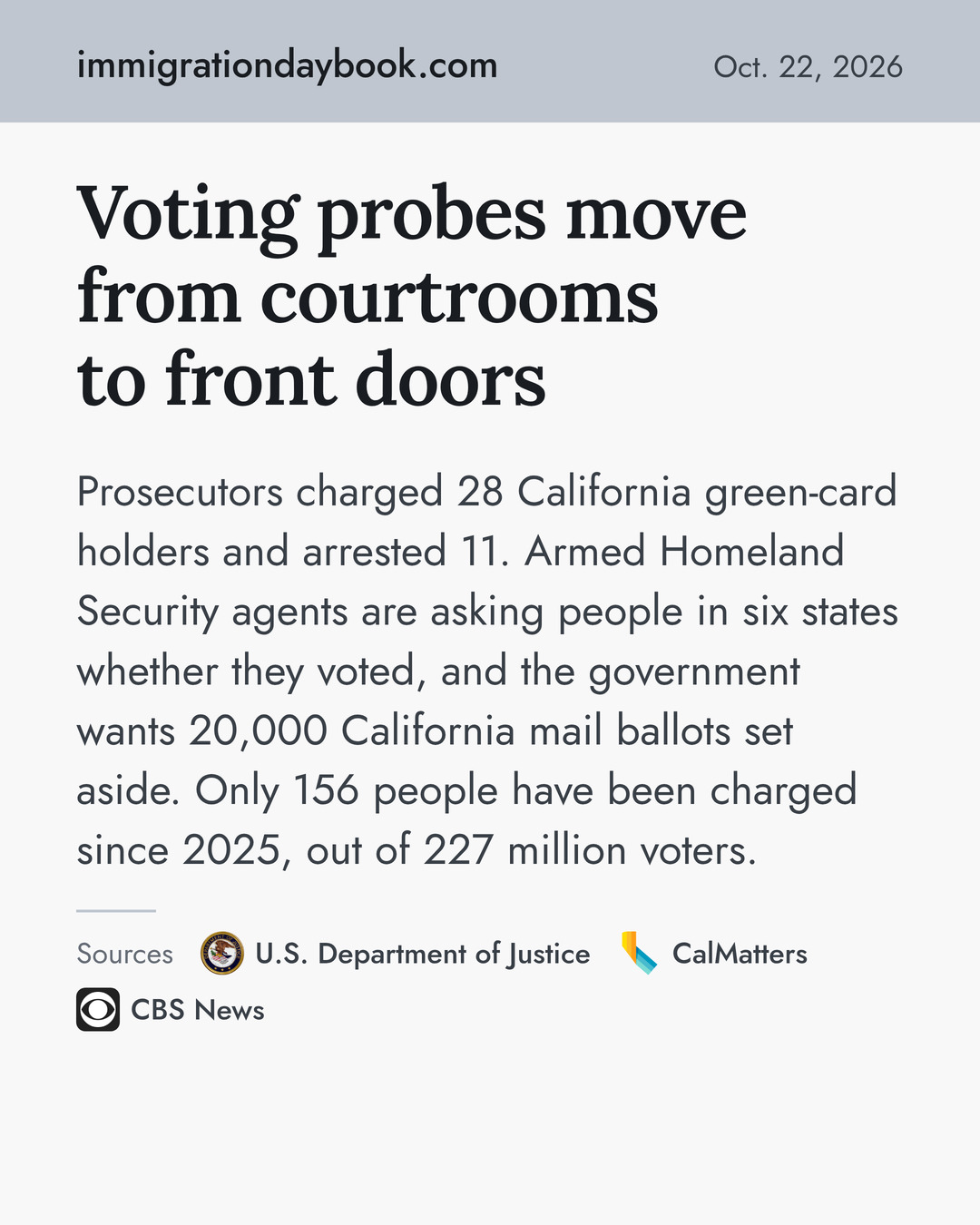
Federal prosecutors charged 28 California green-card holders with voting-related crimes and arrested 11 on Oct. 19. Prosecutors allege 22 voted in at least one election; five only registered. Elsewhere, armed Homeland Security agents have been knocking on doors in at least six states to ask residents about their immigration status and whether they voted. The Justice Department counts 156 people charged with voting-fraud offenses since the administration began, out of 227 million registered voters. [U.S. Department of Justice, CalMatters, CBS News]
In a separate civil case, the federal government asked a judge to force California to set aside up to 20,000 mail ballots it says may have gone to noncitizens. In an Oct. 20 filing, Attorney General Rob Bonta argued the suit borders on the absurd. Los Angeles County officials who reviewed a sample of 200 names said many appear to be citizens and most had not voted. [CalMatters, Court filing]
287(g) Watch shows who’s running for sheriff
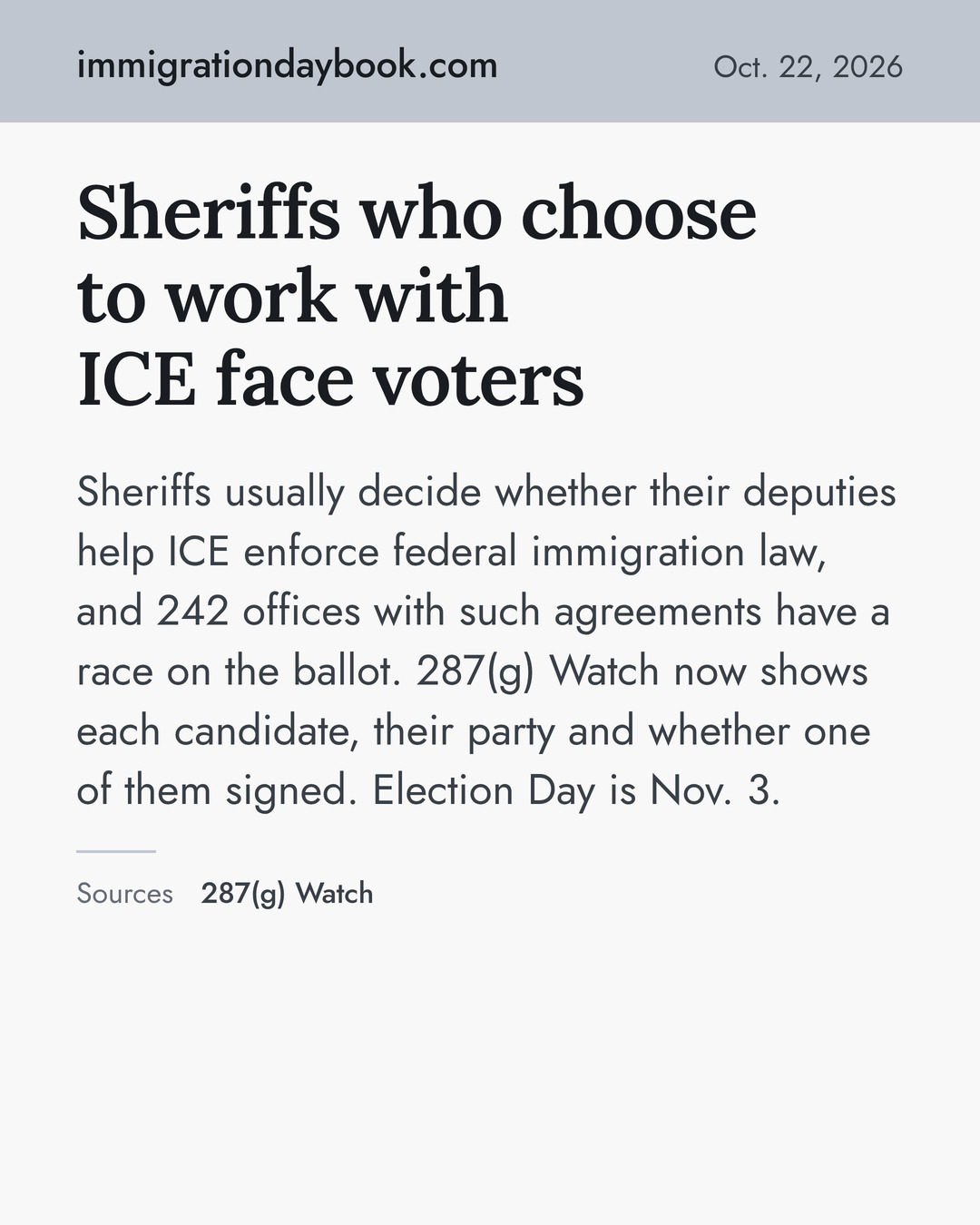
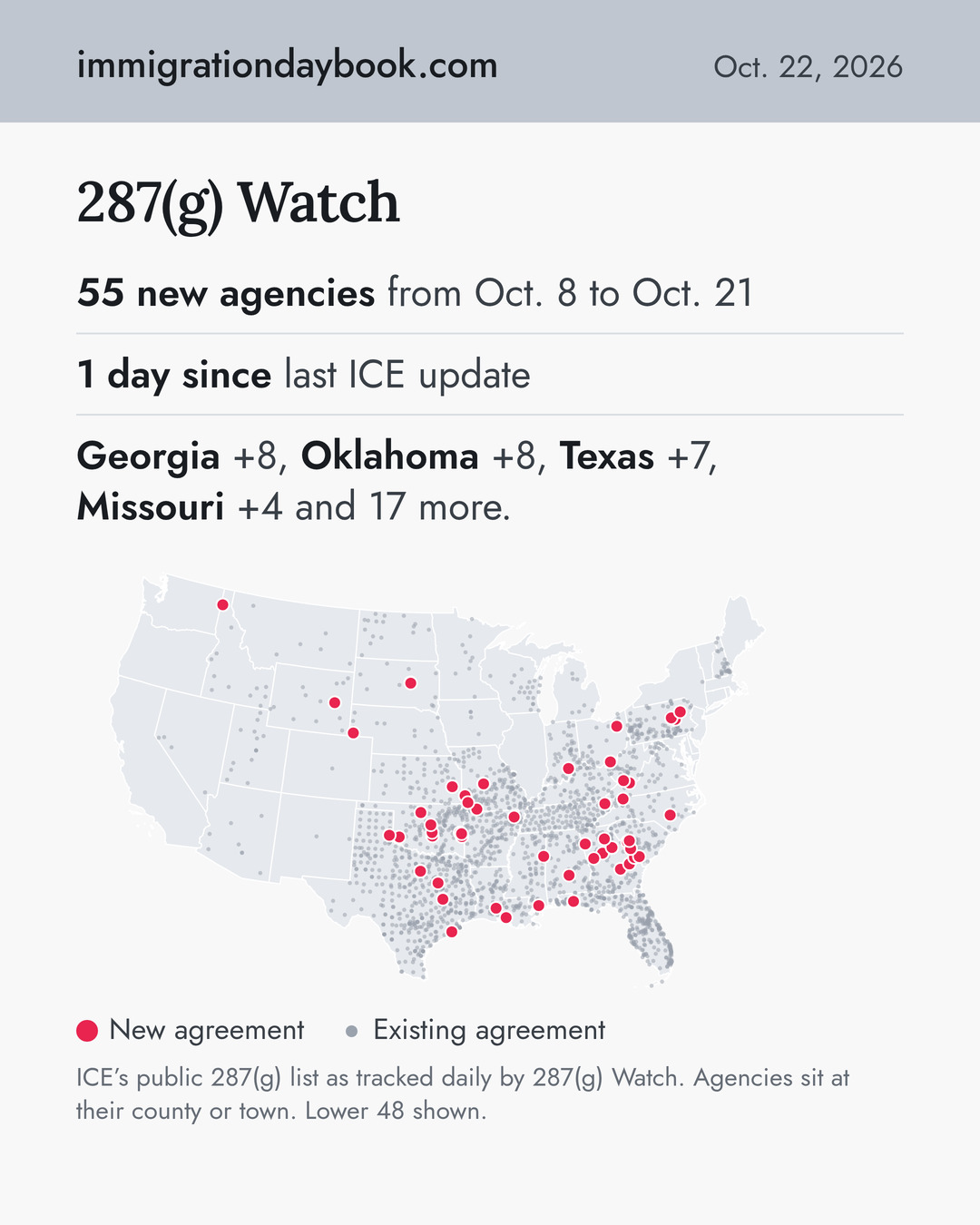
With Election Day two weeks away, 287(g) Watch now shows the sheriff’s race on the page of every agency in a county that elects its sheriff this year — who’s running, their party and whether a candidate signed the office’s 287(g) agreement with ICE. Sheriffs are elected in nearly every state and usually decide whether their deputies help enforce federal immigration law, which makes the vote for sheriff one of the few direct ways voters can weigh in on local collaboration with ICE. We found 242 sheriff’s offices with agreements to work with ICE that have a sheriff’s race on the ballot. [287(g) Watch]
The network keeps growing: the site tracks 2,231 agencies in 40 states that had signed on to work with ICE as of Oct. 16, including 146 in Pennsylvania, while authorized North Carolina highway patrol officers may ask motorists about their immigration status. [287(g) Watch, PennLive, Enlace Latino NC]
Senators challenge government lawyers for children
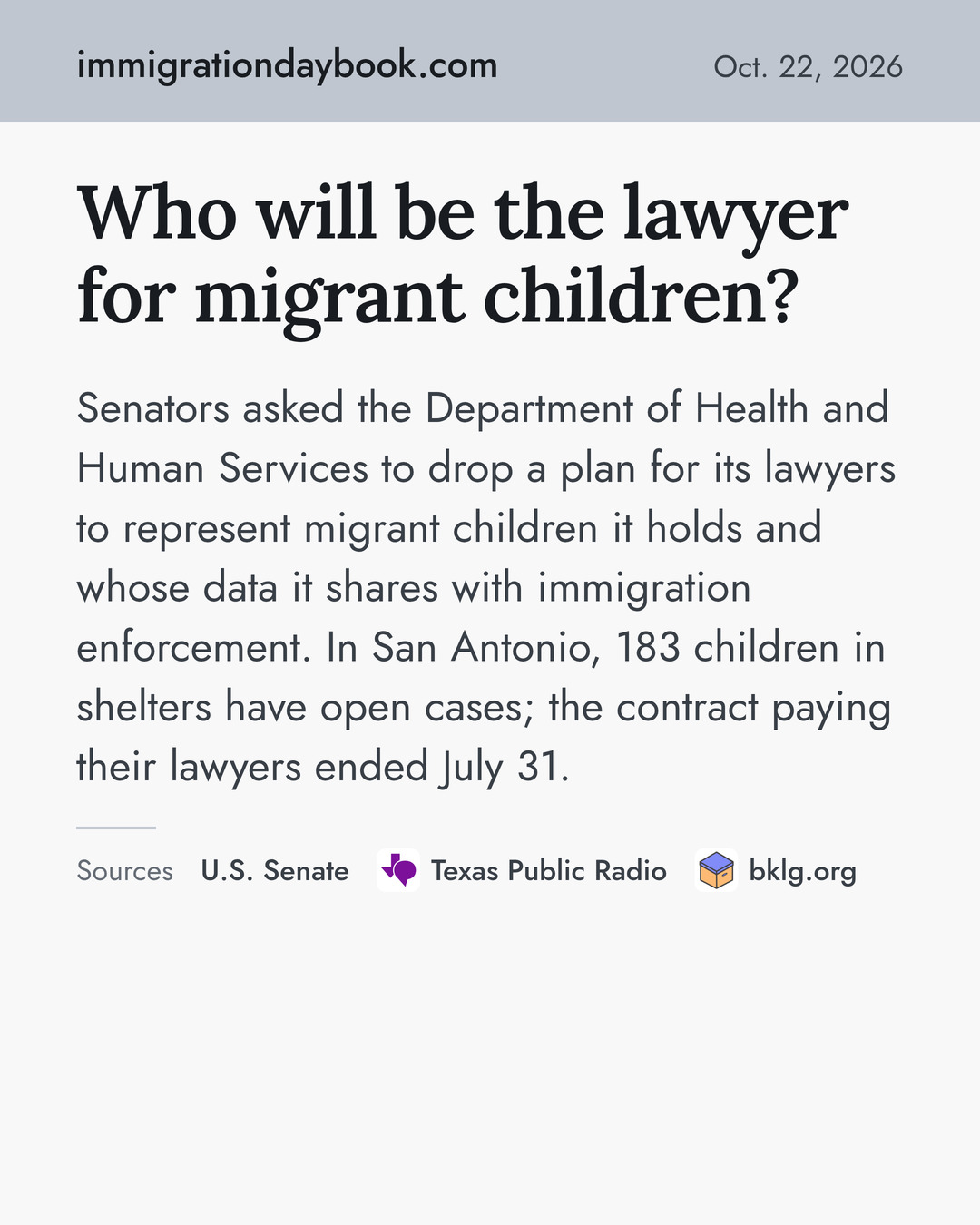
Six senators asked Health and Human Services Secretary Robert F. Kennedy Jr. to reverse a plan for department attorneys to represent unaccompanied children in immigration court, arguing the department cannot be the children’s lawyer while it holds them in custody, decides where they live and shares information with immigration enforcement. “The immigration judge works for the Trump Administration. So does the prosecutor. Under your plan, so would the child’s lawyer,” they wrote, citing a 2008 law that requires the department to seek independent pro bono counsel. [Sen. Ron Wyden]
In San Antonio, 183 unaccompanied children in federal shelter custody had open immigration cases as of Aug. 31, out of 1,523 nationwide, according to bklg.org's analysis of court records. The federal contract that funded community legal providers for those children expired July 31, and more of them are now facing hearings without lawyers. [Texas Public Radio, bklg.org]
New country assessments could shape asylum decisions
State Department assessments sent to asylum officers describe parts of Mexico and Central America as safer than some U.S. cities, even as public travel guidance warns Americans about dangers in the region. The documents compare violent crime there favorably with Baltimore and Houston. Those assessments could affect whether applicants are considered able to relocate safely within their own countries. [CNN, Prensa Libre]
They land on a system already denying most claims: TRAC’s June 2026 asylum-decision data show 13,994 denials, 812 grants of asylum and 439 grants of other relief. Among cases ending in an asylum grant or denial, 94.5% were denied. [TRAC]
Upcoming
The next four weeks.
- Nov. 9, 2026
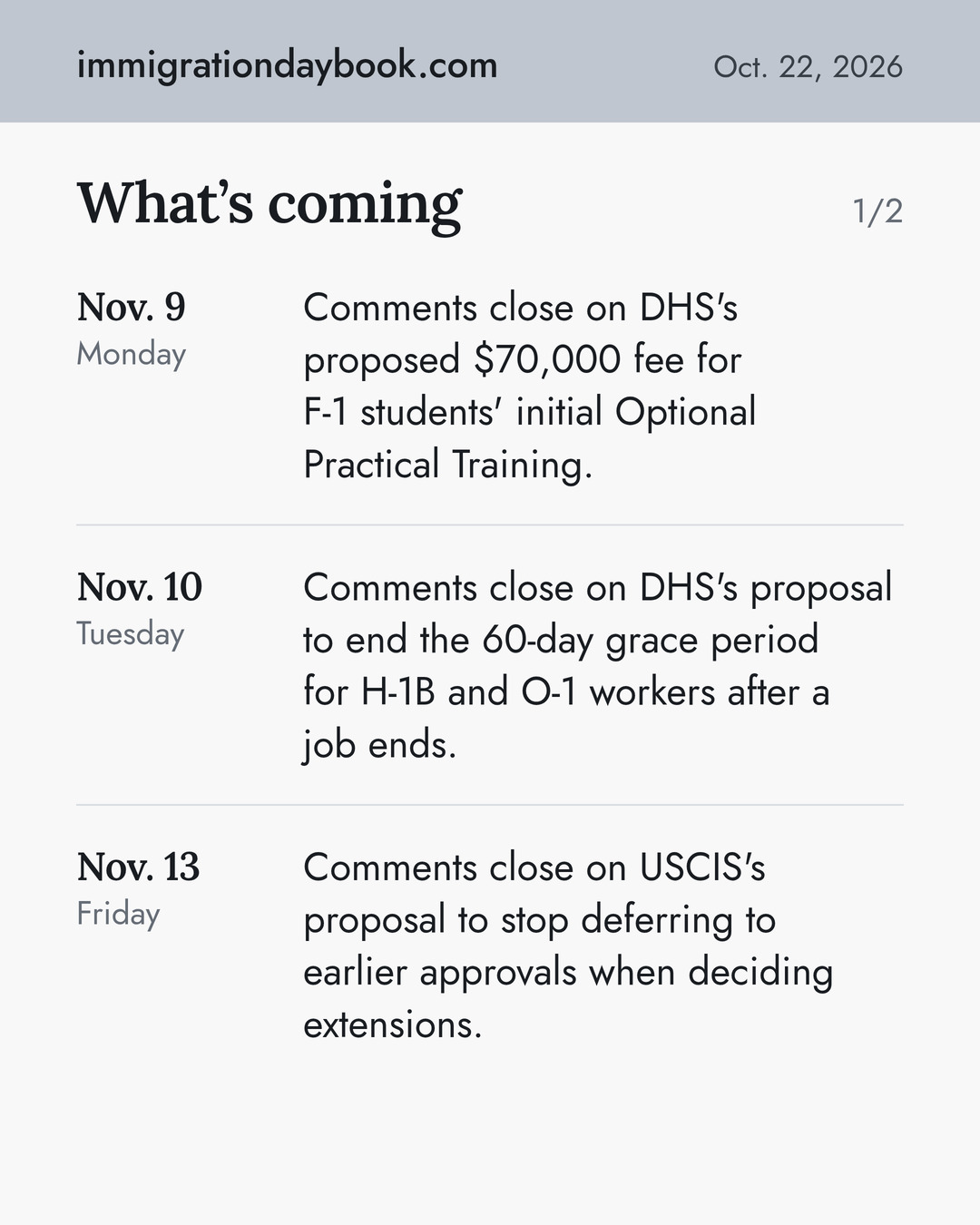
DHS proposes charging F-1 students $70,000 for an initial period of Optional Practical Training and $30,000 for a later period. The fees are not in effect: comments on the proposed rule close November 9, while comments specifically on its required paperwork and information-collection estimates close December 7.
- Nov. 10, 2026
DHS proposes ending the regulation that lets certain H-1B, O-1 and other covered workers—and their families—remain in the United States for up to 60 days after a job ends. The grace period remains in effect for now; comments on the proposal close November 10.
- Nov. 13, 2026
USCIS proposes ending the regulation that generally tells officers to give weight to an earlier approval when deciding an extension involving the same facts. The proposal is not in effect; comments close November 13.
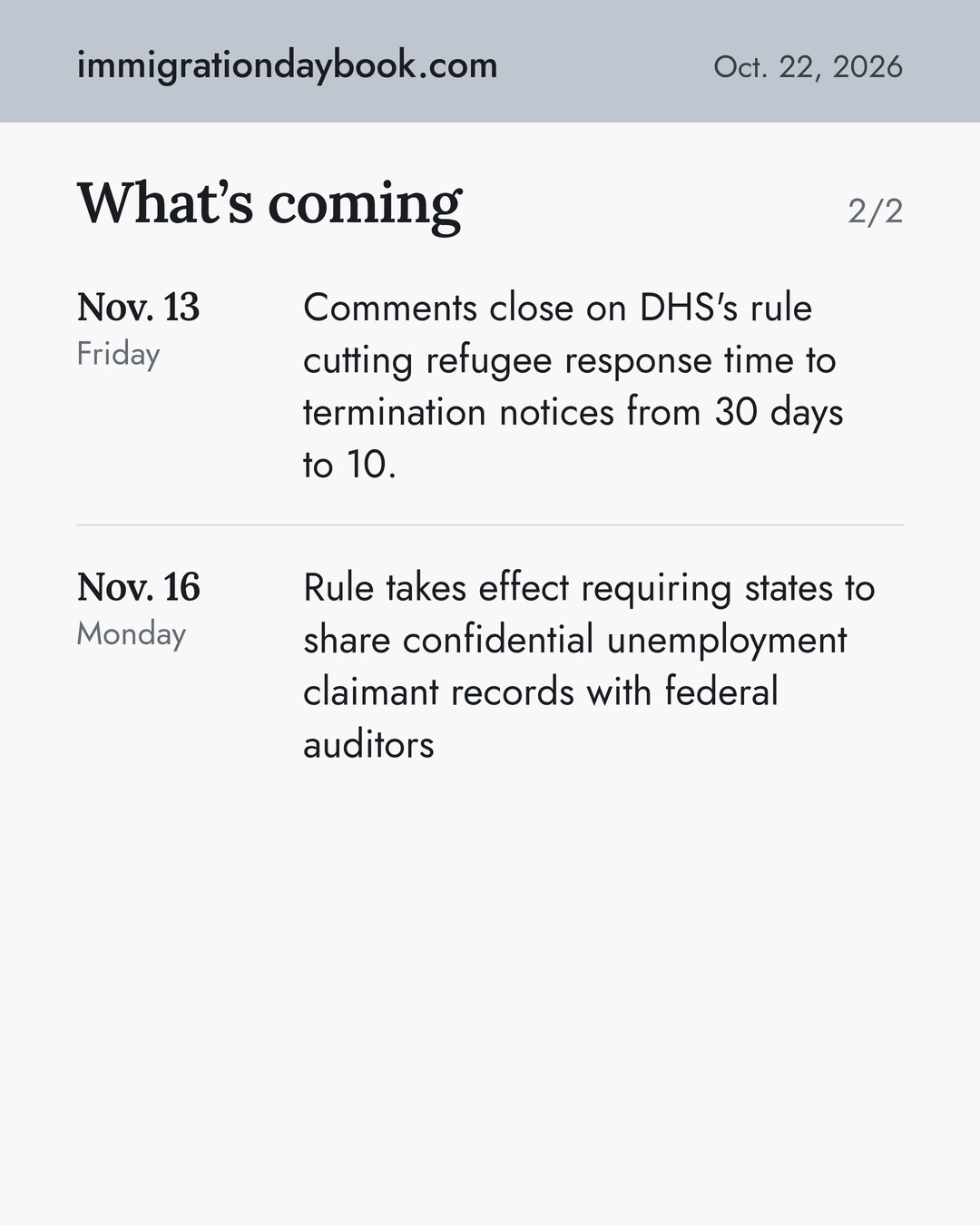
A DHS interim final rule already in effect cuts from 30 days to 10 the time for a refugee to respond to a notice that DHS intends to terminate refugee status because it says the person did not qualify at admission. DHS is accepting post-implementation comments through November 13.
- Nov. 16, 2026
State unemployment agencies will have to hand over confidential unemployment compensation (UC) records — information about individual claims and claimants — to federal officials who audit the programs, including the Labor Department's internal watchdog (DOL Office of Inspector General). The stated purpose is oversight and fraud detection.
Send this edition to someone who should have it.
The link carries “?via” and nothing else — no identifiers, no cross-site tracking.
Around the system
Newly filed court records show federal immigration investigators flagged activist Samuel Tunick as a terrorism suspect before border officers stopped him at the Atlanta airport in January 2025 — while the officers told him they were looking for child-abuse material. Tunick, who entered a code that wiped his phone, faces criminal charges over it. [404 Media]
California Attorney General Rob Bonta filed his 100th lawsuit against the Trump administration, arguing that ICE arrests at or near state courthouses keep people from taking part in the justice system. [KAZU]
Advocates say seriously ill ICE detainees in Florida face imminent deportation to unidentified African countries after Mexico declined to receive some of them. [The Guardian]
The public-charge rule, in effect since Sept. 18, lets immigration officers count an applicant’s use of benefits such as SNAP and Medicaid against a green-card application. [Borderless Magazine]
San Francisco educators have accompanied families to more than 130 immigration appointments and hearings since January, as ICE arrests in the Bay Area run nearly 70% above 2025, according to the Deportation Data Project. [ABC7 Bay Area]
A caravan of about 600 people, mostly from Honduras, Guatemala and El Salvador, set out from southern Mexico; members say they believe the November midterms could change conditions for them. [Associated Press]
Software company Cloudera is barred for two years from sponsoring workers through PERM labor certification, a key step toward many employer-sponsored green cards, and will pay $600,000 in penalties and $1.4 million in back pay to settle federal allegations that it steered U.S. applicants into a separate hiring process. [Reddy Neumann Brown]