This edition in 8 slides Flip through ↓


A new independent count puts deportations near 1 million but short of the White House target. A judge reins in DHS voter-fraud door-knocking before the midterms.
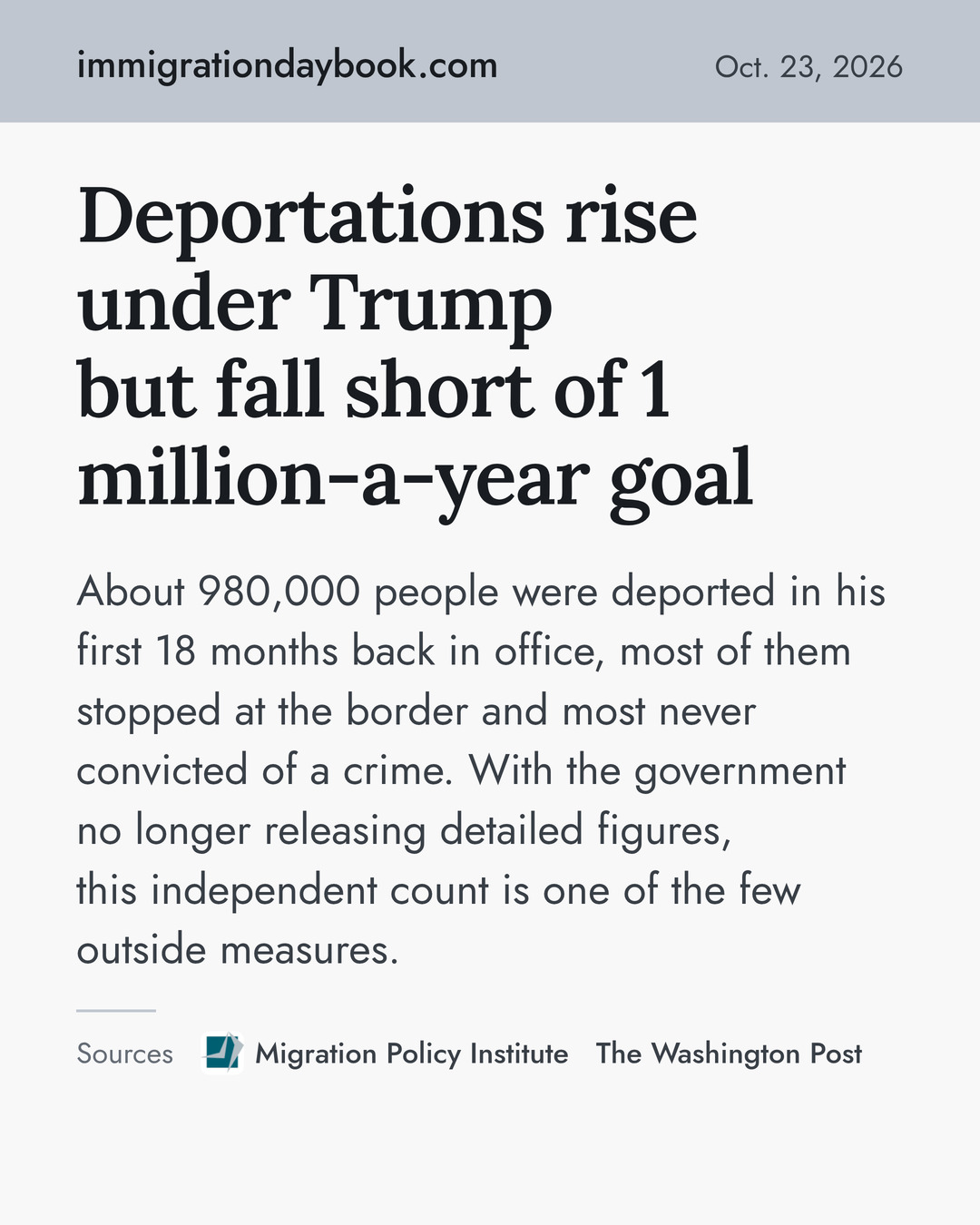
Nearly 1 million deportations in 18 months, short of the White House goal
The Migration Policy Institute estimates that the Department of Homeland Security carried out about 980,000 deportations from Jan. 20, 2025, through July 31, 2026. That is a cumulative figure for the first 18 months of the second Trump term. MPI also annualizes the pace: about 660,000 deportations in fiscal 2026, up from 620,000 in the administration’s first year. That is 26% above the 2021–2024 average but below the 1.86 million recorded in fiscal 2000 and well short of the administration’s goal of 1 million a year. MPI counts both removals and returns. [Migration Policy Institute]
The Associated Press reports that 69% of the deportations were of people first intercepted at the border, even as the share arrested in the interior rose from 28% in 2025 to 39% in July. AP also reports that most people deported had never been convicted of a crime. Separately, the White House says 1.2 million people have been deported or removed, a figure AP could not reconcile with MPI’s count. The independent estimate matters because the administration halted the release of detailed deportation statistics, leaving MPI’s FOIA-based analysis as one of the few outside measures. Univision frames the total as still below Obama-era deportation figures; MPI’s own benchmark is the early-2000s peak. [Associated Press, The Washington Post, Univision]
Get the Daybook in your inbox.
Free. Every weekday. English and Spanish.
We never sell or share your email. Unsubscribe any time.
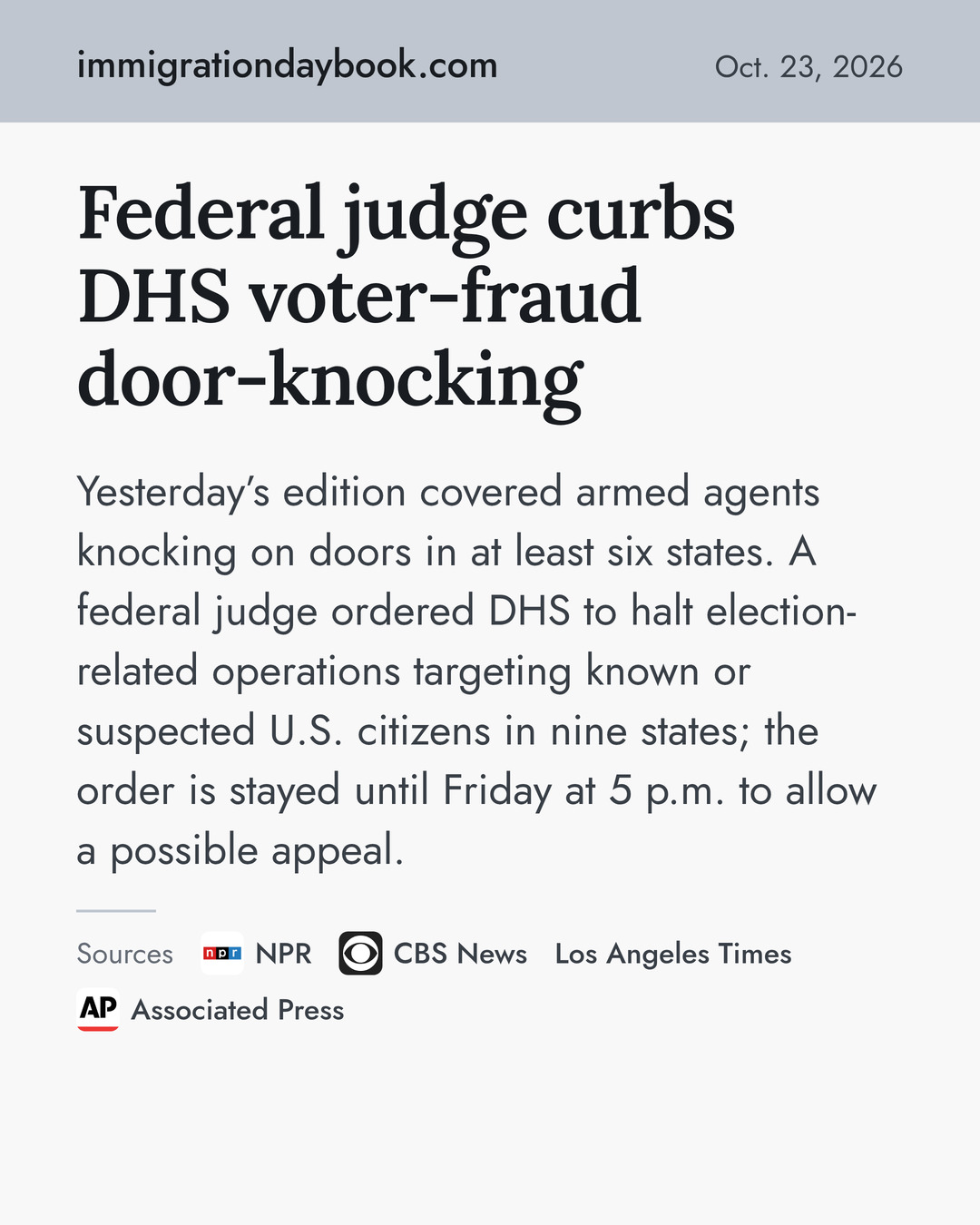
Judge limits DHS door-knocking for suspected noncitizen voters
A federal judge in California has barred DHS officers in nine states from election-related field operations aimed at people they know, or should reasonably suspect, are U.S. citizens. The order also bars operations based wholly on USCIS matching data without further investigation. In a 19-page order issued late Wednesday, U.S. District Judge Araceli Martínez-Olguín wrote that the government was using “flawed” data and that its efforts likely violated the Voting Rights Act’s ban on voter intimidation. The states are California, Connecticut, Georgia, Missouri, Nevada, New York, Pennsylvania, Washington and Wisconsin. DHS said it has “no plans to question or investigate people we believe to be U.S. citizens.” [NPR]
The judge stayed the order until 5 p.m. Friday to give the government a chance to appeal; after that, it stays in effect until polls close on Election Day. It is not a final ruling in the case. The Los Angeles Times places it within a broader legal fight between the administration and California ahead of the midterms. The order follows recent Daybook reports on armed agents knocking on doors and on the nine-state investigation the judge ordered halted. [CBS News, Los Angeles Times, Associated Press]
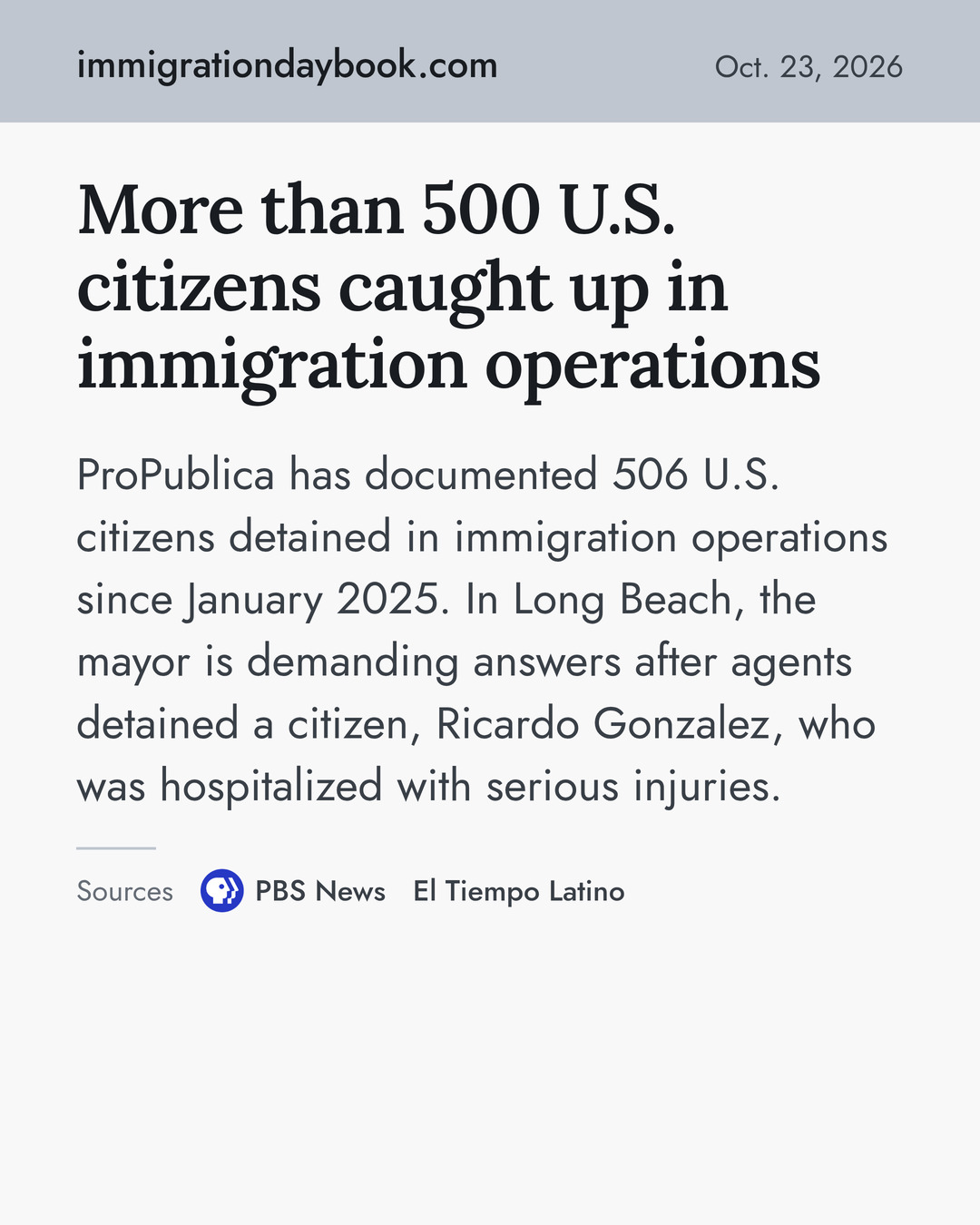
Hundreds of U.S. citizens caught up in immigration operations
A ProPublica investigation has found more than 500 U.S. citizens caught up in the administration’s immigration operations. PBS NewsHour discussed the findings with ProPublica’s Nicole Foy, alongside the case of Ricardo Gonzalez. Gonzalez is a U.S. citizen who was detained in Long Beach, California, and treated at a hospital for serious injuries. ICE says he was rioting and damaged a government vehicle; video does not show whether the vehicle hit him. El Tiempo Latino reports that ProPublica has counted 506 citizens detained since January 2025. It also reports that Long Beach Mayor Rex Richardson asked DHS to pull the agents involved off the streets and filed a complaint with the DHS inspector general. DHS says the agents used the minimum force necessary. The Oct. 20 edition first reported Gonzalez’s case. Zooming out, Migrant Insider reports on a Government Accountability Office finding that ICE lacks reasonable assurance its agents turn on body cameras as policy requires. [ProPublica, PBS News, El Tiempo Latino, Migrant Insider]
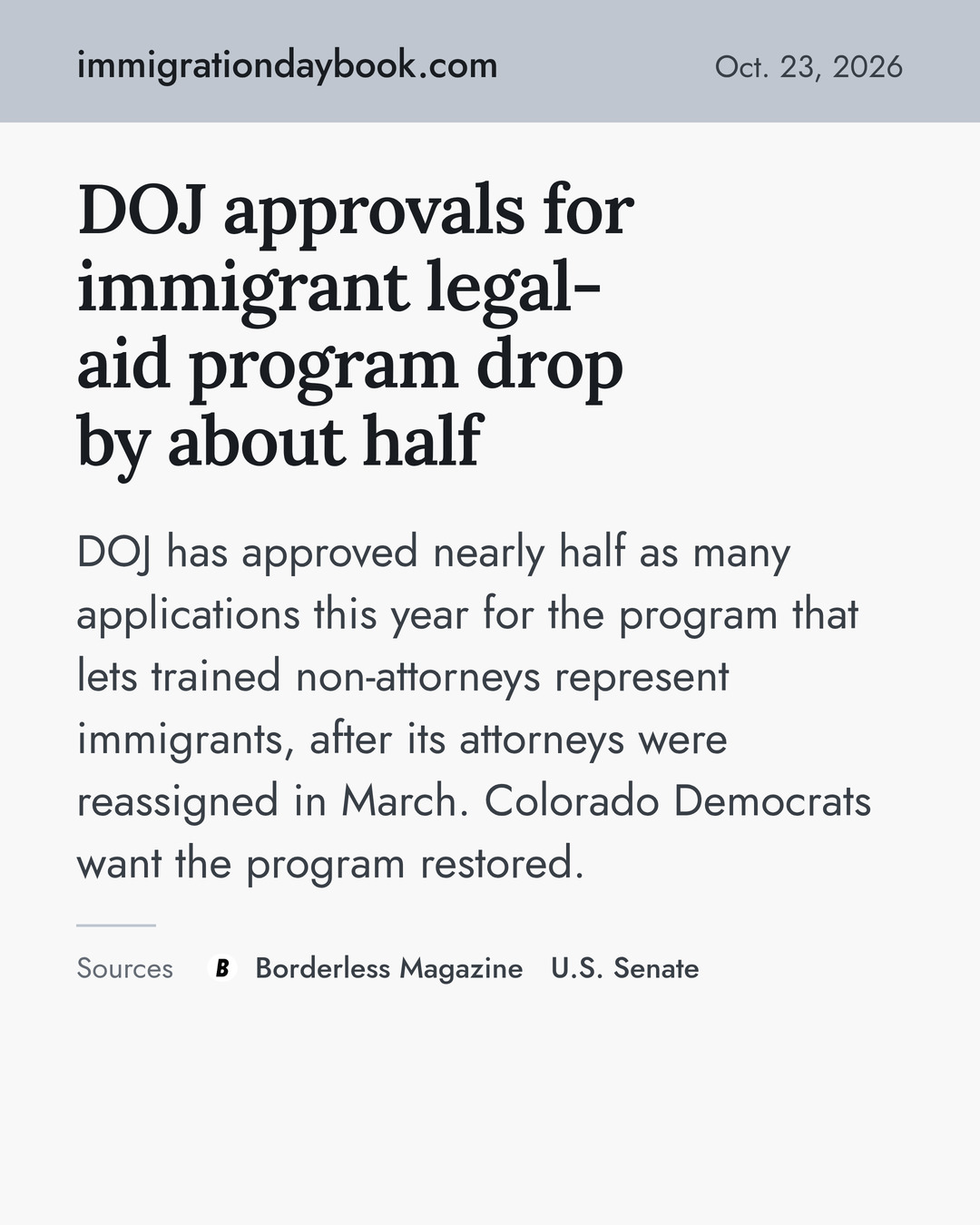
Legal help for immigrants thins as DOJ slows accreditations
The Justice Department has approved nearly half as many applications this year for its Recognition & Accreditation program, which lets trained non-attorneys represent immigrants. Borderless Magazine found the drop after the government reassigned the program’s attorneys to entry-level clerk positions in March. That left two support staff with no authority to approve or renew applications. Colorado’s congressional Democrats have asked DOJ to assign adjudicators, clear the backlog and restore a 90-day processing standard. They note that 71% of people facing deportation in Colorado immigration courts lack counsel. [Borderless Magazine, U.S. Senate]
The squeeze extends to children. The Detroit News reports that federal lawyers may take over representation of hundreds of unaccompanied children in Michigan. Critics question whether lawyers from the department that holds the children in custody can be independent. In a separate case, the government is appealing an injunction ordering restoration of legal aid for undocumented children. Both developments follow the Oct. 22 edition’s report on senators challenging the plan for HHS lawyers to represent children. [The Detroit News, Courthouse News Service]
The Border Chronicle starts tracking wall contractors
The Border Chronicle has introduced the Wall Watch Project and a database of border-wall contractors, a new public resource for following who builds the barrier. The database gives readers a way to identify the companies building the border wall and follow their work through federal contracting records and agency documents. [The Border Chronicle]
Upcoming
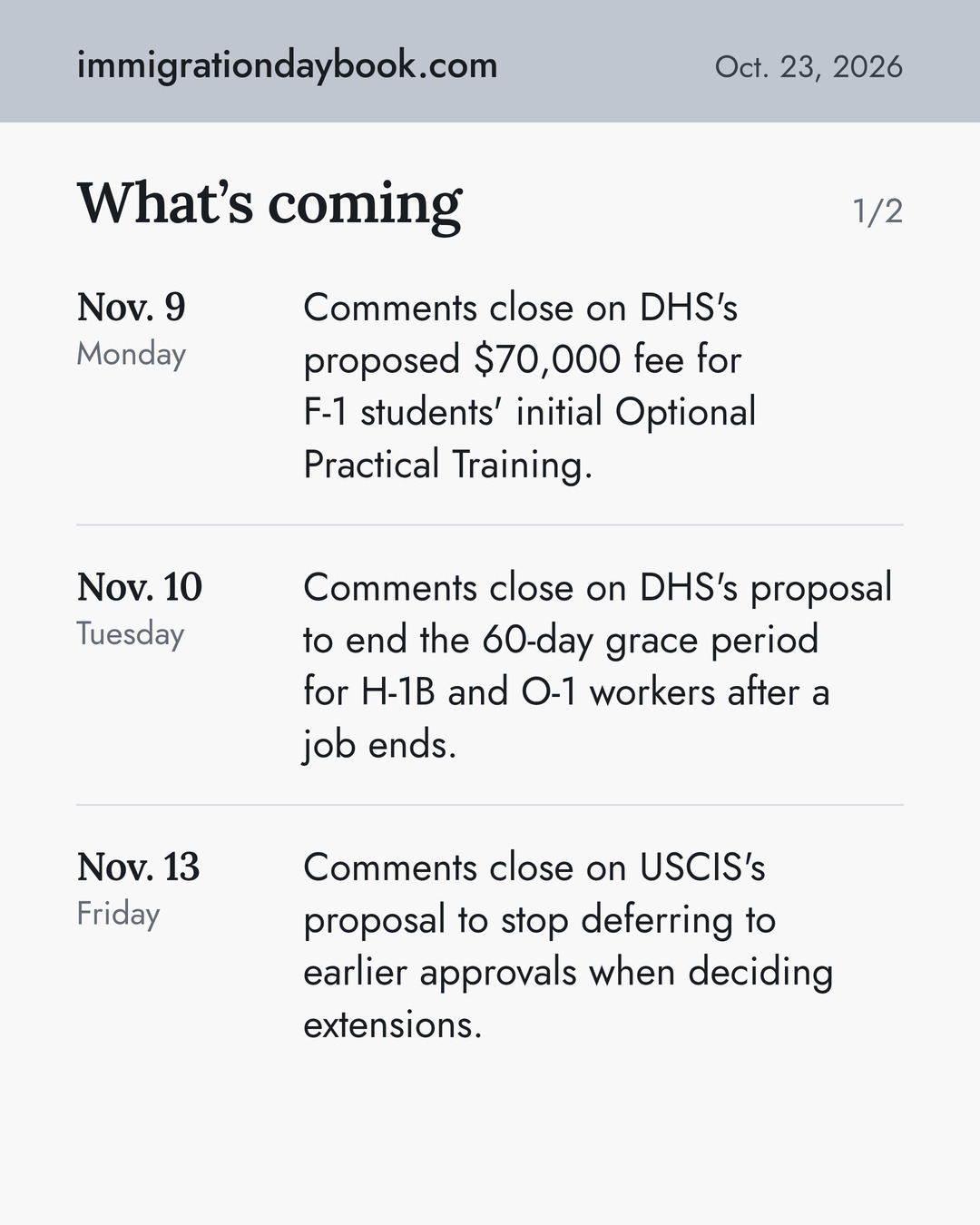
The next four weeks.
- Nov. 9, 2026
DHS proposes charging F-1 students $70,000 for an initial period of Optional Practical Training and $30,000 for a later period. The fees are not in effect: comments on the proposed rule close November 9, while comments specifically on its required paperwork and information-collection estimates close December 7.
- Nov. 10, 2026
DHS proposes ending the regulation that lets certain H-1B, O-1 and other covered workers—and their families—remain in the United States for up to 60 days after a job ends. The grace period remains in effect for now; comments on the proposal close November 10.
- Nov. 13, 2026
USCIS proposes ending the regulation that generally tells officers to give weight to an earlier approval when deciding an extension involving the same facts. The proposal is not in effect; comments close November 13.
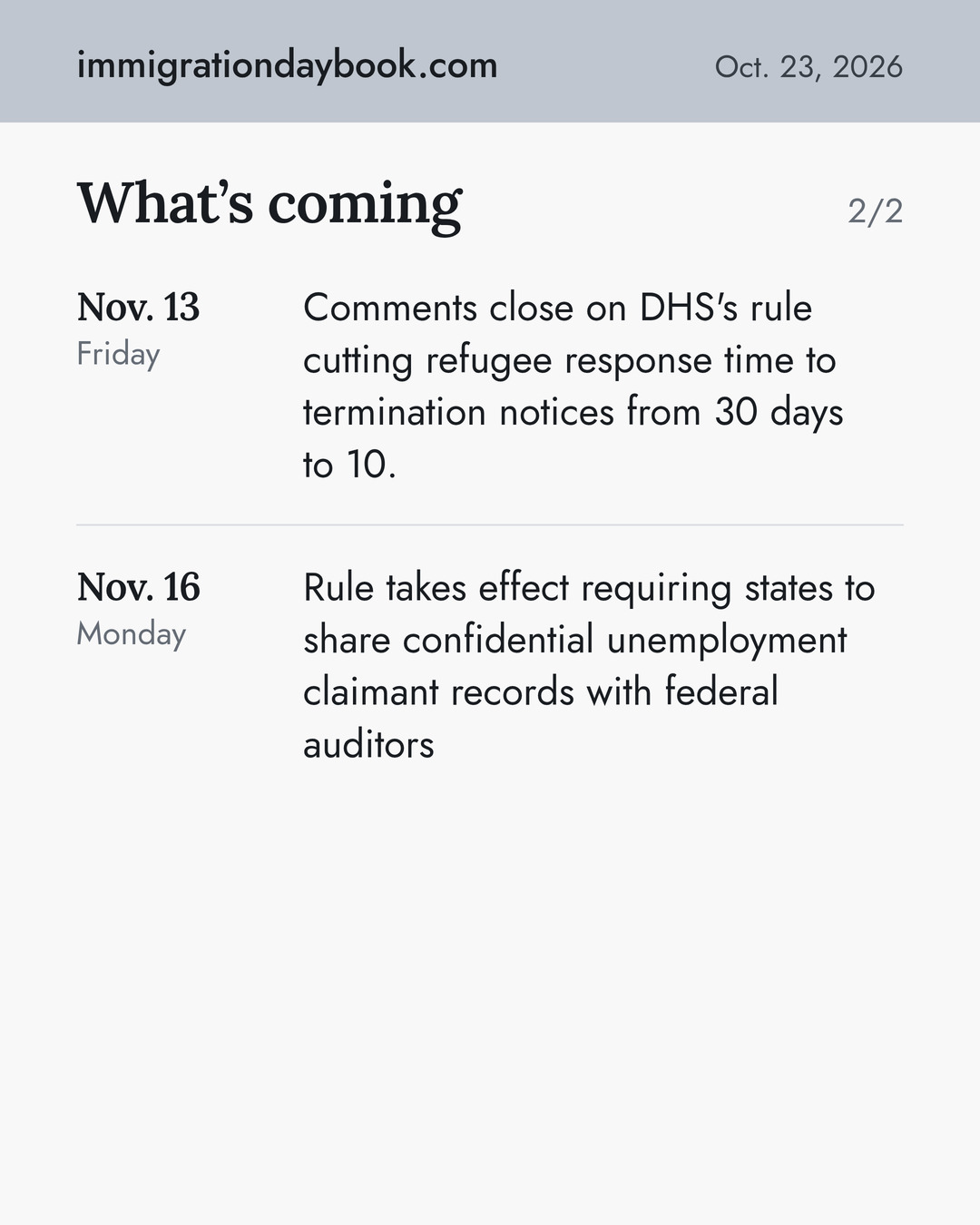
A DHS interim final rule already in effect cuts from 30 days to 10 the time for a refugee to respond to a notice that DHS intends to terminate refugee status because it says the person did not qualify at admission. DHS is accepting post-implementation comments through November 13.
- Nov. 16, 2026
State unemployment agencies will have to hand over confidential unemployment compensation (UC) records — information about individual claims and claimants — to federal officials who audit the programs, including the Labor Department's internal watchdog (DOL Office of Inspector General). The stated purpose is oversight and fraud detection.
Send this edition to someone who should have it.
The link carries “?via” and nothing else — no identifiers, no cross-site tracking.
Around the system
The administration asked the Supreme Court on Oct. 21 to let border-wall construction resume in Big Bend, Texas. The request seeks to lift Judge Kathleen Cardone’s Oct. 2 order halting construction in the project area. It is an emergency application, not a ruling. [Univision, Reuters]
WUWM’s “ICE Revealed” series examines detention conditions. The episode reports “systemic neglect,” mismanaged medications and 56 deaths at ICE detention centers. It extends recent coverage of deaths in ICE custody. [WUWM]
USCIS changes how it counts filing deadlines starting today, Oct. 23. Under Policy Alert PA-2026-15, deadlines counted in days still roll to the next business day. Deadlines tied to a fixed date, such as a 21st birthday, no longer do, so a paper filing that arrives Monday can be late. What counts is the date USCIS receives a paper filing, not the mailing date. [Actual USA, Voz Federal]
A unanimous Ninth Circuit panel blocked California’s No Vigilantes Act from applying to federal officers. The law requires officers, including ICE agents, to display identification under threat of criminal penalty. The Oct. 14 ruling reversed a lower court’s refusal to grant the federal government a preliminary injunction. It found the requirement improperly regulated federal operations without approval from Congress. [Justia Verdict, Conduit Street]
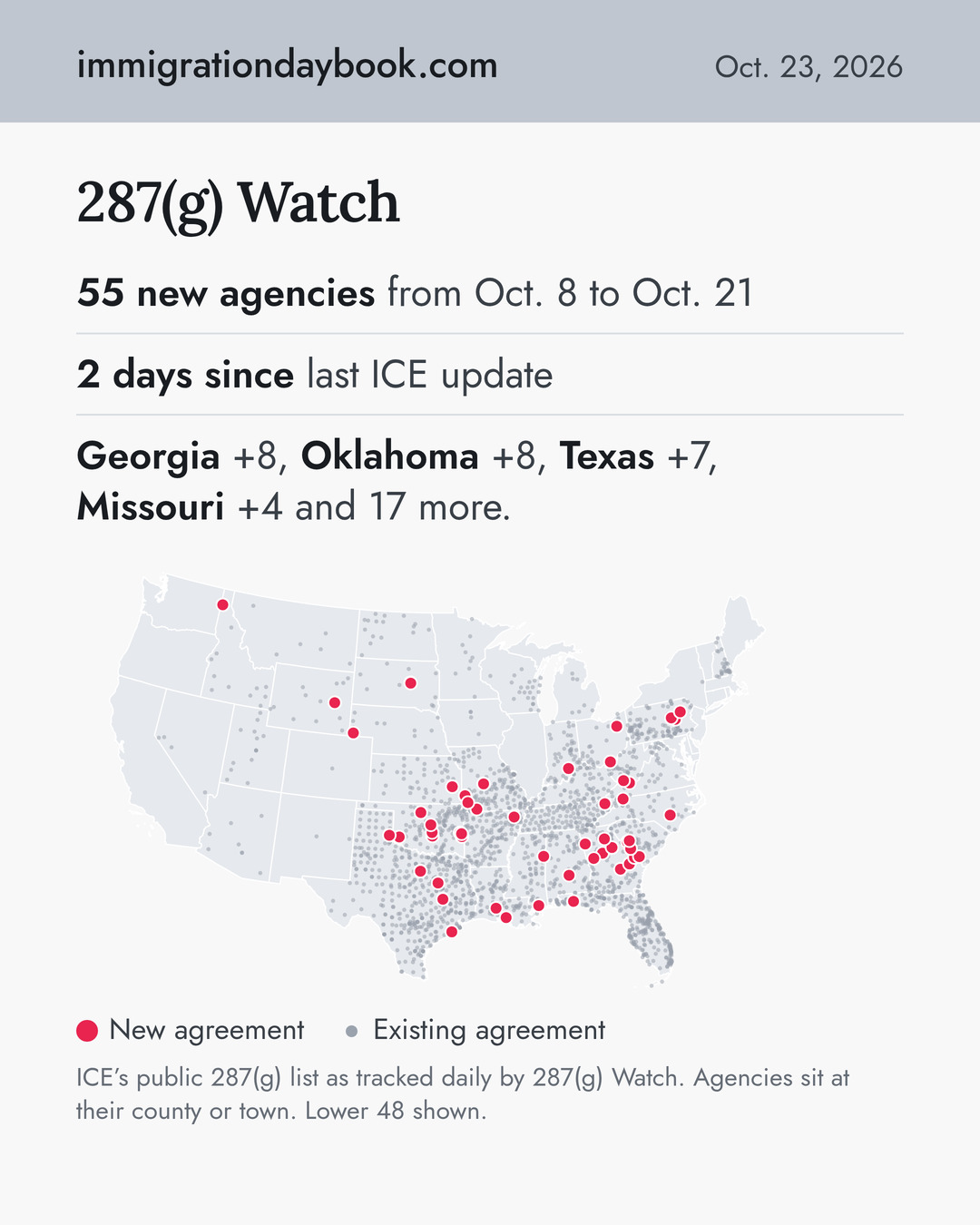
The Idaho Department of Correction has entered a 287(g) agreement with ICE. FAIR describes it as the second Idaho state agency to do so. The agreement uses the Warrant Service Officer model, under which designated prison staff serve ICE warrants. That model is one of the delegation arrangements ICE describes for the program. [FAIR, U.S. Immigration and Customs Enforcement]
The ACLU calls a $100 million ICE intelligence program “a domestic secret police agency in the making.” The program, called ERO ONE, would hire 142 contractor “intelligence” analysts to identify “threats” and analyze “relationships”. [American Civil Liberties Union]
A Nashville chancellor temporarily blocked Tennessee from requiring immigration-status checks in an HIV/AIDS safety-net program. Chancellor I’Ashea L. Myles’s restraining order covers the Ryan White program and HOPWA housing aid. A hearing is set for Nov. 4 in the suit brought by Nashville CARES. [Tennessee Lookout]
Springfield, Ohio, is losing jobs and businesses as Haitian residents face deportation. The Washington Post reports that Haitian residents are staying home or leaving after their Temporary Protected Status ended. Residents and advocates have also begun a four-day, 40-mile pilgrimage to Columbus protesting ICE practices, including ankle monitors. The walk ends with a rally on Oct. 24. [The Washington Post, The Haitian Times]
Minnesota officials say the Justice Department has again stopped sharing evidence in the Renee Good and Alex Pretti killing probes. The reversal raises questions about potential criminal charges against the federal agents involved. [Star Tribune]
The November 2026 Visa Bulletin advances selected cutoffs. WR Immigration summarizes a three-month move for EB-2, a five-month advance for EB-3 Other Workers, and one-year gains in several family categories. [WR Immigration]