This edition in 8 slides Flip through ↓


Today: finding people in ICE custody, checking detention conditions, and the expanding reach of immigration scrutiny.
Thousands missing from ICE’s public locator
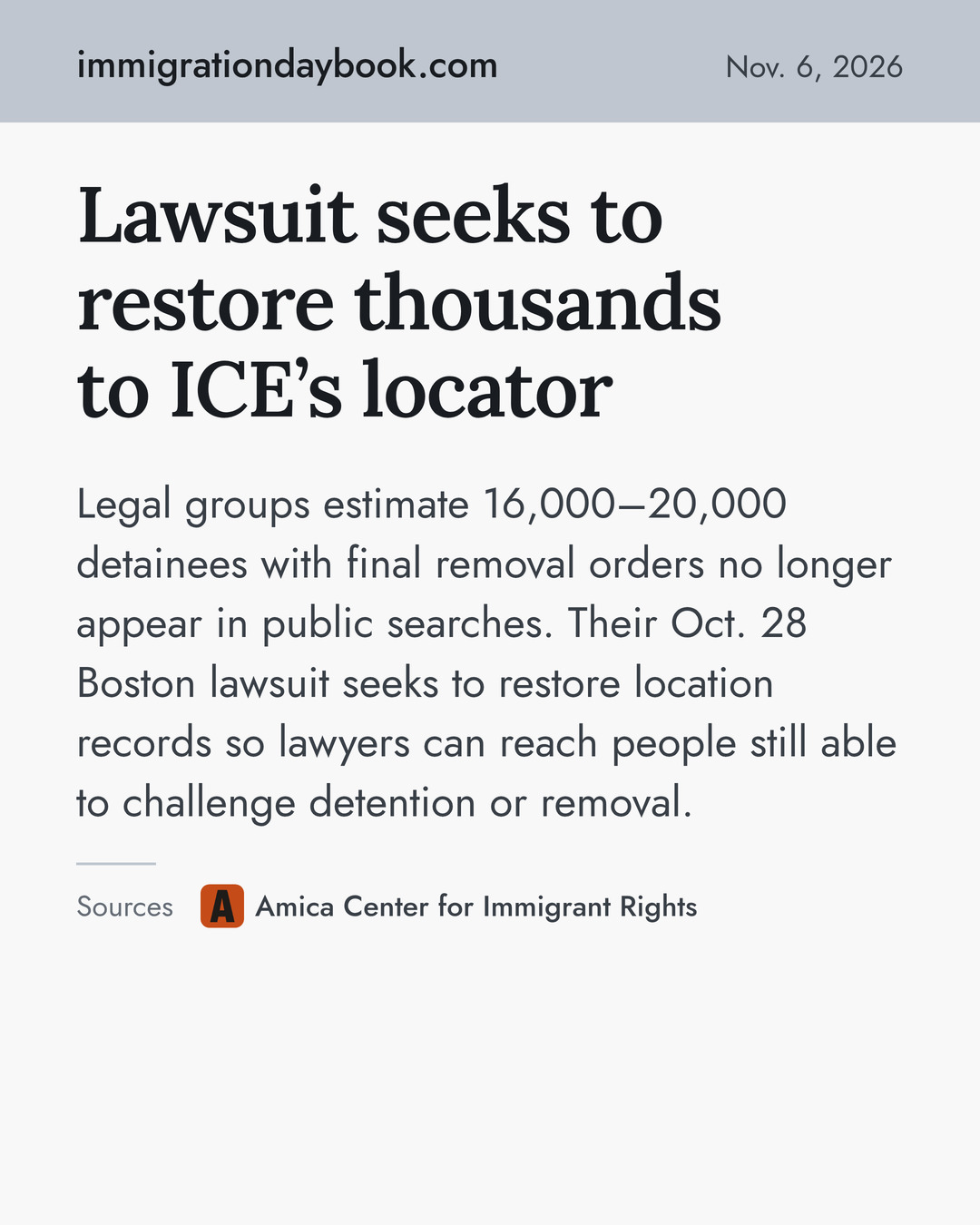
Legal groups estimate that 16,000 to 20,000 people in ICE custody no longer appear in its public detainee locator because they have final removal orders; a federal lawsuit filed Oct. 28 in Boston seeks to restore access to their locations. Since about Sept. 15, searches for these adults have returned no results even while they remain detained—a change The Washington Post first reported Sept. 21. The plaintiffs say lawyers need that information because people with final orders can still seek to reopen cases, challenge detention or contest removal to a third country. Documented also has a Chinese-language guide to contacting detained relatives. [Amica Center for Immigrant Rights, The Washington Post, Documented]
Get the Daybook in your inbox.
Free. Every weekday. English and Spanish.
We never sell or share your email. Unsubscribe any time.
Detention grows as ICE relies more on self-inspections
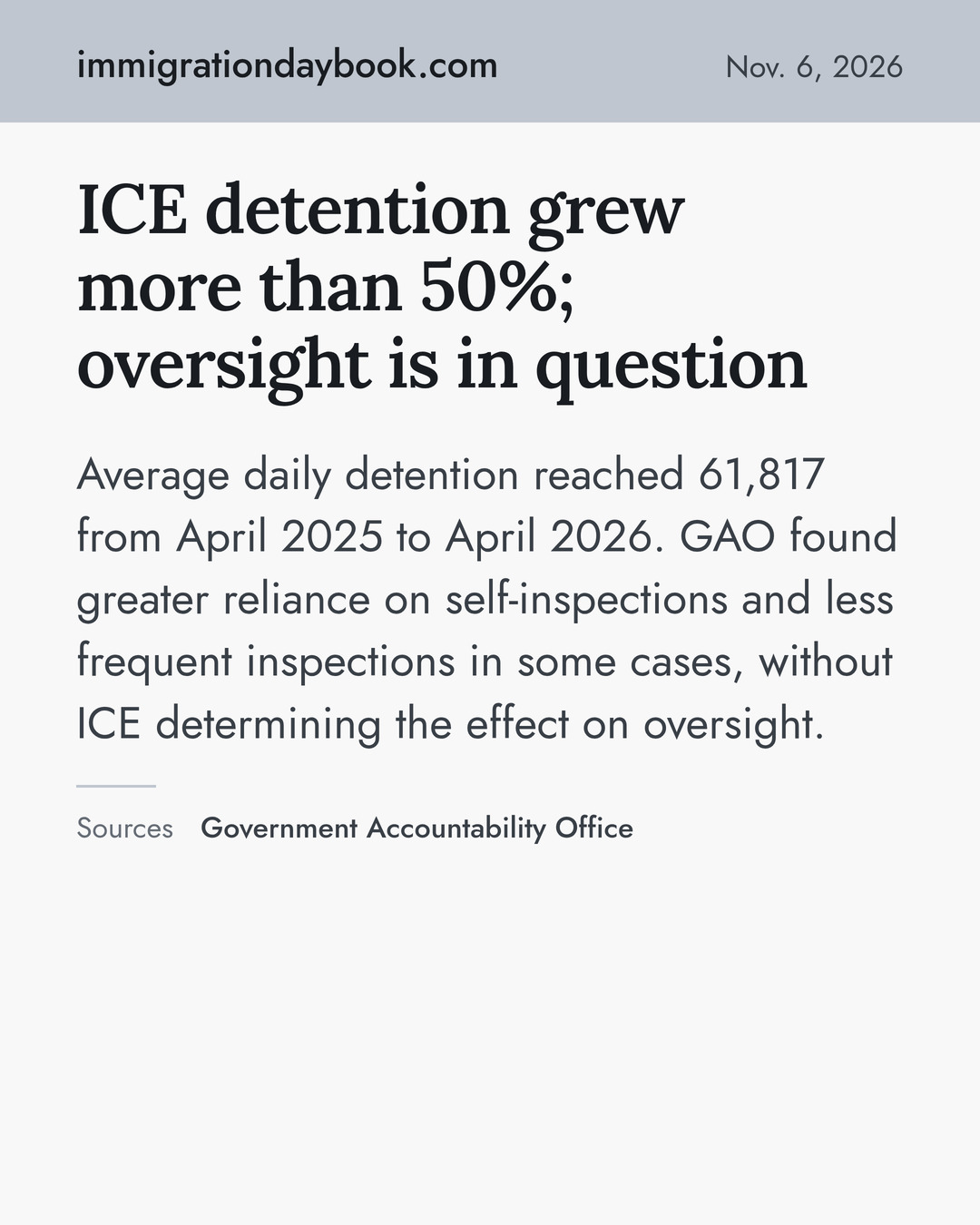
ICE’s average daily detained population grew more than 50%, to 61,817, from April 2025 to April 2026, while the agency added more than 40 facilities holding people longer than 72 hours, the Government Accountability Office reported Nov. 5. Overlapping changes in oversight meant less frequent inspections in some cases and greater reliance on facilities inspecting themselves. GAO found that ICE has not determined how those changes affected its oversight of medical care, food service and other detention standards. [Government Accountability Office]
IRS payment plans become a citizenship hurdle
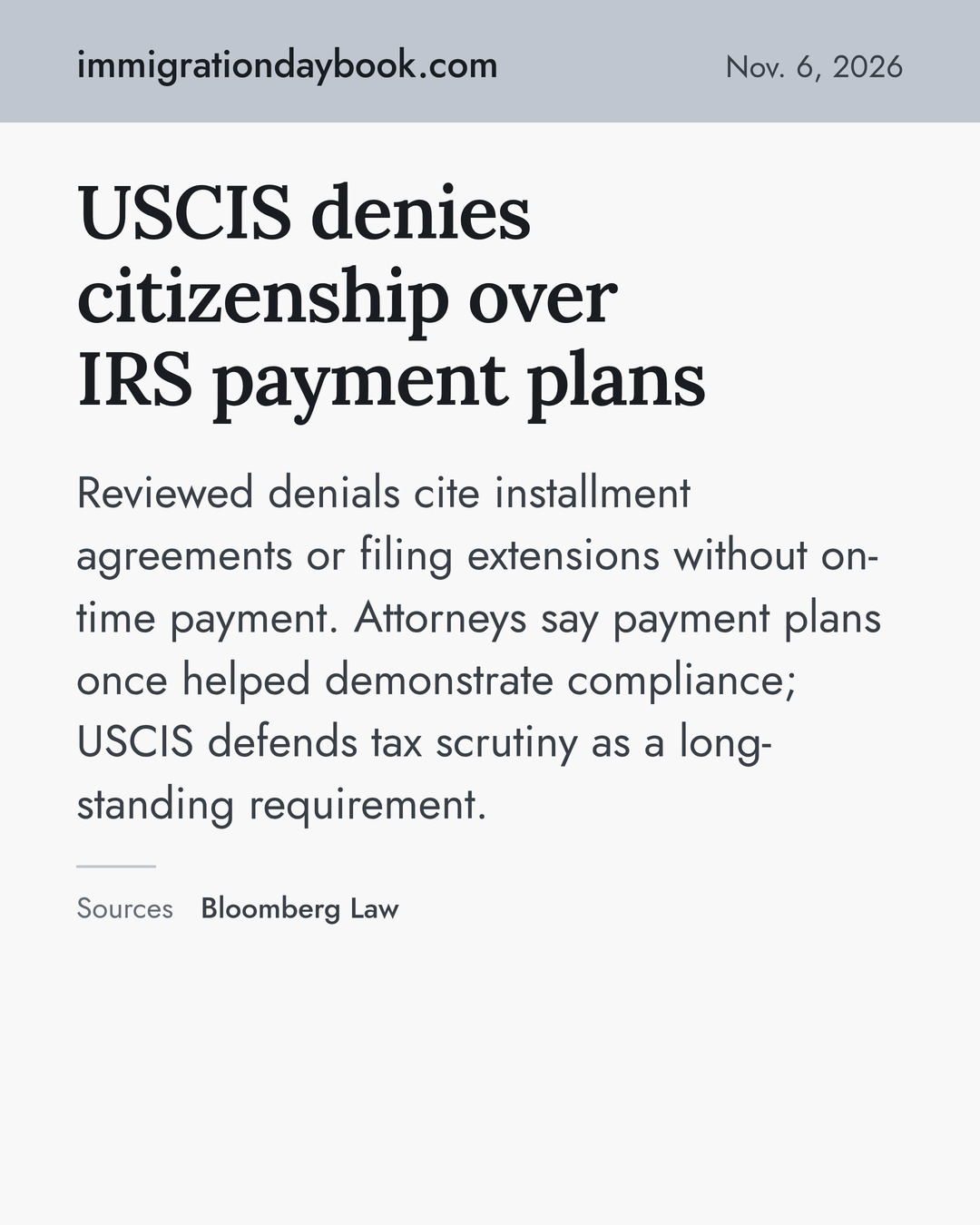
USCIS is denying citizenship over IRS installment agreements and filing extensions without on-time payment, according to denials reviewed by Bloomberg Law. Attorneys say payment plans previously counted as evidence of an applicant’s willingness to meet tax obligations; the denials follow a 2025 memo directing officers to assess “good moral character” holistically. USCIS spokesman Zach Kahler called tax compliance “a long-standing legal requirement,” while former agency official Doug Rand predicted successful appeals. Korea Daily also reports closer scrutiny of green-card applicants’ tax records. [Bloomberg Law, Korea Daily]
ICE buys phone tracking through app advertising
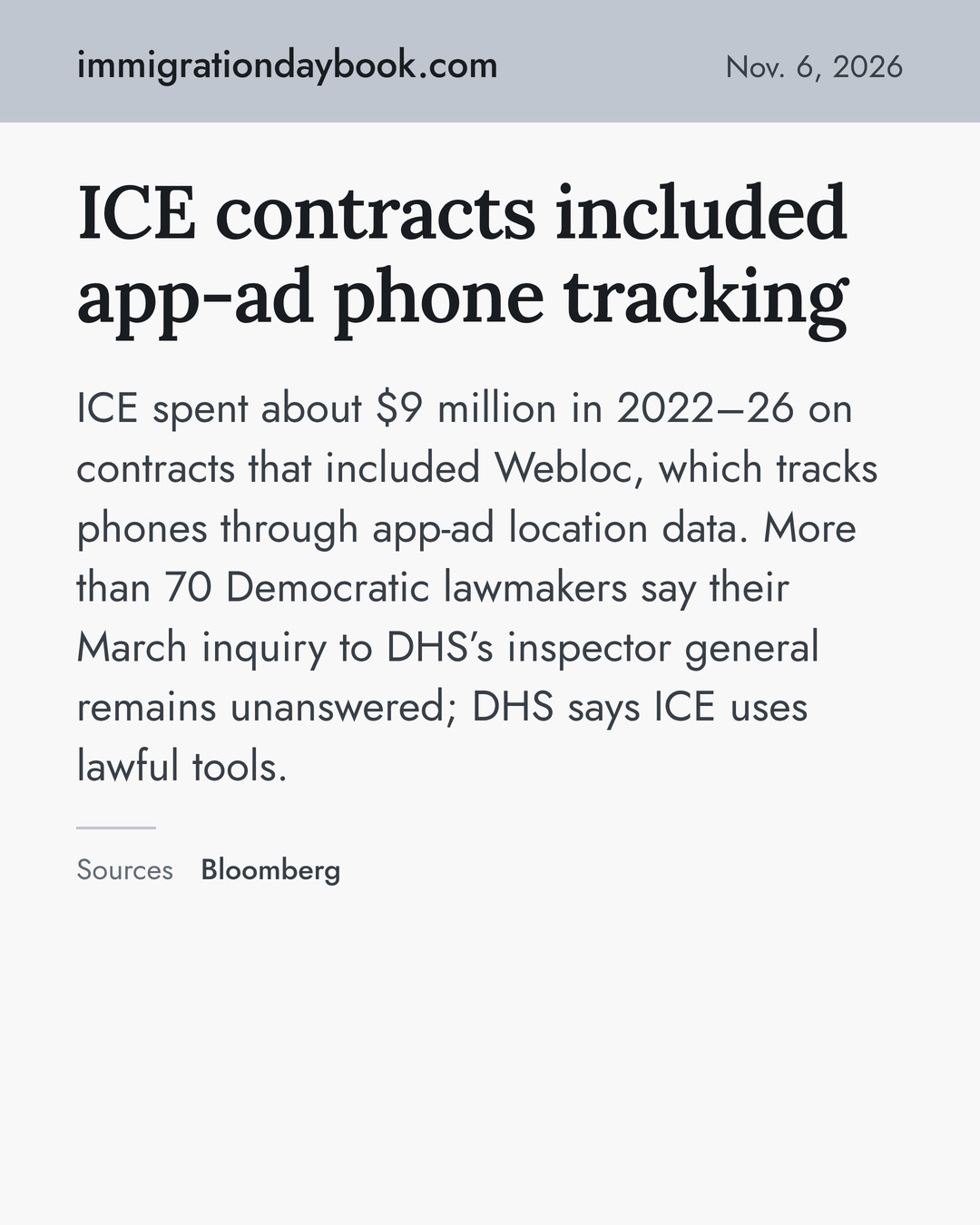
ICE spent about $9 million from 2022 to 2026 on contracts that included Webloc, a tool that locates phones using location data flowing through app advertising auctions, Bloomberg reports. The contracts were with Cobwebs and Penlink; the Justice Department argues that warrant protections do not cover commercially purchased location data. More than 70 Democratic lawmakers who asked DHS’s inspector general in March about ICE’s use of Webloc say they have received no answer. DHS says ICE uses only tools it has legal authority to use. Infobae reports that Citizen Lab found the system draws on up to 500 million devices. [Bloomberg, Infobae]
ICE’s GPS policy faces a judge’s questions
An ICE Denver supervisor told U.S. District Judge Nina Y. Wang on Nov. 5 that a written headquarters policy requires GPS monitoring for people released during deportation proceedings, barring complicating medical conditions. At the hearing over restrictions ICE added to a court-ordered release, a federal prosecutor could cite no Supreme Court or 10th Circuit decision allowing an agency to tighten a judge’s release order. Wang signaled she may investigate ICE’s conduct, a day after Judge Charlotte N. Sweeney opened an inquiry into ICE’s rearrests of people freed by court order. [Colorado Politics]
Upcoming
The next four weeks.
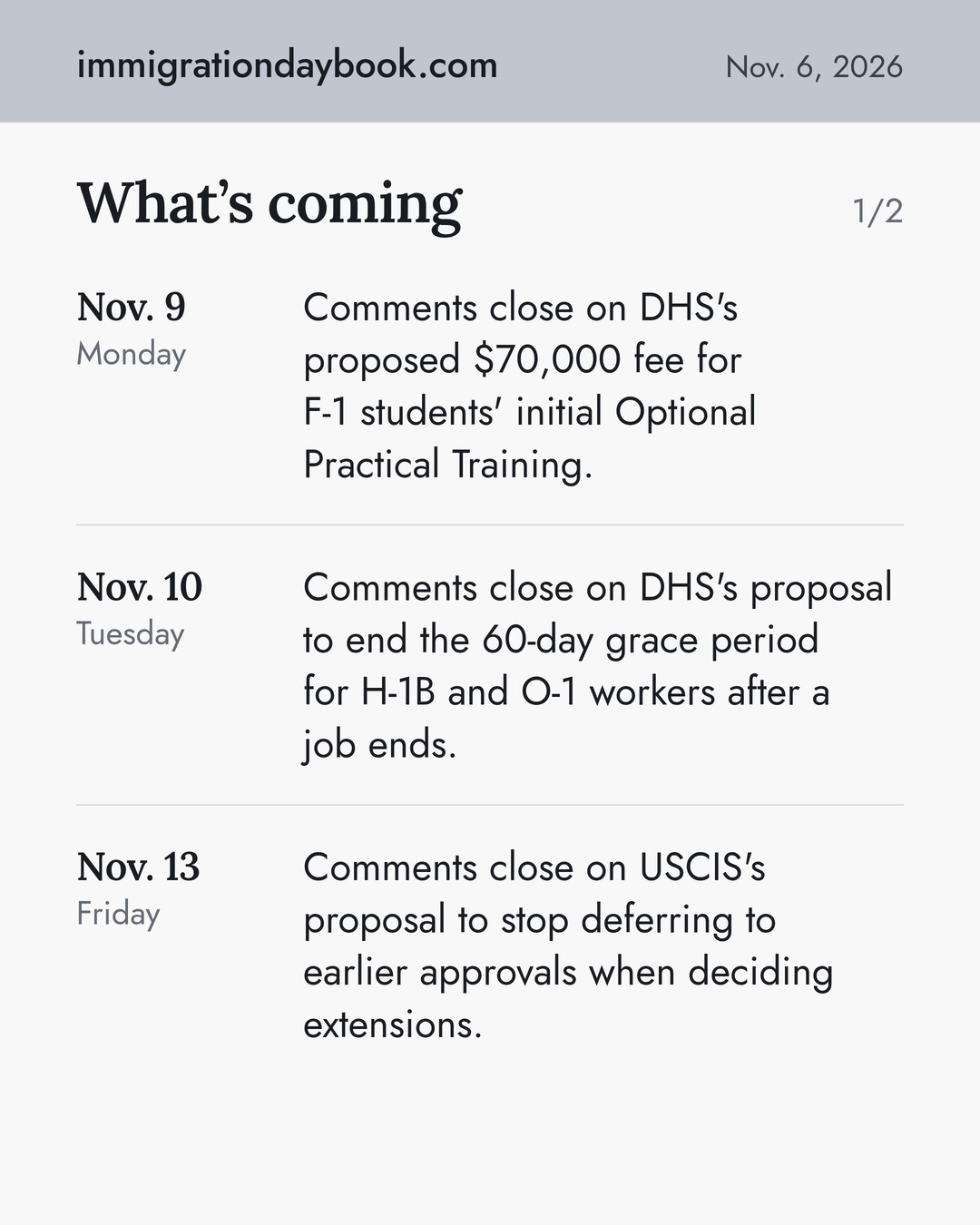
- Nov. 9, 2026
DHS proposes charging F-1 students $70,000 for an initial period of Optional Practical Training and $30,000 for a later period. The fees are not in effect: comments on the proposed rule close November 9, while comments specifically on its required paperwork and information-collection estimates close December 7.
- Nov. 10, 2026
DHS proposes ending the regulation that lets certain H-1B, O-1 and other covered workers—and their families—remain in the United States for up to 60 days after a job ends. The grace period remains in effect for now; comments on the proposal close November 10.
- Nov. 13, 2026
USCIS proposes ending the regulation that generally tells officers to give weight to an earlier approval when deciding an extension involving the same facts. The proposal is not in effect; comments close November 13.
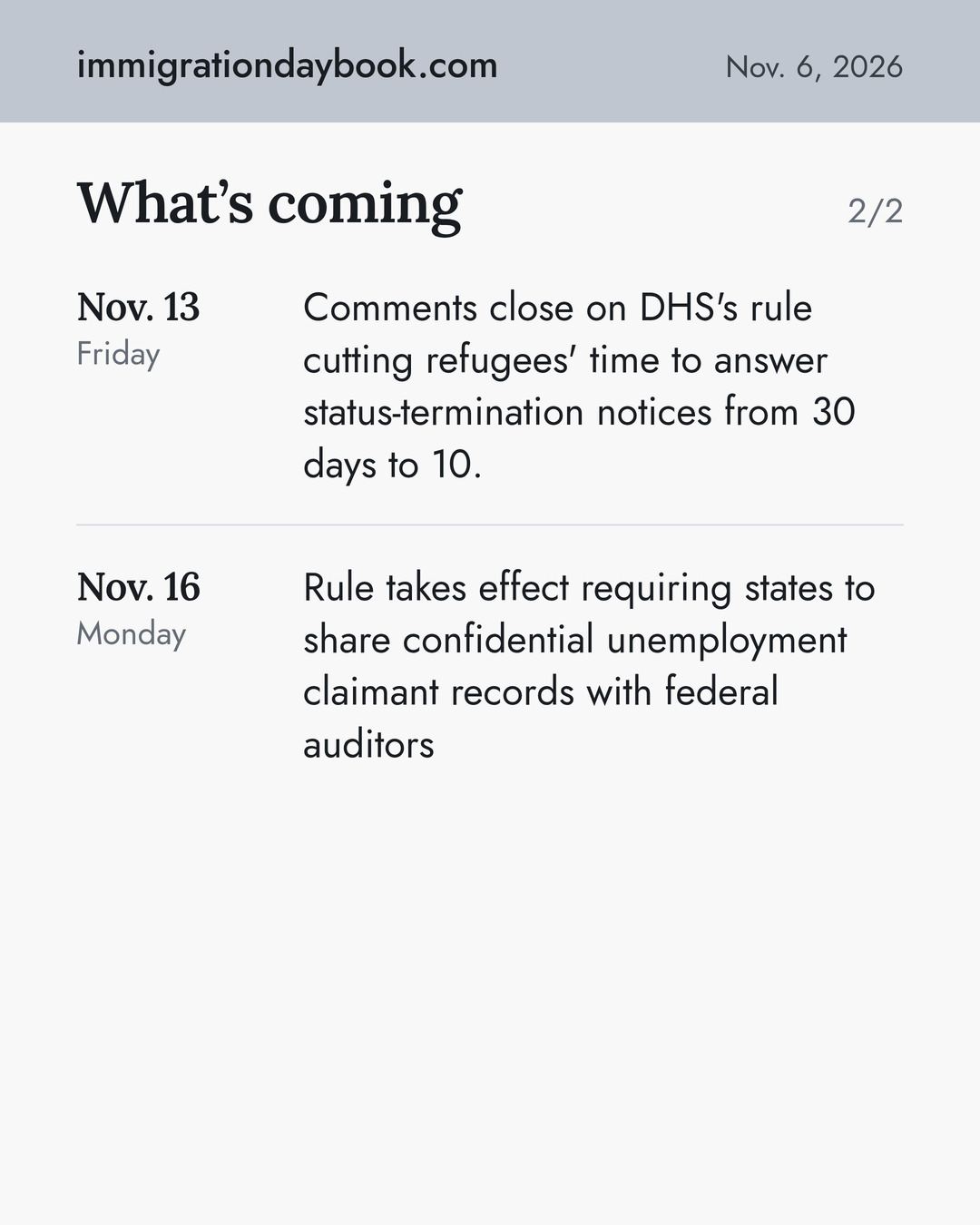
Comments close November 13 on DHS's rule cutting from 30 days to 10 the time refugees have to answer notices proposing to terminate their status. A court has blocked the shorter deadline through November 6 for refugees sent notices October 14–27 giving them fewer than 30 days.
- Nov. 16, 2026
State unemployment agencies will have to hand over confidential unemployment compensation (UC) records — information about individual claims and claimants — to federal officials who audit the programs, including the Labor Department's internal watchdog (DOL Office of Inspector General). The stated purpose is oversight and fraud detection.
Send this edition to someone who should have it.
The link carries “?via” and nothing else — no identifiers, no cross-site tracking.
Around the system
- Justin Sherman writes that no federal law enforcement agency, including DHS components, has published a comparable framework or transparency report on its commercial data purchases, unlike the Office of the Director of National Intelligence, which issued its first report in September. [Lawfare]
- The Electronic Frontier Foundation sued the Justice Department and DHS for records about government demands to remove apps that document immigration enforcement activity. [Law360/MLex]
- In Matter of Chomorro Castillo, the Board of Immigration Appeals held that courts need take no further steps when a notice mailed to the only address on file comes back undeliverable. His address was correct, but his mailbox was full; he missed the hearing and was ordered deported. [The Asylumist]
- KFF finds that USCIS’s public-charge guidance leaves key definitions and the list of benefits officers may consider unclear. The Aug. 18 guidance accompanies the rule effective Sept. 18; KFF says the uncertainty is likely to deepen immigrant families’ avoidance of health coverage and care. [KFF]
- Starting Jan. 1, 2027, Marketplace subsidies will be limited to lawful permanent residents, Cuban-Haitian entrants and migrants covered by the Compacts of Free Association. Refugees, asylees, TPS holders and temporary-visa holders can still buy plans without subsidies; KFF estimates 1.4 million lawfully present immigrants will lose coverage under the 2025 tax-and-budget law. [El Tiempo Latino]
- A Maryland federal judge extended a settlement protecting certain asylum seekers from deportation until their applications are fully processed, after finding that DHS wrongfully deported at least 84 people covered by the agreement. [Law360]
- Sen. Chris Van Hollen requested records and an independent investigation into Julian Curo-Churata’s Sept. 29 death in ICE custody. He also questioned possible retaliation against Curo-Churata’s wife, Veronica Ramirez, whose Notice to Appear was dated three days after she spoke to The Washington Post about his death. [U.S. Senate]
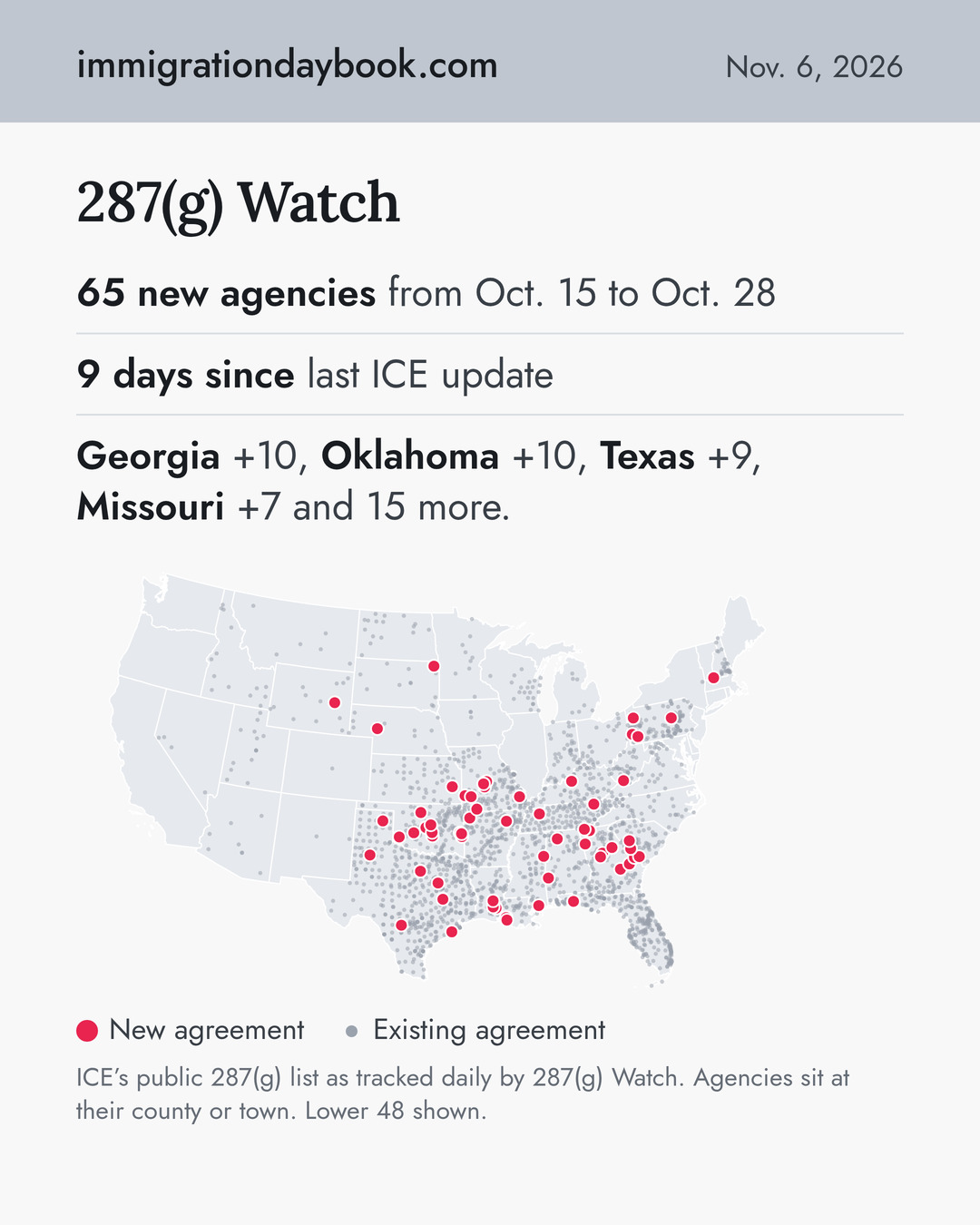
- Pennsylvania police agencies with 287(g) agreements to assist ICE nearly doubled in six months, from 78 in April to 146, The Philadelphia Inquirer found. Nationally, DHS counted 2,698 agreements as of Oct. 20, up from 135 when the administration began. [The Philadelphia Inquirer]